Who can be your preceptor at UTA
UTA publishes two minimums for every graduate preceptor: a provider license that is active and unencumbered, and a year or more of clinical practice in the specialty role itself. The list of preceptor types each clinical course accepts sits inside Exxat, not on a public page, so read it before you ask anyone.
Check a preceptor against UTA's rules
Tell us your track and course. A placement advisor replies with what a preceptor who fits UTA's published minimums looks like for you.
The two minimums UTA publishes
UTA's Preceptor Resources page sets the floor for every graduate preceptor. The person must “Hold an active, unencumbered provider license” and “Have a MINIMUM of 1 year of clinical experience in the specialty role.” Both conditions apply at the same time, and the capitals are UTA's.
Read “specialty role” carefully. Years as a bedside RN are not the same thing as a year practicing as a nurse practitioner in the specialty, so if a candidate is newly certified, ask your Clinical Coordinator before you count their earlier nursing years.
Other UTA pages describe the same person in slightly different words. The Graduate Nursing program pages ask for “a licensed preceptor with expertise in their advanced nursing practice specialty.” UTA's online FNP page goes further, asking for “a licensed and certified preceptor”, which adds national certification that the Preceptor Resources page does not mention. Where the wording differs, plan for the stricter version.
Which license types count, and what UTA does not publish
Per UTA's online FAQ, “Acceptable categories of preceptors are listed for each clinical course”, but none of those course lists is published. They sit with your course materials and with the Graduate Student Clinical Site and Preceptor Policy, which lives in Exxat alongside the preceptor guidelines under Resources.
Whether a physician (MD or DO) or a physician assistant can precept you today is not stated on any current public UTA page. The only current UTA text we found that lists license types is a hidden, undisplayed block on the Preceptor Resources page about the 2024 Preceptor of the Year award. It names NP, PA, DO, MD, LCSW and therapist. Treat that as a hint about who has precepted UTA students, not as a rule.
Texas rules are broader than UTA's pages. 22 TAC §219.2 defines a qualified preceptor as an APRN, a physician or another health care professional acceptable to the Board of Nursing, with an active, unencumbered license and current practice in the role and population focus. Physician assistants are not named. UTA's written criteria decide, so the course list in Exxat outranks anything you read here.
What earlier UTA syllabi (2016–2018) said by track
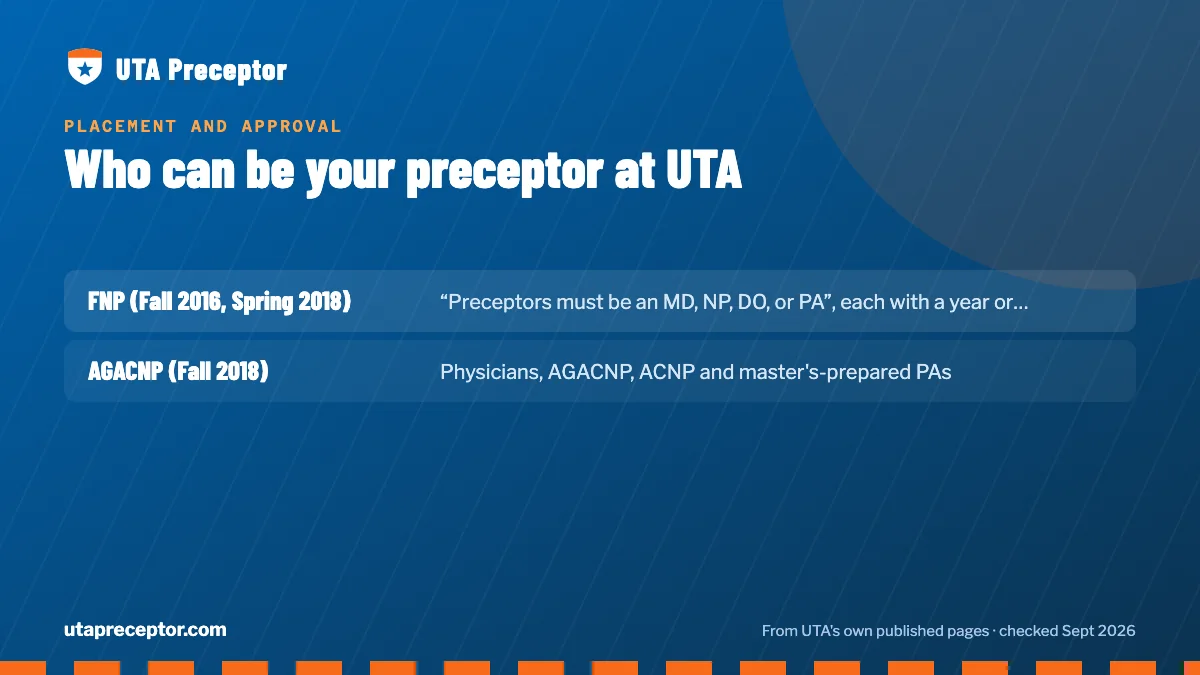
Earlier UTA syllabi (2016–2018) spelled out preceptor types that current public pages do not. They show how UTA has applied its own rules, but they are not current policy, and your course's list in Exxat may differ.
| Track | Preceptor types | Other limits |
|---|---|---|
| FNP (Fall 2016, Spring 2018) | “Preceptors must be an MD, NP, DO, or PA”, each with a year or more of experience | Outpatient primary care only; UTA listed hospitals, inpatient care, house calls and emergency care centers as “not approved”; two preceptors per course at most |
| AGACNP (Fall 2018) | Physicians, AGACNP, ACNP and master's-prepared PAs | At least one rotation under an NP; CNS (with prescriptive authority), FNP and AGNP preceptors considered case by case |
The FNP setting rule still lines up with the current catalog, which describes NURS 5337 and NURS 5338 as preceptorships in “selected primary health practice sites”. If your best lead for an FNP course is hospital-based, check with your Clinical Coordinator before you pitch it.
Requirements by program today
The rules shift by program. This is what UTA's current public sources say for each one, and where the gap is.
| Program | Who precepts | Still unclear |
|---|---|---|
| NP tracks and post-master's NP certificates | A licensed provider with at least 1 year in the specialty role, from the course's acceptable categories | The categories themselves, including MD, DO and PA |
MSN Nursing Education (NURS 5362) | Someone who meets the minimums and “must be in nursing education”, working in a clinic, hospital or academic setting | Whether the practicum can be at your employer |
| MSN Nursing Administration | Not listed on the Preceptor Resources page; the online page places the practicum where “administrative senior nurses are present” | Preceptor qualifications; ask course faculty |
| DNP | “Preceptors are not used in the DNP program”; your DNP Faculty Project Advisor approves hours | Nothing on preceptors; the project site is what you line up |
| RN-to-BSN | No preceptor: UTA says “you will not need to identify a specific preceptor” | Current assignment details per course |
DNP students plan a project site rather than a preceptor; see DNP project site. RN-to-BSN practice work is covered on RN-to-BSN practice experiences.
Relationships that rule a preceptor out
A qualified clinician can still be the wrong preceptor for you. UTA lets you do clinical hours at your employer, yet it rules out your own department and it rules out your current supervisor as preceptor. Anyone you report to at work is out, however strong their license and experience.
Money is the other line. UTA describes graduate preceptors as volunteers, and its FAQ bars students from being paid by their employer or their preceptor for clinical hours. A preceptor arrangement that doubles as paid work will not fit either rule.
Earlier UTA syllabi (2016–2018) went further and kept clinical practice hours off the student's own work unit entirely. The full set of employer rules, program by program, is on clinical hours at your employer.
Check a candidate before UTA does
A preceptor who misses a published minimum costs you a request slot in Exxat MyRequest and weeks of your term clock. Screen each candidate before you enter anything.
Before you submit a preceptor
- License: active and unencumbered. Confirm it on the issuing board's public lookup and note the state.
- Experience: at least one year in the specialty role. Ask for the date they started in that role.
- Category: on your course's acceptable list in Exxat or the course Canvas page.
- Certification: current national certification, since the online FNP page asks for a certified preceptor.
- Setting and population: a practice that fits the course description, such as primary care for
NURS 5337. - Paperwork: willing to share a CV or resume and to sign UTA's Preceptor Agreement.
- Site: an affiliation agreement with UTA already in place, or a site willing to sign one.
Our placement desk runs the same screen on every preceptor we propose: license lookup, time in role, setting and population fit. It saves a round trip, but it does not replace UTA's review. The Clinical Coordinator and course faculty still decide, as described on Clinical Coordinator approval.
A clinician with the right license can still be declined if their type is not on your course's list in Exxat. Read the list first.
Questions UTA students ask
Can a physician be my preceptor in a UTA NP program?
Possibly, but UTA's current public pages do not say. Texas rule 22 TAC §219.2 names physicians as qualified preceptors, and earlier UTA syllabi (2016–2018) listed MD and DO preceptors for FNP and physicians for AGACNP. The deciding list is the acceptable preceptor categories for your specific course in Exxat, so check it or ask your Clinical Coordinator.
Can a physician assistant precept a UTA nurse practitioner student?
UTA does not say publicly. Texas rule does not name PAs, though it allows other licensed professionals acceptable to the Board of Nursing. Earlier UTA syllabi (2016–2018) accepted PAs for FNP and master's-prepared PAs for AGACNP, with at least one AGACNP rotation under an NP. Confirm against your course's list before you ask a PA.
Does my UTA preceptor need a Texas license?
UTA's minimum is an active, unencumbered provider license, and it does not name a state. The bigger constraint is yours: NP clinicals must happen in a state UTA has approved for your program, and your own RN license has to be valid there. Read out-of-state clinicals before you look across a state line.
Does a UTA preceptor have to be board certified?
The Preceptor Resources page lists only a license and one year in the role. The online FNP page, however, asks for a licensed and certified preceptor, and national NP education standards expect programs to document each preceptor's certification. Assume certification is expected for NP courses, and ask your Clinical Coordinator first if your candidate is not certified.
Can a nurse practitioner with less than a year of experience precept me?
Not under UTA's published rule. The Preceptor Resources page asks for at least a year of experience in the specialty role, and it writes the word minimum in capitals. A newer NP can still help you: ask them to introduce you to an experienced colleague in the same practice who meets the rule.
Related pages
Last checked 2026-09-23
We check these pages against UTA's own sources. UTA's current handbook and your course faculty have the final word.
Hand us the search. Keep your term.
Tell us your UTA track, your county and when your clinical course opens. We look for a preceptor and a site that fit what UTA asks for, and we help you put the approval packet together.
- Matched to your track's population and setting
- Paperwork prepared the way UTA's clinical team expects it
- In person near you, or a virtual option where your course allows it
Start your placement plan
A placement advisor replies with what a UTA-ready preceptor and site look like for you.