Finding an acute care preceptor for UTA's AGACNP track
UTA's Adult-Gerontology Acute Care NP track needs preceptors in specialty and high-acuity settings for adolescents through older adults, across three clinical courses and 720 hours. When the site is a hospital, the search runs on two clocks: UTA's approvals and the hospital's own student process.
Get your placement plan
Tell us your UTA track and where you live. A placement advisor replies with what a UTA-ready preceptor and site look like for you.
Admission comes first: the acute care experience rule
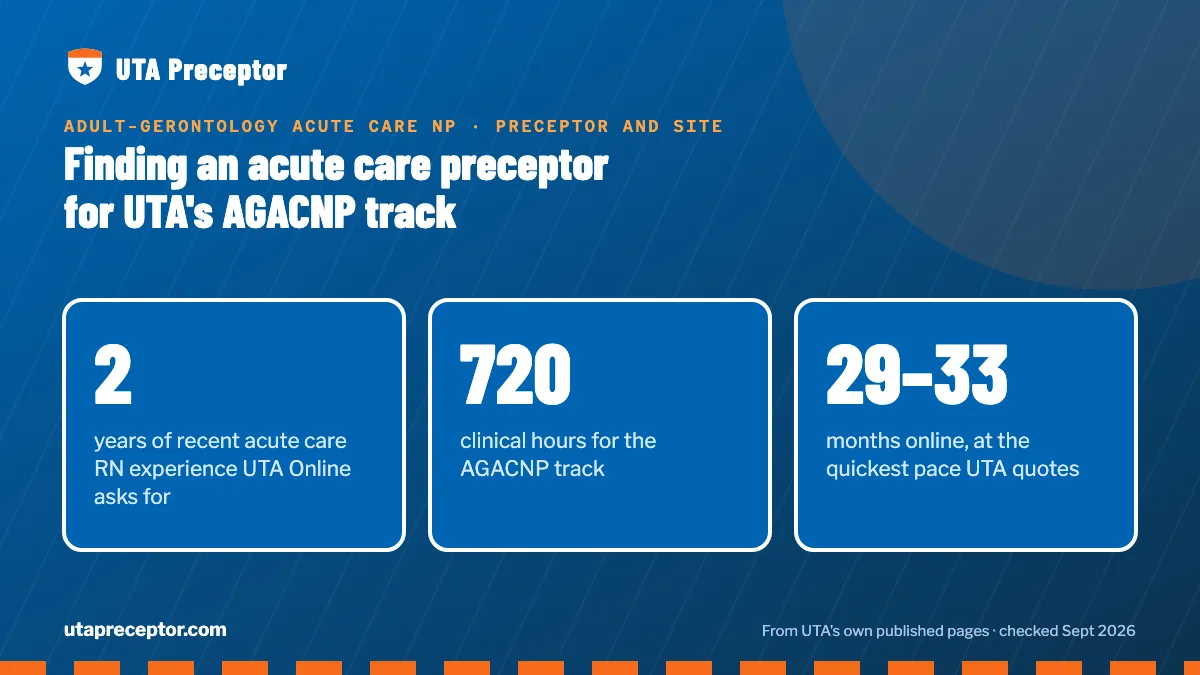
UTA's AGACNP track screens for an acute care background before you ever look for a preceptor. The 2026-27 catalog's unconditional admission criteria include “Two years of clinical experience as a Registered Nurse (RN),” two years in a US or equivalent health system for international applicants, CPR certification and a C or better in undergraduate statistics. UTA Online's version is tighter: the two years must be clinical RN work in an acute care setting, in your area of concentration, within the past five years.
The online wording asks for acute care, not just any RN work, and for recent experience. If the catalog and the online page give different answers for your history, ask admissions which applies to your format before you apply.
That experience does more than get you in. The hospitalists, intensivists and acute care NPs you have worked beside are the first people who can tell you who precepts and how their hospital handles students. The limit is UTA's employer rule: no hours in your own department and no current supervisor as preceptor, as clinicals at your employer explains.
Formats, time to finish and the clinical sequence
UTA offers the 41-credit AGACNP MSN both campus-based and in the accelerated online format. Online, courses run one after another, and UTA Online quotes “As few as 29-33 months” to finish. On campus, new students begin in fall or spring, and UTA's graduate nursing page gives full-timers a 24- to 36-month range.
| Course | Title | Online length | Place in the sequence |
|---|---|---|---|
NURS 5354 | Adult Gerontology Acute Care Clinical Practice 1 | 11 weeks | First clinical; NURS 5463 done or taken alongside |
NURS 5355 | Adult Gerontology Acute Care Clinical Practice 2 | 11 weeks | Continues the same kinds of settings |
NURS 5640 | Adult Gerontology Acute Care NP Advanced Practicum | 13 weeks | Final practicum; needs NURS 5354 and NURS 5355 |
UTA's only published hour figure is the track total, 720 clinical hours, from its 2020-21 AGACNP course list, with no split by course. The 2026-27 course inventory also lists newer acute care clinical numbers (NURS 5454, NURS 5455 and the NURS 5560 Clinical Residency) that are not yet in the degree plan. UTA's AGACNP clinical courses covers both points; confirm which numbers your plan shows before you give a preceptor dates.
The preceptor and setting acute care calls for
The catalog sets the scene for the AGACNP clinical courses: “specialty practice and high acuity health care settings,” managing adolescents, adults and elders with “common secondary and tertiary health care needs.” Settings that can fit include hospital medicine teams, intensive care units and specialty services. The catalog names the acuity, not the unit, so confirm a specific setting with course faculty.
UTA's public floor for preceptors is the same in every track: an active, unencumbered provider license and at least one year in the specialty role. UTA does not publish the per-course lists of acceptable preceptor types. A Fall 2018 UTA practicum syllabus accepted physicians, AGACNPs, ACNPs and master's-prepared PAs, and took other NP and CNS preceptors only case by case. Read that as a signal of fit, then check the current guidelines in Exxat; UTA preceptor requirements has the detail.
Texas Board of Nursing rules point the same way. Under 22 TAC §219.2, an APRN, physician or other Board-acceptable professional qualifies only while practicing in the student's advanced role and population focus, which steers you toward clinicians who practice adult acute care themselves.
Where Texas AGACNP students look for acute care sites
Every Texas region has large public, academic or system hospitals where adult acute care happens. Examples, by region:
- Dallas–Fort Worth: Parkland Health, UT Southwestern Medical Center, JPS Health Network, Texas Health Resources, Baylor Scott & White and Methodist Health System.
- Houston: Harris Health, Memorial Hermann, Baylor St. Luke's Medical Center, UTMB Health in Galveston and MD Anderson Cancer Center.
- San Antonio and Austin: University Health and Methodist Healthcare in San Antonio; Dell Seton Medical Center (Ascension Seton) and St. David's HealthCare in Austin.
- West, South and East Texas: University Medical Center of El Paso, DHR Health in the Rio Grande Valley, UMC Health System in Lubbock and UT Health East Texas in Tyler.
A name on this list says nothing about whether that system takes UTA students. A few publish something useful: UTA's nursing college appears among University Health's education partners in San Antonio, and UT Southwestern ranks its own employees first when it places APRN students. Texas Health Resources considers new agreements for students who are not its employees only when the preceptor submits a business case signed by an entity president or CNO.
That can make the hospital where you already work the shortest path, within UTA's department and supervisor limits. Texas hospital onboarding goes system by system.
Seven states, and travel contracts
UTA's state map opens its MSN nurse practitioner programs, AGACNP included, in Arkansas, California, Colorado, Florida, New Mexico, Texas and Virginia only, and your clinical site has to be in one of them. UTA's handbook warns that living in, moving to or working in an unapproved state can delay or deny a placement, lead to withdrawal, or mean relocating your clinicals to Texas or another approved state.
Travel contracts are where acute care nurses meet this rule. The handbook requires an email to NursingSOA@uta.edu before you accept a travel assignment, seek a preceptor in another state or move. You also need an RN license valid where the hospital sits, bought at your own cost if yours is not a compact license. Out-of-state clinicals covers moves in the middle of the program.
Timing: 12 to 16 weeks is the floor for hospitals
UTA's online FAQ suggests opening the search three to four months (12 to 16 weeks) before clinicals begin, and a General MSN answer on the same page sets Pharmacology as the latest point to have a preceptor. UTA publishes a year-two clinical start only for online FNP students, so read your first AGACNP clinical term off your MyMav degree plan. For a hospital rotation, treat UTA's numbers as a minimum: several Texas systems start their own process only after you have a preceptor, and some publish lead times of their own.
- University Health (San Antonio): requests come from the school's coordinator, 30 to 45 days ahead of the rotation; a brand-new affiliation agreement averages 6 to 8 weeks.
- Memorial Hermann (Houston): a UTHealth Houston page says paperwork and computer access take about two months once an agreement exists.
- CHRISTUS Good Shepherd (East Texas): preceptor applications are due 60 days before the rotation.
- Baylor Scott & White: its student orientation must be done within 90 days before the rotation starts.
UTA's own steps run alongside: the Exxat MyRequest before its Wishlist closes, approval by the Clinical Coordinator and/or course faculty, an affiliation agreement, the background check and drug test no earlier than 30 days before the course, and the Preceptor Agreement by day one. The placement timeline sets them out in sequence.
Your acute care years get you admitted, not placed. Your own unit and your own manager are off the table as a clinical site and preceptor.
Why acute care students choose us
The placement desk looks for adult acute care preceptors near you in the settings your course allows, and checks each candidate against UTA's license and one-year minimums and the catalog's setting before you submit. We help with the approval file (preceptor resume, a license check, UTA's forms, the hospital's details) and keep the hospital's onboarding steps in view alongside UTA's.
If a preceptor's schedule changes mid-course, we start the search for someone new right away. UTA gives the final approval and each hospital runs its own onboarding; our part is making sure both receive a complete, accurate file on the first pass. Read how it works for our side, or give us your course and region in the form below.
Questions UTA students ask
Can I count hours from my RN job toward UTA AGACNP clinicals?
No. Clinical hours are unpaid student time with an approved preceptor; UTA's online FAQ rules out payment for them from your employer or your preceptor. You can do student hours at the hospital where you work, outside your own department and away from your current supervisor, but paid shifts stay separate. A 2018 UTA syllabus also recommended one rotation away from your employer.
How many hours is each UTA AGACNP clinical course?
UTA doesn't currently publish a per-course figure. The 720-hour total comes from a 2020-21 course list. A Fall 2018 AGACNP syllabus used 180 hours each for NURS 5354 and NURS 5355 and 360 for the practicum, and capped non-patient-care time in the practicum at 25 hours, but that is history. Use the figure in each course syllabus when you agree a schedule.
Can I add adult-gerontology primary care after the AGACNP?
UTA Online's AGACNP page describes adding the AGPCNP post-master's certificate, which it says could make you eligible for both certification exams while saving up to 16 credits. The certificate brings its own clinical courses, NURS 5352, NURS 5353 and NURS 5645, set in primary and long-term care, so it means a second preceptor search in a very different setting.
Which certification exams count for AGACNP licensure in Texas?
The Texas Board of Nursing recognizes two adult-gerontology acute care exams: ANCC's AGACNP and the AACN Certification Corporation's ACNPC-AG, with no preference between them. Texas no longer gives new graduates interim approval, so you cannot practice as an APRN until you are certified and licensed. Your program's documentation for the license includes your clinical hours.
What if I can't find an acute care preceptor for UTA?
UTA's published line is that graduate nursing helps students who are “experiencing difficulty” with placement, and the policy behind it is posted in Exxat. Raise it early with your Clinical Coordinator or the AGAcuteNP@uta.edu mailbox UTA's directory lists for the track, then your program director if needed. UTA placement assistance covers how to ask.
Related pages
Last checked 2026-09-23
We check these pages against UTA's own sources. UTA's current handbook and your course faculty have the final word.
Hand us the search. Keep your term.
Tell us your UTA track, your county and when your clinical course opens. We look for a preceptor and a site that fit what UTA asks for, and we help you put the approval packet together.
- Matched to your track's population and setting
- Paperwork prepared the way UTA's clinical team expects it
- In person near you, or a virtual option where your course allows it
Start your placement plan
A placement advisor replies with what a UTA-ready preceptor and site look like for you.