UTA graduate clinical clearance, item by item
The Graduate Nursing Clinical Clearance Requirements policy can stop you registering for a clinical course or cost you a site. You have 60 days from admission to clear, you pay for every item, and the clinical agency where you train can add requirements of its own.
Get your placement plan
Tell us your UTA track and where you live. A placement advisor replies with what a UTA-ready preceptor and site look like for you.
What the policy is and who it covers
The policy's full title is Graduate Nursing Clinical Clearance Requirements. It is approved by the Chair of the Department of Graduate Nursing, carries a last approval date of 1/7/2022, and is still linked from UTA program pages in 2026. It applies to MSN Education, MSN Nurse Practitioner and DNP students.
Two lines explain why it carries so much weight. The policy says its requirements "are integrated into the affiliation agreement with each clinical agency," which makes clearance part of the contract that lets you train at a site at all. It also names the clinical management software, Exxat at UTA, as the place where every requirement is recorded and monitored.
Inside Exxat it sits alongside five other policies, from the Graduate Student Clinical Placement Policy and Procedure to Students Experiencing Difficulties with Clinical Placements. The UTA clinical policies page explains what each of the six governs.
The 60-day deadline and the 30-day exception
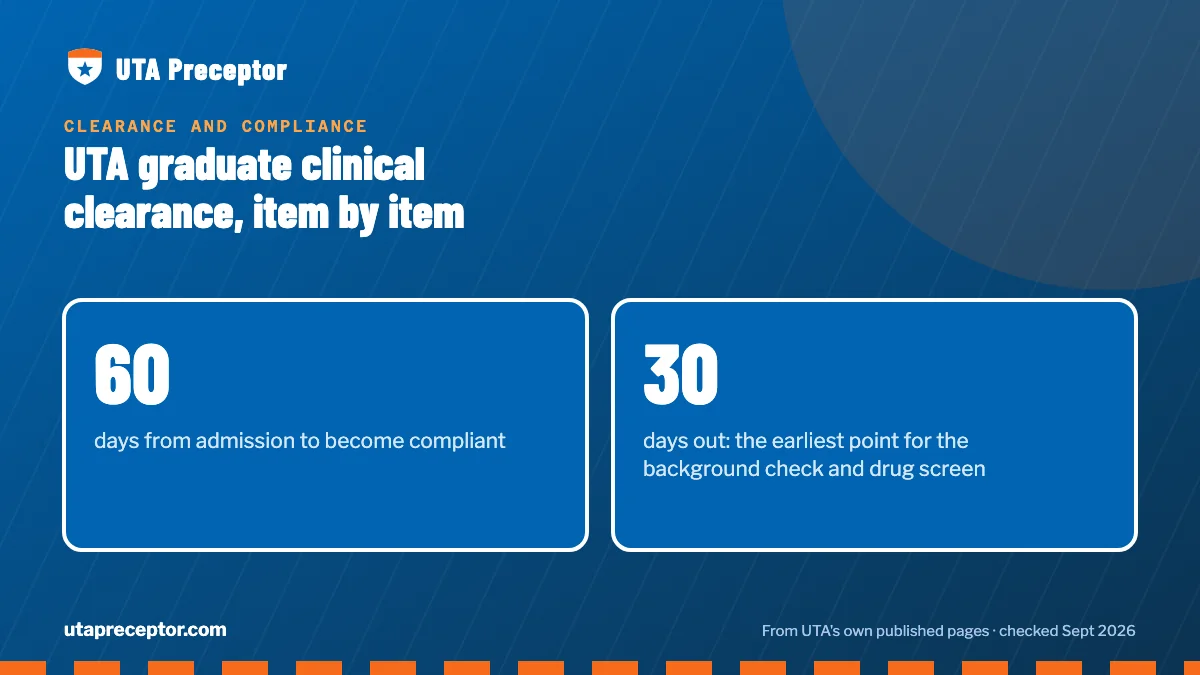
The policy sets the deadline as compliance "within 60 days of being admitted," then requires ongoing compliance until the program ends. UTA's Exxat page words it a little differently: compliance documents are due within 60 days of beginning your first graduate course. If those two dates differ for you, work to the earlier one.
The background check and drug screen are the exception. The Exxat page leaves them out of the 60-day deadline, and the UTA Online FNP page says neither should be done more than 30 days before your first clinical course. That timing has its own page: background check and drug screen.
Staying compliant is the part that catches people later. Exxat labels each item Get started, In progress, Pending Review, Approved, Not Approved, Expiring or Expired. Treat Expiring as your prompt to renew before a lapse turns into a hold.
The full clearance list
Pulling together the policy, the MSN and PMC Student Handbook and UTA's program pages, these are the items graduate students complete and keep current. You upload them through the Compliance tile in Exxat.
- Immunizations and titers. UTA follows CDC guidelines but does not print the vaccine list publicly; the list is in Exxat. See immunization requirements.
- TB testing, named in the policy alongside the vaccines.
- CPR, plus ACLS, PALS or NRP where they apply to you. See CPR, ACLS and PALS.
- Criminal background check and urine drug screen, inside the 30-day window.
- FERPA release, which the policy requires of all students.
- An unencumbered RN license, with any Board of Nursing investigation reported to the Chair of Graduate Nursing. See RN license for clinicals.
- Medical insurance that includes Emergency Department coverage and needle-stick follow-up, and professional liability insurance through a UTA student fee. See clinical insurance.
- Exemption documents, if you are declining a vaccine for medical or conscience reasons.
The handbook adds one rule for the clinical day itself: MSN and post-master's certificate students must be identifiable as UTA graduate students and wear a UTA MyMav ID.
Who pays for clearance
You do. The policy states that "Students are responsible for paying all clinical clearance requirement costs," and names what that includes: vaccines, titer testing, TB testing, CPR, ACLS, PALS, NRP, the criminal background check and the urine drug screen.
Three related costs sit around clearance. UTA requires you to purchase Exxat on entry to the graduate program, and the system asks for it the first time you log in. Professional liability insurance is charged as a student fee each year at Fall registration. And the graduate catalog notes that some clinical agencies charge for parking passes.
None of these amounts appears on UTA's public pages. Budget for them in your first semester, since all clearance items but the background check and drug screen fall inside the 60-day window.
When a clinical agency asks for more
UTA designed its vaccine and TB rules to meet most clinical agencies' requirements, not every agency's. The policy says plainly that agencies may develop additional requirements, and Texas systems do: Baylor Scott & White requires its own online orientation within 90 days before a rotation, Children's Health assigns training and a student badge, and University Health asks for a current flu vaccine.
It does not work in reverse. You are not exempt from a UTA requirement because your agency does not ask for it. UTA's Exxat upload guide also notes that compliance items "may be shared with clinical partners," so a site can see what you submitted.
For the hospital side of onboarding in North Texas and elsewhere in the state, see DFW hospital onboarding.
What happens if you fall out of compliance
The consequences are spelled out in the policy, and they escalate. Noncompliance can lead to:
- a clinical hold that blocks registration
- a delayed clinical course
- a denied placement
- removal from the clinical setting
- course failure
The policy applies the same penalties to an unfavorable criminal background check, including pending charges, or an unfavorable urine drug screen at any point in the program. Vaccine exemptions carry a separate risk: a site that will not accept one can cost you the placement and push your course back a semester.
Clearance is not a one-time task at admission. An item left to expire mid-program puts you back out of compliance, with the same penalties.
Why students choose us for the site side
Clearance is yours to complete in Exxat and UTA's to review. The site side is where a placement advisor does the heavy lifting.
Every search we run asks what the site will require on top of UTA's list and by when, then weighs that against your course start date. A site whose onboarding you cannot finish in time is not a good match, however willing the preceptor. We also flag timing you may not have checked, such as a clearance item due to expire partway through the course we are placing you for. For a site that fits your clearance calendar, send us your track and start date.
Questions UTA students ask
Does the clearance policy apply to Nursing Administration or RN-to-BSN students?
The policy names MSN Education, MSN Nurse Practitioner and DNP students. It does not name Nursing Administration, and no public UTA source says whether RN-to-BSN students complete immunizations or background checks for their workplace and community practice experiences. If you are in either program, ask your advisor what applies before your first practicum course.
Where do I find UTA's exact graduate vaccine list?
In Exxat. The public policy puts every requirement in the clinical management software, and UTA's Exxat page says the Resources tile holds compliance information. The only vaccine list on UTA's public website is the prelicensure BSN list, which is a useful guide but not your list. Read the Exxat version before you book any titers.
What does Pending Review mean in Exxat?
It means the item is uploaded and waiting to be checked. UTA's Exxat compliance guide lists seven statuses, from Get started through Approved to Expired, and only Approved means the item is done. If an item comes back Not Approved, correct it and upload again promptly, since the 60-day deadline keeps running while you wait.
Is clearance done once, or every year?
Both, in a sense. You clear within 60 days of admission, but the policy requires you to stay compliant for the whole program, and Exxat marks items as Expiring and Expired so renewals surface. UTA's public BSN list, for example, requires a TB blood test every year. Your graduate list in Exxat shows which of your items renew.
Who do I ask about a clearance problem?
For Exxat login or upload errors, UTA's Exxat page points to Exxat support at v4support@exxat.com; trouble with your UTA login itself goes to the IT service desk. For questions about what a clinical requirement means for you, write to your program's mailbox, listed in the CONHI directory with the Graduate Clinical Coordination Team, such as FNP@uta.edu or PsychNP@uta.edu.
Related pages
Last checked 2026-09-23
We check these pages against UTA's own sources. UTA's current handbook and your course faculty have the final word.
Hand us the search. Keep your term.
Tell us your UTA track, your county and when your clinical course opens. We look for a preceptor and a site that fit what UTA asks for, and we help you put the approval packet together.
- Matched to your track's population and setting
- Paperwork prepared the way UTA's clinical team expects it
- In person near you, or a virtual option where your course allows it
Start your placement plan
A placement advisor replies with what a UTA-ready preceptor and site look like for you.