The UTA Preceptor Agreement
Every preceptor who teaches you in a UTA clinical course signs a Preceptor Agreement, and the Clinical Coordinator needs it in hand by your first clinical day. UTA doesn't publish the form itself, so this page sets out what is known: who signs, when, how it differs from the affiliation agreement, and what the older preceptor packet looked like.
Line up a preceptor who will sign
Tell us your track and start date. A placement advisor replies with how we'd approach the search and the paperwork.
What the agreement is
The Preceptor Agreement is the form that formally brings an individual clinician into your UTA course. UTA's online FNP page puts it plainly: “All preceptors must sign a ‘Preceptor Agreement.’” The same page sets the deadline: the Clinical Coordinator must have it “no later than the first day of the clinical experience.”
It is a different document from the affiliation agreement. The Preceptor Agreement is signed by the person teaching you. The affiliation agreement is a contract between UTA's College of Nursing and Health Innovation and the clinical agency, and UTA requires one before you can do clinicals there. A typical NP placement needs both: a clinician who has signed, and an agency UTA has contracted with.
Neither document replaces approval. The Clinical Coordinator and/or course faculty still have to approve the preceptor and the site, which our page on UTA approval covers.
Who signs, and when you need more than one
Take UTA's wording at face value: all preceptors sign. If your course splits hours between two clinicians, each signs an agreement. If a preceptor drops out mid-term and you find a replacement, the new preceptor signs too, and the form should reach the Clinical Coordinator before your first day with them. Our preceptor dropped out guide covers the rest of that situation.
Whether the form applies depends on your track:
- NP tracks and post-master's NP certificates. UTA's online FNP and RN-to-MSN FNP pages state the requirement. The other NP tracks' public pages don't repeat it, so confirm the form in your course.
- MSN Nursing Education and Administration.
NURS 5362carries 135 precepted hours, and UTA's online RN-to-MSN page describes theNURS 5340hours as preceptored. No public page confirms these courses use the same Preceptor Agreement. - DNP. The DNP Student Handbook says the program doesn't use preceptors, so there is no Preceptor Agreement. The project site needs a contract with UTA instead; see the DNP project site page.
- RN-to-BSN. No preceptor to identify, so nothing to sign.
What the form covers, and what UTA keeps private
UTA does not publish the Preceptor Agreement's text. Its online FNP page says the “forms to use” sit in Exxat alongside recruiting guidelines, and the Exxat Resources tile holds UTA's preceptor guidelines. Get the current version there rather than from a classmate's old download.
Texas regulation shows what agreements like this are for. The Texas Board of Nursing rule for APRN education, 22 TAC §219.10, requires that any preceptorship be covered by a written agreement between the program, the preceptor and, when applicable, the agency, stating the functions and responsibilities of each. The same rule says written clinical objectives go to the preceptor before the experience begins. UTA's documents don't cite the rule or say how its form maps to it.
In practice, hand your preceptor the objectives from your current course syllabus along with the agreement, so they know what they are agreeing to teach.
Getting it signed before day one
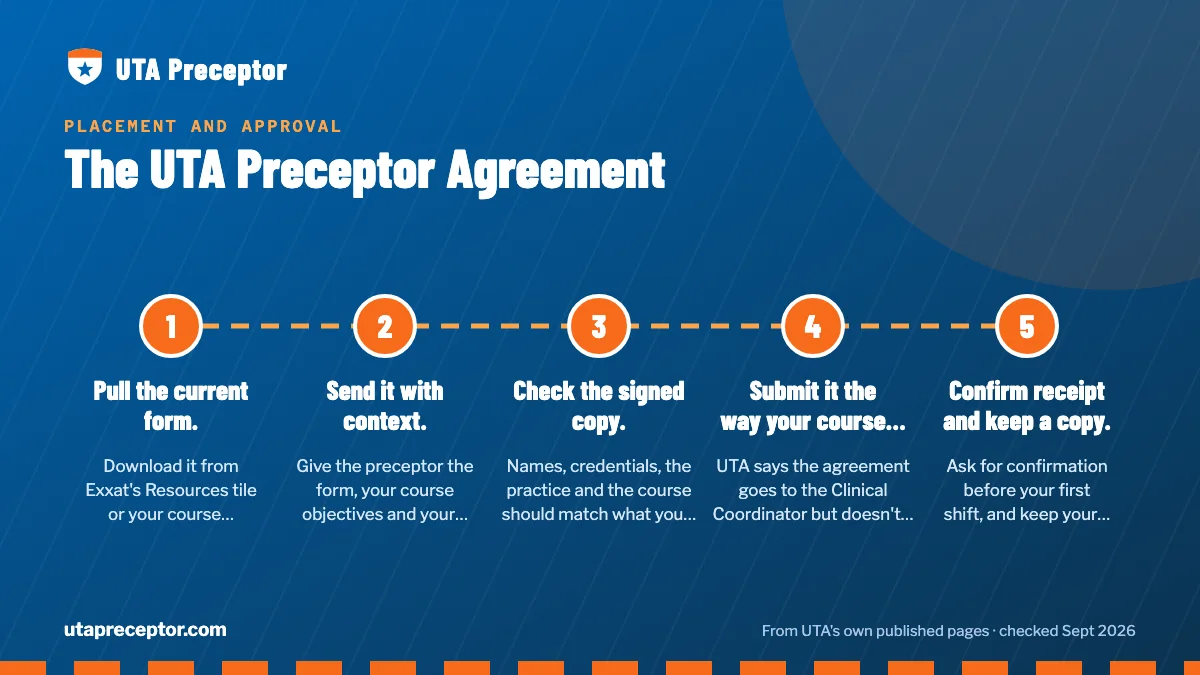
The first clinical day is the deadline, but aiming for it leaves no room for a missing signature. A calmer order:
- Pull the current form.Download it from Exxat's Resources tile or your course materials, not from an older semester.
- Send it with context.Give the preceptor the form, your course objectives and your Exxat profile, which UTA says can be shared with potential preceptors.
- Check the signed copy.Names, credentials, the practice and the course should match what you put in your MyRequest.
- Submit it the way your course asks.UTA says the agreement goes to the Clinical Coordinator but doesn't say publicly whether it is uploaded to Exxat or emailed. Your course Canvas page or coordinator will tell you.
- Confirm receipt and keep a copy.Ask for confirmation before your first shift, and keep your own copy in case a question comes up during the term.
The old preceptor packet
The phrase “preceptor packet” comes from older UTA course documents, and you may still hear it from preceptors or classmates. Earlier UTA syllabi (2016–2018) said:
- FNP students submitted a preceptor packet, made up of the preceptor agreement and a preceptor bio, two weeks before the clinical start.
- Preceptors completed an evaluation of the student, and students completed a Student Evaluation of Preceptor and Clinical Site.
- Any preceptor who worked with the student for more than 8 clinical hours had to complete an evaluation.
None of that is confirmed as current. UTA's public pages today name only the Preceptor Agreement, and they don't say whether a bio or CV still travels with it. Check the form set in Exxat before you ask a busy clinician for extra paperwork, and don't assume the old two-week lead time still applies.
What your preceptor gets, and why students hand us the paperwork
Preceptors sometimes ask what signing brings them. UTA's Preceptor Resources page lists what preceptors receive: access to UTA's electronic library resources, continuing education courses and the honorary title “Graduate Nursing Clinical Education Specialist.” Our guide to asking a preceptor for a UTA rotation covers how to raise that.
We work on the preceptor's side of the paperwork. Once we've found a preceptor who fits your course, we walk them through what UTA asks for, gather their CV and license verification, and help you get the agreement signed well before your start. The preceptor signs and the Clinical Coordinator reviews; we keep the form moving and aim to have it with the Clinical Coordinator, complete, well before day one. How our service works lays out the full order, or use the form below.
Questions UTA students ask
Does my preceptor sign a new agreement for each clinical course?
UTA doesn't say publicly. Its deadline is tied to the first day of the clinical experience, not to a term or a preceptor. If the same preceptor is taking you through NURS 5337 and then NURS 5338, ask your Clinical Coordinator whether one signed form covers both or each course needs its own.
What happens if the agreement isn't in by my first clinical day?
UTA publishes the deadline but not the consequence of missing it. Because the rule says it must arrive no later than that day, plan on not starting hours until it is in. If a signature is slipping, tell your Clinical Coordinator before the start date rather than on it.
Does a preceptor at my own workplace still sign one?
Yes. UTA's wording covers all preceptors, wherever they practice. Working at the site doesn't change the paperwork, though it does add two limits: your hours can't be in your own department, and your current supervisor can't be your preceptor. Approval and an affiliation agreement are still required for that site.
Can I have more than one preceptor in a single course?
No current public UTA page sets a number. Earlier UTA syllabi (2016–2018) capped FNP students at two preceptors per clinical course, and the current limit may be in your course's guidelines in Exxat. Whatever your course allows, every preceptor needs UTA's approval and a signed agreement of their own.
Who sends the agreement to UTA, me or my preceptor?
UTA's public wording says only that the agreement “must be sent to the Clinical Coordinator.” It doesn't say by whom or through which channel. UTA describes Exxat as the place it manages clinical paperwork, so look there first, then check your course Canvas page. Either way, it's your placement, so confirm it arrived.
Related pages
Last checked 2026-09-23
We check these pages against UTA's own sources. UTA's current handbook and your course faculty have the final word.
Hand us the search. Keep your term.
Tell us your UTA track, your county and when your clinical course opens. We look for a preceptor and a site that fit what UTA asks for, and we help you put the approval packet together.
- Matched to your track's population and setting
- Paperwork prepared the way UTA's clinical team expects it
- In person near you, or a virtual option where your course allows it
Start your placement plan
A placement advisor replies with what a UTA-ready preceptor and site look like for you.