Doing your UTA clinical hours where you work
UTA lets you log clinical hours at the place you work, as long as the site fits your course. Two limits apply: no hours inside your own department, and no preceptor who is your current supervisor. The site still needs an affiliation agreement, and the preceptor still needs UTA approval.
No fit at your employer?
Tell us your track, course and county. A placement advisor replies with what a preceptor outside your workplace could look like.
The rule, and the words to quote
UTA's online FAQ says you may do clinical hours at your place of employment “if it meets these specific clinical focus guidelines.” It then names two exclusions: no hours “within your department or under your current supervisor as preceptor.”
UTA does not define “clinical focus guidelines” publicly. The practical reading is the course's population and setting, so check the course description and the clinical guidelines on your course Canvas page and in Exxat. An FNP course such as NURS 5337 is a preceptorship in “selected primary health practice sites”, while an AGACNP course such as NURS 5354 points to “specialty practice and high acuity health care settings.”
UTA does not define “department” in public either. If your organization's structure is ambiguous, raise it with your Clinical Coordinator before you submit, not after.
What counts as your department or supervisor
Use the plain reading and stay clear of the line. A different unit, clinic or service line in the same health system fits the wording; your own unit does not. Your preceptor should sit outside your reporting line entirely, not a manager, lead or physician you answer to at work.
Earlier UTA syllabi (2016–2018) were blunter. They said clinical practice hours were not allowed on the unit where the student currently worked, and a Fall 2018 AGACNP syllabus, while allowing hours at the employer, recommended doing one rotation elsewhere.
There is a practical reason as well. Co-workers know you as a nurse, and a student role on a familiar floor blurs fast. A unit where you are only the student makes it easier for your preceptor to teach and evaluate you, and easier for faculty to trust that evaluation.
Keep student hours and paid hours apart
UTA's FAQ says students “cannot be paid by your employer or clinical site preceptor” for clinical hours. A clinical shift is unpaid student time, logged in Exxat, even inside your own building.
Rules that follow you onto an employer site
- ID: MSN and post-master's certificate students have to be clearly identifiable as UTA graduate students, with a UTA MyMav ID worn on site.
- Records: the handbook says your employee log-on should not be used to open medical records unless the facility explicitly allows it.
- Privacy: no protected health information leaves the clinical setting, on paper or electronically.
- Hours: only precepted student time goes on your Exxat timesheet. Paid work stays off it.
DNP students face the strictest version of this rule. The DNP handbook says practice hours “must be outside of the individual's normal scope of paid employment.” Details are on DNP practice hours.
Program by program
The employer question lands differently in each UTA program. Current public sources say this:
| Program | Employer site? | What UTA says |
|---|---|---|
| NP tracks (FNP, AGACNP, AGPCNP, PNP, PMHNP) | Allowed with limits | Not your department, not your current supervisor; must fit the course's clinical focus |
| MSN Nursing Administration | Allowed, not preferred | For NURS 5339, “location other than place of employment is preferred” (online RN-to-MSN page) |
| MSN Nursing Education | Not stated | No public statement for NURS 5362; ask course faculty |
| DNP | Project site may be your workplace | Practice hours must fall outside your normal paid role; notify the DNP program director and Academic Adviser if you change jobs |
| RN-to-BSN | Expected | NURS 3315 and NURS 4455 can be done in the workplace; co-op NURS 3300 needs 120 hours in your work environment |
The Administration wording is a preference, not a ban, but plan for it: a practicum at another organization is the safer default for NURS 5339. RN-to-BSN students do not need a preceptor at all; see RN-to-BSN practice experiences.
Your employer still needs an affiliation agreement
Working somewhere does not make it a UTA clinical site. UTA “requires that an affiliation agreement be in place with clinical agencies” before you do clinicals there, and your employer is a clinical agency like any other.
Employees often have an easier path into large Texas systems. UT Southwestern's student placement guidelines rank UTSW employees first and employees of its partner systems (Children's, Parkland, Texas Health) second. Children's Health says it is not adding affiliations for undergraduate and MSN Education students “unless it is for a current employee”, and Cook Children's asks employees outside a school cohort to identify a preceptor, confirm or start an agreement, and apply.
Each system runs its own student onboarding on top of UTA's clearance. The system-by-system rules are on DFW hospital onboarding, and how agreements work is on affiliation agreements.
Setting up a rotation at your employer
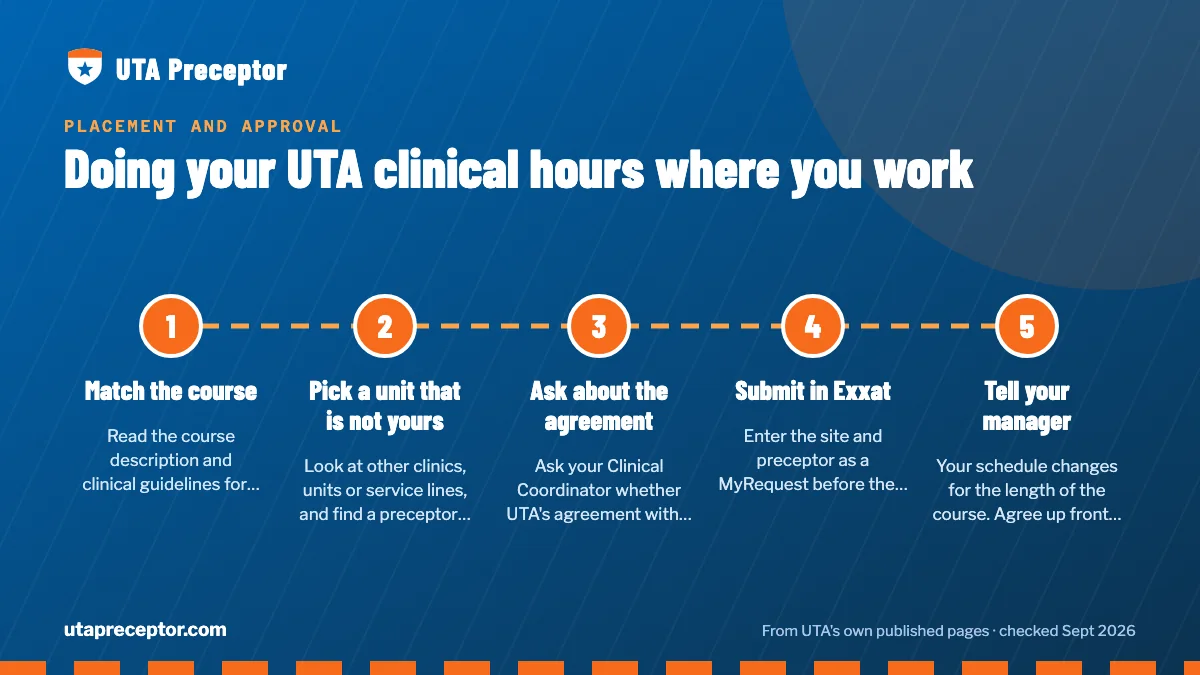
- Match the courseRead the course description and clinical guidelines for the population and setting it needs. Your employer only helps if it runs that kind of practice.
- Pick a unit that is not yoursLook at other clinics, units or service lines, and find a preceptor outside your reporting line who meets UTA's preceptor requirements.
- Ask about the agreementAsk your Clinical Coordinator whether UTA's agreement with your employer covers your program, and ask your employer's education office how students are onboarded.
- Submit in ExxatEnter the site and preceptor as a MyRequest before the course Wishlist closes. The signed Preceptor Agreement goes to the Clinical Coordinator on or before day one of the rotation.
- Tell your managerYour schedule changes for the length of the course. Agree up front on how student shifts and paid shifts stay separate.
If your employer has no suitable unit, or no agreement it is willing to sign, our placement desk can look outside it for a preceptor who fits your course. UTA still approves the result.
Being on staff does not skip a step: the site still needs an affiliation agreement and the preceptor still needs UTA approval.
Questions UTA students ask
Can I do my UTA FNP clinicals at the hospital where I work?
Only in a setting that fits the FNP courses. The catalog places NURS 5337 and NURS 5338 in primary health practice sites, so an inpatient unit is a poor fit, while a primary care clinic run by the same system may work. It cannot be your own department, and your preceptor cannot be your current supervisor.
Can my manager or a physician I work with be my preceptor?
Not if they are your current supervisor. UTA's online FAQ excludes hours under your current supervisor as preceptor. A physician or NP in another department who plays no part in your job evaluation is a different case, provided they meet UTA's preceptor minimums and appear in your course's acceptable preceptor categories.
Can I get paid for clinical hours I do at my job?
No. UTA's FAQ rules out pay from your employer or your clinical site preceptor for clinical hours. If you work at the same facility, keep student shifts and paid shifts on separate days or clearly separate blocks of time, and log only the precepted student time in Exxat.
What happens if I change jobs during a UTA clinical course?
UTA publishes no MSN rule on this, so tell your Clinical Coordinator right away; losing an employer site can mean a new preceptor, a new site approval and a new Preceptor Agreement. For the DNP, the catalog makes it your responsibility to notify the DNP program director and Academic Adviser if you change jobs or cannot finish the project at your work site.
Can Nursing Administration students do the practicum at their own hospital?
It is allowed but not preferred: for NURS 5339, UTA's online RN-to-MSN page favors a location other than your workplace. The practicum needs a healthcare facility where administrative senior nurses are present, so another hospital or health system is the cleaner choice. See MSN Nursing Administration and confirm with course faculty.
Related pages
Last checked 2026-09-23
We check these pages against UTA's own sources. UTA's current handbook and your course faculty have the final word.
Hand us the search. Keep your term.
Tell us your UTA track, your county and when your clinical course opens. We look for a preceptor and a site that fit what UTA asks for, and we help you put the approval packet together.
- Matched to your track's population and setting
- Paperwork prepared the way UTA's clinical team expects it
- In person near you, or a virtual option where your course allows it
Start your placement plan
A placement advisor replies with what a UTA-ready preceptor and site look like for you.