RN-to-BSN practice experiences at UTA: no preceptor, some legwork
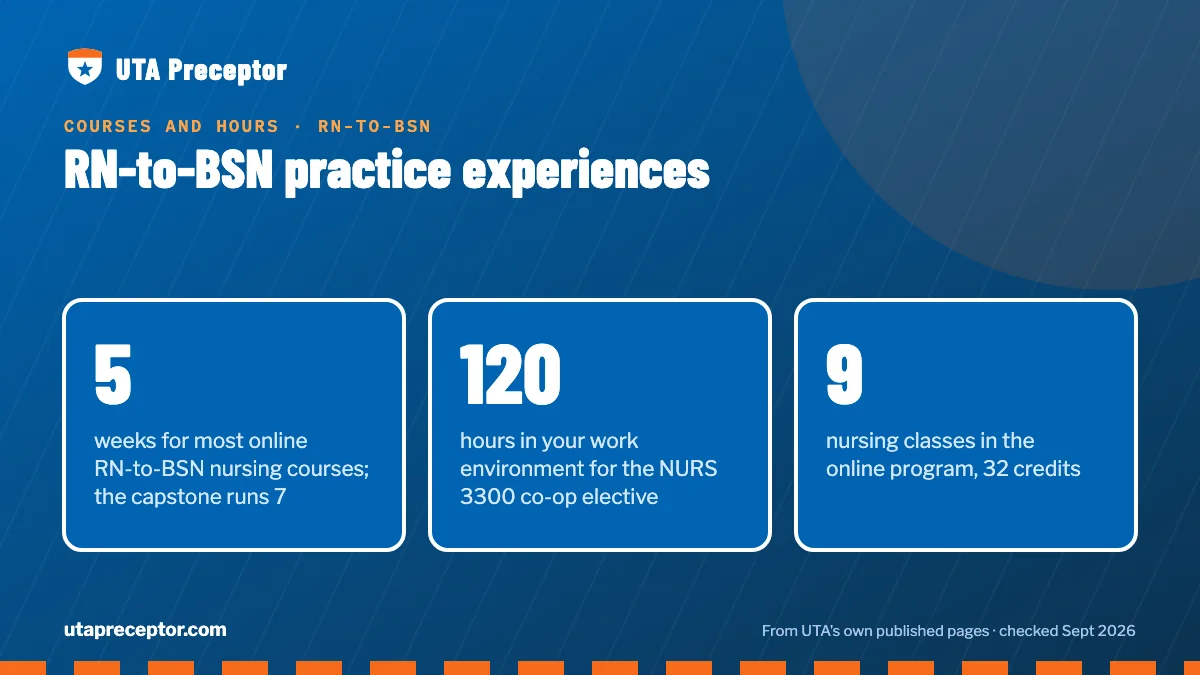
UTA's online RN-to-BSN has no traditional supervised clinicals, and UTA says “you will not need to identify a specific preceptor.” Five nursing courses still ask you to apply what you learn at work or in your community, and the optional co-op course asks for 120 hours on the job.
Stuck on a practice assignment?
Tell us which RN-to-BSN course is coming up and what you are missing: an agency, a nurse leader or a setting. A placement advisor replies with options.
The short answer: no preceptor to find
UTA's RN-to-BSN FAQ says it plainly: “UTA doesn't require traditional supervised clinical experiences.” You apply course content in your workplace or community instead, which is why UTA tells students they do not need to line up a preceptor for this program.
What replaces clinicals is application-based work. UTA says students may write a report or complete a project to share with their faculty and classmates. UTA publishes no hour counts for the five nursing courses with practice work; the only published figure in the program belongs to the optional co-op course.
So the question is not who will supervise you but where you will do the work: a workplace with access to patients and leaders, a community agency, and a topic for your capstone. If you already work as an RN in a hospital or clinic, much of that is in place.
Course by course
UTA's online program page describes each practice component in a single line. The table follows those lines; UTA gives no hour counts except for the co-op elective.
| Course | Title | Credits | Online length | Where the practice work happens |
|---|---|---|---|---|
NURS 3315 | RN-BSN Holistic Health Assessment Across the Lifespan | 3 | 5 weeks | Workplace |
NURS 3325 | RN-BSN Holistic Care of the Older Adult | 3 | 5 weeks | Community |
NURS 4455 | RN-BSN Nursing Leadership & Management | 4 | 5 weeks | Workplace; the catalog adds clinical application in diverse settings |
NURS 4465 | RN-BSN Population and Community Health Nursing | 4 | 5 weeks | Community |
NURS 4685 | RN-BSN Capstone | 6 | 7 weeks | Concentrated study in management, clinical or education |
NURS 3300 (elective) | Cooperative Nursing Work Experience – Applications Course | 3 | 5 weeks | At least 120 hours in your work environment; RN students only |
The nursing coursework is 9 classes and 32 credits, and the online program can take as few as 9 months for a January or February start, or 10 months otherwise. The full course list and start dates are on UTA's RN-to-BSN program page.
A workplace that can host the work
Two courses, NURS 3315 and NURS 4455, say their practice experience can be completed in the workplace. UTA's FAQ says the NURS 3315 work is applied in a clinical setting, which you can do where you work.
Earlier UTA syllabi for NURS 4455, from 2016, carried a header saying access to a healthcare facility “is required for successful completion of this course.” If you are between jobs, work outside a clinical setting, or your employer limits student projects, sort that out before these courses open.
Checklist before your first practice course
- An active, unencumbered RN license, verifiable on Nursys or with your state board
- Access to a clinical setting for
NURS 3315 - Your manager's agreement, if assignments will use work time or involve observing colleagues
- A plan for the two community courses and the leadership course, covered below
A community agency for NURS 3325 and NURS 4465
NURS 3325 (older adults) and NURS 4465 (population and community health) move the practice work into the community. UTA's current pages do not describe the assignments, and UTA has not published whether an agency you work with needs any formal agreement or sign-off.
Earlier UTA syllabi, from Spring 2018, when NURS 4465 was titled Care of Vulnerable Populations across the Lifespan, included a windshield survey, a statistical analysis of a community, a community education nursing intervention and a FEMA disaster management certificate. One course outcome was to work with professionals in “a community agency that serves a target population.”
The agencies that fit that description serve a defined group. For NURS 3325, think senior centers, adult day programs or home health services; for NURS 4465, a local health department, a school health program, a shelter or a community clinic. Check your current syllabus for what the agency has to provide before you call.
A nurse leader to observe for NURS 4455
NURS 4455 is the leadership course, and it is the one most likely to involve a specific person at your workplace. UTA's FAQ says its practice work is something you can do at work.
Earlier UTA syllabi, from 2016, built a large share of the grade around an organizational analysis worth 35 percent, with parts titled Shadow Plan, Organization, Nurse Leader and Your experience. The same syllabus included a change theories project, a staffing and budgeting assignment, a professional development plan and an attestation form.
UTA's current pages do not confirm the shadowing piece, so check your syllabus. If it is still there, line up a nurse manager, director or other leader who will let you observe and ask questions, and do it before the 5-week course starts, since there is little slack once it opens.
Your capstone focus and the co-op elective
In NURS 4685, the 7-week capstone, UTA says “The student will pick one of three areas (management, clinical or education)” for concentrated study. Earlier UTA syllabi, from Fall 2016, described a real project presented to co-workers, friends, family or patients, and required a course attestation form first.
Pick your area before the course opens. A focus tied to a problem you already see at work, such as a gap in patient education or a unit workflow, is easier to finish in 7 weeks than one that needs new access.
The optional NURS 3300 co-op is the only RN-to-BSN course with a published hour figure: “a minimum of 120 hours during the term” in your work environment. Earlier UTA syllabi required goals, a job description, supervisor information, an attestation, and a supervisor's evaluation and hours verification form, so expect to need a supervisor willing to sign.
When RN-to-BSN students bring us in
UTA does not ask RN-to-BSN students for a preceptor, and a clinical job covers much of what these courses need. Students come to us for the pieces a job cannot supply.
That usually means one of three gaps: you are not working in a clinical setting right now, your employer will not host a student project, or no community agency or nurse leader has agreed to give you time yet. In each case a placement advisor looks for a suitable agency or leader near you and matches them to the course that needs them. Your faculty decide whether the work meets the course, and we look for a host who fits what the syllabus describes. Ask through the form below, or read how it works first.
Questions UTA students ask
Do UTA RN-to-BSN students need a background check or immunizations?
No RN-to-BSN-specific requirement was found in UTA's public sources. The undergraduate handbook's clearance section is written for prelicensure BSN students, and the catalog's medical insurance rule applies to students in clinical courses without saying whether RN-to-BSN courses count. A community agency may still set its own conditions. Ask your academic advisor before your first practice course.
Can I take UTA's RN-to-BSN if I live outside Texas?
Usually. UTA's state map lists the RN-to-BSN for every state and DC except Tennessee, Washington and Wisconsin, and UTA uses the mailing address in MyMav as your location. The program does not lead to licensure; you work on the RN license you already hold. Moving to an ineligible state mid-program needs UTA's approval to continue. The state-by-state guide covers each state.
How many clinical hours are in UTA's RN-to-BSN?
UTA publishes no hour count for the practice work in NURS 3315, NURS 3325, NURS 4455, NURS 4465 or NURS 4685. The only published figure is the 120-hour minimum for the optional NURS 3300 co-op. Your course syllabus sets the actual expectations, and in the five core courses the work is application-based rather than a set number of logged hours.
What if I am not working as a nurse right now?
You still need an active, unencumbered RN license to be admitted and to remain an active student. The community courses do not depend on an employer, but the workplace courses, NURS 3315 and NURS 4455, assume access to a clinical setting. Ask your course faculty early about alternatives, and if you need a setting, a placement advisor can help look.
Does the RN-to-MSN include these RN-to-BSN courses?
The RN-to-MSN tracks include an RN-to-BSN portion; UTA's catalog counts 161 total hours for the RN-to-MSN FNP, including that portion. Once you reach the graduate clinical courses, you do need a preceptor. The RN-to-MSN page explains when that point arrives.
Related pages
Last checked 2026-09-23
We check these pages against UTA's own sources. UTA's current handbook and your course faculty have the final word.
Hand us the search. Keep your term.
Tell us your UTA track, your county and when your clinical course opens. We look for a preceptor and a site that fit what UTA asks for, and we help you put the approval packet together.
- Matched to your track's population and setting
- Paperwork prepared the way UTA's clinical team expects it
- In person near you, or a virtual option where your course allows it
Start your placement plan
A placement advisor replies with what a UTA-ready preceptor and site look like for you.