UTA's DNP: what you line up instead of a preceptor
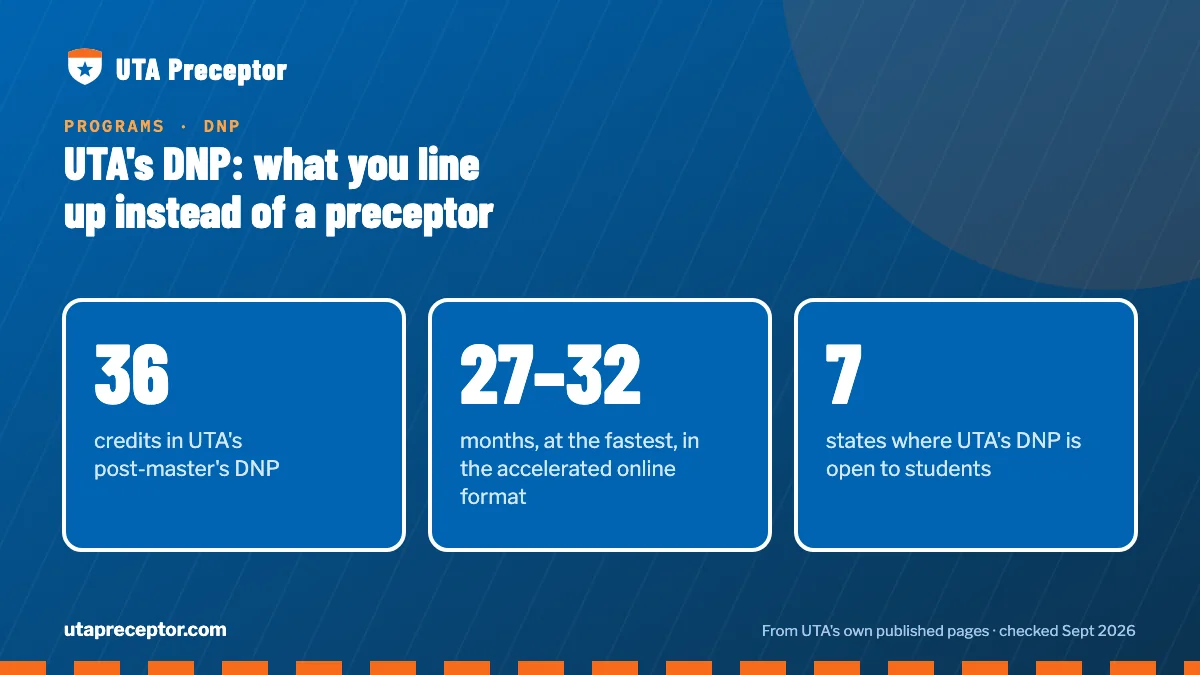
UTA's Doctor of Nursing Practice is a 36-credit, post-master's program taught online in two formats. It uses no preceptors. What you need is an approved project site and a doctoral-prepared faculty project advisor, and you must live in one of the seven states where UTA offers the degree.
Plan around your DNP project
Tell us your MSN background, your state and where your project might sit. A placement advisor replies with how we would look for a project home in your state.
Who UTA's DNP is for
The DNP at UTA admits only nurses who already hold a master's degree. The 2026-27 catalog lists a Nursing DNP, a Nursing PhD and a BSN to PhD, and no BSN-to-DNP route, so a nurse with only a bachelor's degree cannot enter the DNP directly.
The catalog describes the typical applicant as someone whose MSN prepared them for advanced nursing practice. That covers APRNs, meaning nurse practitioners, clinical nurse specialists, certified nurse-midwives and nurse anesthetists, and it names nurses with an MSN in Administration as well.
A third group can get in with the DNP Director's approval: BSN-prepared nurses whose master's is an MBA, an MHA, an MSN in Education, or a degree in informatics, population health or a related field. Which of these routes you take matters later, because it decides how many practice hours UTA credits from your earlier degree.
Two online formats and how long each takes
The catalog offers the DNP in two formats: accelerated online, which is asynchronous, and a traditional semester format with synchronous online classes. UTA's DNP handbook says neither requires a face-to-face class meeting, and courses run 8 to 13 weeks.
The accelerated version pairs two courses in each eight-week session, taken back to back, and its last three sessions are 13-week courses. UTA's online page puts the fastest finish at 27 to 32 months. The handbook sets two years as the full-time minimum, three to five years for part-time study, and six years as the outer limit.
Accelerated online starts for 2026-27 fall on August 17 and October 12, 2026; January 11, March 8 and May 17, 2027; and August 23 and October 18, 2027. We found no published start dates for the traditional semester format, and the UTA campus DNP page linked from the online site returned an error when we checked in September 2026. If that format suits you, ask the program directly.
The courses that carry the project and the hours
Four courses carry your project from idea to finished work, and every practice hour you earn in the program attaches to them. The rules for each stage are on two detailed pages, linked in the last column.
| Course | Online length | What it asks of you | Read more |
|---|---|---|---|
NURS 6323 Evidence Appraisal | 8 weeks | Develop the prospectus; your project site must be entered in Exxat before this course ends | Project site rules |
NURS 6326 Project Proposal Development | 13 weeks | Write the proposal the Graduate Nursing Review Committee reviews; 180 practicum hours are applied once it is approved | How hours are counted |
NURS 6620 DNP Practicum I | 13 weeks | Implement the project at the approved site | Contract and approvals |
NURS 6621 DNP Practicum II | 13 weeks | Evaluate the project; give a virtual podium presentation and write a manuscript | Logging and approval |
The program opens with NURS 6327 Clinical Scholarship to Improve Healthcare Outcomes, and the other 8-week courses cover leadership, population health, translational research, clinical information systems and health care policy. None of them carries practice hours. The site deadline in NURS 6323 therefore arrives well before any hours do, which is easy to overlook while the practicums still seem far off.
Hours: what you bring in and what you earn
UTA sets a floor of 1,000 post-baccalaureate practice hours, of which your master's can supply as many as 500. How many you still owe depends on the route you took in.
- APRN entry. The handbook credits nurse practitioners, clinical nurse specialists, nurse-midwives and nurse anesthetists with 500 hours, leaving at least 500 to earn in the program.
- MSN in Administration or another non-APRN MSN. You provide a verification letter of the clinical hours from your MSN, and UTA credits what it verifies, up to 500.
- A master's outside nursing, admitted with the Director's approval. UTA does not say how hours are credited in this case. The handbook's range for in-program hours runs from 500 up to 1,000, so ask where you fall before you enroll.
Two rules apply to every route. Hours earned in the program must sit outside your normal paid employment, and your faculty project advisor approves or denies each entry. Your personal total is identified at the start of your first practicum, which is late in the program, so get an early estimate from your advisor and plan your project scope around it.
Who you need: a site and a faculty advisor, not a preceptor
UTA's DNP handbook is plain on this point: the program does not use preceptors. The people who matter are your faculty project advisor, drawn from doctoral-prepared (DNP or PhD) RN faculty, and whoever opens the door for you at your project site.
Your advisor approves the objectives for your practice hours, then reviews the hours you log in Exxat. The site has to be entered in UTA's clinical management system, contracted by UTA's legal staff and, where the organization requires it, cleared by its own IRB or administration. The affiliation agreement page explains why contracts with outside organizations need lead time.
Your first DNP planning task, then, is a place rather than a person: an organization willing to host a project, accept a contract with UTA and give you access to the process or data you want to change.
If you are recruiting a preceptor for UTA's DNP, stop. The program does not use one; put that effort into securing a project site before NURS 6323 ends.
Where you have to live
UTA's state-authorization map lists the DNP in seven states only: Arkansas, California, Colorado, Florida, New Mexico, Texas and Virginia. It is the same short list that applies to UTA's nurse practitioner programs, and UTA decides which state you are in from the address you keep in MyMav.
Licensure follows the program. The DNP catalog page requires an unencumbered APRN and RN license, as designated by the Board of Nursing, for practicum courses, and applicants who are APRNs must hold current national certification plus an unencumbered APRN license issued by a U.S. state or territory.
A move, a new job across a state line or a project site in another state can each change what UTA allows. Before any of those, write to NursingSOA@uta.edu, UTA's state authorization contact, and read out-of-state clinicals for how UTA treats each situation.
What UTA does not publish
Several practical questions have no public answer. Raise each one with your faculty project advisor or the DNP program office before it affects your timeline.
- Whether the project site is yours to find. The handbook has you enter and investigate the site but stops short of saying who identifies it.
- How long UTA's legal staff need to contract with a new project site once you enter it.
- How many practice hours UTA credits to a nurse whose master's is outside nursing.
- Start dates for the traditional semester online format.
- A DNP handbook newer than the 2024-25 edition, revised January 2025, which is the one UTA links today.
- How the handbook's “(500 Clinical Hours)” label on each practicum fits with its statement that each student's requirement is set individually.
Why DNP students come to us for a project home
UTA's DNP has no preceptor to place, so the search that matters is for a project home, and that is the search DNP students hand to us. We look for organizations in your state that fit your topic, can host work reaching past your normal job and are open to a contract with UTA.
From that shortlist, a placement advisor gathers the contact and site details you will need to enter the site before NURS 6323 closes, which gives UTA's legal staff the lead time the handbook asks for. The project, the hours and your faculty advisor's sign-off stay yours, and UTA decides on the site with complete information in front of it. If it would help, send the placement desk a note with your MSN background and project idea.
Questions UTA students ask
What GPA and prerequisites does UTA's DNP require?
The catalog sets a 3.5 GPA for unconditional admission, and applicants between 3.0 and 3.49 may be admitted on probation. You must also finish a graduate statistics course with a grade of B or better before admission. Check the full list on the catalog's DNP page before you apply, since the handbook UTA links is from 2024-25.
Do I ever have to travel to Arlington for the DNP?
UTA's DNP handbook says no face-to-face class meeting is required, and both formats are taught online; the traditional format simply uses scheduled live online classes. The podium presentation in NURS 6621 is virtual. The hands-on part of the program happens at your project site, not on campus.
Can I work full-time while doing UTA's DNP?
UTA publishes a part-time pace of three to five years alongside the two-year full-time minimum, and it sets no public rule on outside employment. What you must plan for is that practice hours sit outside your normal paid role. Project time comes on top of your job, not out of it, even if the project is at your workplace.
Do DNP students need to buy Exxat?
UTA's DNP handbook has you log practice hours in Exxat, and UTA's Exxat page makes buying it a condition of starting the graduate program. UTA does not publish the cost. Exxat is also where your project site gets entered, so set up access early rather than in the final week of NURS 6323.
Will UTA assign me a faculty project advisor?
UTA's public sources say doctoral-prepared RN faculty serve as DNP faculty project advisors, but they do not describe how an advisor is matched to a student. Ask the program early. That advisor approves your hour objectives and every hour you log, so knowing who it is shapes how you plan the project.
Related pages
Last checked 2026-09-23
We check these pages against UTA's own sources. UTA's current handbook and your course faculty have the final word.
Hand us the search. Keep your term.
Tell us your UTA track, your county and when your clinical course opens. We look for a preceptor and a site that fit what UTA asks for, and we help you put the approval packet together.
- Matched to your track's population and setting
- Paperwork prepared the way UTA's clinical team expects it
- In person near you, or a virtual option where your course allows it
Start your placement plan
A placement advisor replies with what a UTA-ready preceptor and site look like for you.