Preceptor or site not approved by UTA: why, and how to fix it
A denial usually traces back to one of UTA's own rules: the preceptor's license or time in role, your course's preceptor categories, a setting that doesn't fit, an employer conflict, a missing affiliation agreement, an agency's vaccine decision or your state. Find out which rule it was: each has its own fix, and some don't mean starting over.
Request came back denied?
Tell us your course, its start date and what the denial said. A placement advisor replies about searching for a preceptor who meets the rule.
First, find out exactly what was denied
UTA doesn't publish a review checklist or a list of denial reasons, so the notice you received may be brief. Before you change anything, write to your Clinical Coordinator or course faculty from MavMail and ask three things: which requirement wasn't met, whether the decision concerns the preceptor, the site or your own file, and whether it can be resubmitted with more information.
The answers sort your next step. A missing detail means resubmitting. A rule the preceptor can't meet means a new preceptor. A problem in your own file has to be fixed first, or the next request fails too.
Check your runway at the same time. Requests per course are capped by the school, so find out how many you have left, and note the date your course's Wishlist closes.
A denied preceptor doesn't rule out the site, and a denied site doesn't always rule out the preceptor. Ask which one UTA ruled on.
Reasons about the preceptor, and the fix
UTA's Preceptor Resources page sets two minimums, and each course adds its own list of acceptable preceptor types. Most preceptor-level denials fall under one of these; the full picture is on UTA preceptor requirements.
| Reason | UTA's rule | The fix |
|---|---|---|
| License not active, or restricted | “Hold an active, unencumbered provider license” | Choose another preceptor, and check the next one on the issuing board's public lookup first. |
| Under a year in the specialty role | “a MINIMUM of 1 year of clinical experience in the specialty role” | Ask an experienced colleague in the same practice, or ask your coordinator whether this preceptor would qualify for a later term. |
| License type not on the course's list | “Acceptable categories of preceptors are listed for each clinical course” | Look for your course's list in Exxat's Resources tile and course materials. Whether a physician or PA qualifies today isn't public. |
| Certification not shown | UTA's online FNP page wants “a licensed and certified preceptor” | If they're certified, resubmit with proof. If not, raise it with course faculty before resubmitting. |
If something simply couldn't be confirmed, such as a license number or the date they started in the role, resubmit with the missing detail.
Reasons about the site, and the fix
A preceptor can meet every requirement and still be turned down because of where they practice.
- The setting doesn't match the course. UTA's catalog describes
NURS 5337as a preceptorship in “selected primary health practice sites” andNURS 5354as “specialty practice and high acuity health care settings.” For FNP, earlier UTA syllabi (2016–2018) were stricter and listed emergency care centers, house calls, inpatient care and hospitals as “not approved.” Fix: propose another location where your preceptor practices that fits the course, or a new site. - It's your own department, or your supervisor. UTA allows your employer as a site, but not hours “within your department or under your current supervisor as preceptor.” Fix: a different unit or service line, with a preceptor outside your reporting line. See clinical hours at your employer.
- There's no affiliation agreement. Without a contract between UTA and the agency, you can't complete clinicals there, and at some systems agreements are written per college and degree program. Fix: ask your coordinator whether one can be started and finished before your start date; if not, look for a site an existing agreement covers. Affiliation agreements has what Texas systems publish.
Reasons about you, and the fix
Some denials have nothing to do with the preceptor or the site.
- An agency declined your vaccine exemption. UTA accepts a provider-signed medical declination waiver or a notarized Texas DSHS affidavit, but says exemptions are good only for admission. The agency decides, and if it won't take you, “the self-placement request will be denied” and your course slides to the following semester. Fix: ask each site about its exemption policy before you submit. See immunization requirements.
- Your compliance lapsed. UTA's clearance policy names a denied placement as one result of noncompliance. Fix: clear every Expired or Not Approved item in Exxat, then resubmit.
- The site is in the wrong state. Clinicals for UTA's NP tracks, NP certificates and DNP can only happen in Arkansas, California, Colorado, Florida, New Mexico, Texas and Virginia, and UTA takes your state from your MyMav mailing address. Fix: choose a site in an approved state, and read out-of-state clinicals before looking across a border.
Resubmitting without losing the term
The second request has to be cleaner than the first, because you may not get many more. Screen the next candidate against everything above before you enter anything in Exxat.
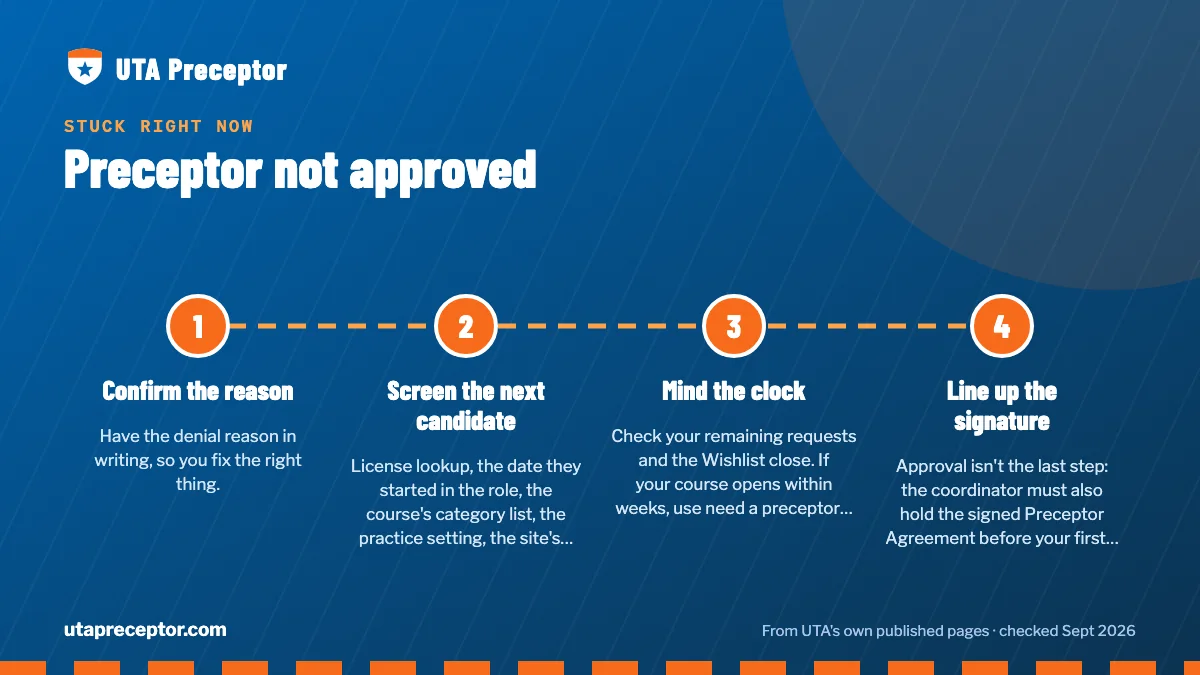
- Confirm the reasonHave the denial reason in writing, so you fix the right thing.
- Screen the next candidateLicense lookup, the date they started in the role, the course's category list, the practice setting, the site's agreement with UTA, its exemption policy if that applies to you, and the state.
- Mind the clockCheck your remaining requests and the Wishlist close. If your course opens within weeks, use need a preceptor fast.
- Line up the signatureApproval isn't the last step: the coordinator must also hold the signed Preceptor Agreement before your first clinical day.
Screening that heads off a denial
Most of the reasons above can be checked before a request goes in, and that screening is built into every search we run. We test each preceptor against UTA's published minimums and your course's setting, and we ask the site about its affiliation agreement at the outset. We look in person near you first, and bring in virtual arrangements where your course and faculty accept them.
After a preceptor commits, we help you compile the reviewer's file: their CV and license verification, the signed Preceptor Agreement, and the site's particulars. You submit in Exxat, and UTA's reviewers see a request that answers their questions up front. If someone we found is turned down, or drops later, we keep searching with the reason in hand. Start with the form below or the chat, and tell us what the denial said.
Questions UTA students ask
Can I appeal a preceptor or site denial at UTA?
UTA doesn't publish an appeal process for placement decisions. The handbook's route for issues regarding clinical placements runs from your Program Director to the Associate Chair. If you believe a rule was misread, put the rule and your evidence in writing. Ask your Clinical Coordinator first, since the fix may be as simple as a missing detail.
Does a denied request count toward my MyRequest limit?
The MyRequest guide confirms UTA sets a lower and upper limit on requests per course, but not whether a denied one is subtracted from that limit. Ask your Clinical Coordinator before you resubmit, and treat every request as though it counts.
Does a denial mean my clinical course is delayed?
UTA doesn't say a denial alone delays a course. The practical question is whether there's time to get another preceptor approved and the Preceptor Agreement in by day one. The one delay written into UTA policy is the vaccine exemption case, where the course moves to the next semester if the agency declines you.
Can I use a preceptor in another state if Texas options keep failing?
Only in a state open to your program, and only after emailing NursingSOA@uta.edu. You'd also need an RN license that works there; if your license isn't a compact one covering that state, getting licensed is on you. Approval, the affiliation agreement and the Preceptor Agreement all apply there too.
Should I tell my preceptor why they were turned down?
Yes, plainly and briefly, especially if they can fix it, such as by providing proof of certification or a license detail. If the reason is their license type or time in role, thank them and ask whether a colleague in the same practice might meet UTA's rules. A referral from a declined preceptor can be your quickest next lead.
Related pages
Last checked 2026-09-23
We check these pages against UTA's own sources. UTA's current handbook and your course faculty have the final word.
Hand us the search. Keep your term.
Tell us your UTA track, your county and when your clinical course opens. We look for a preceptor and a site that fit what UTA asks for, and we help you put the approval packet together.
- Matched to your track's population and setting
- Paperwork prepared the way UTA's clinical team expects it
- In person near you, or a virtual option where your course allows it
Start your placement plan
A placement advisor replies with what a UTA-ready preceptor and site look like for you.