Finding a pediatric primary care preceptor for UTA's PNP-PC
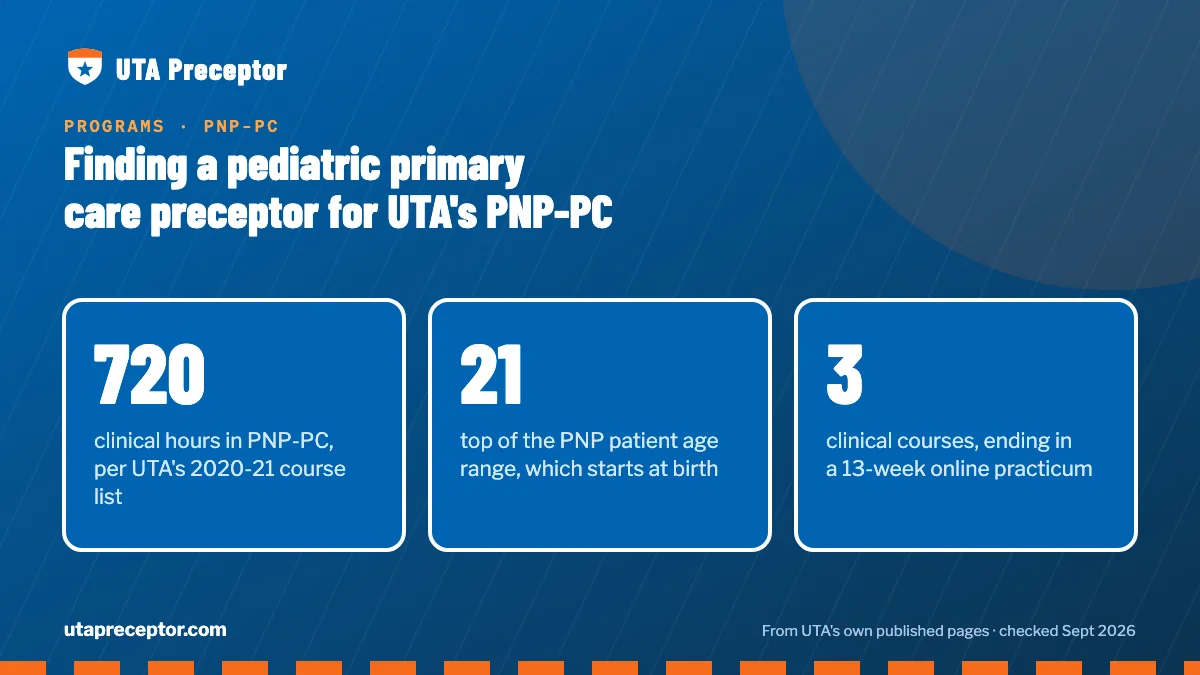
UTA's Pediatric Primary Care NP track needs an outpatient pediatric preceptor for three clinical courses and 720 hours, with patients from birth to 21. You find the preceptor and the practice; the Clinical Coordinator and/or course faculty approve them. Begin at least 12 to 16 weeks before NURS 5371, and earlier if the clinic belongs to a large health system.
Find a pediatric primary care preceptor
Tell us your PNP-PC start date, your next clinical course and your county. A placement advisor replies with what a fitting pediatric practice looks like near you.
What a PNP-PC site has to offer
Start with the patients. UTA's PNP-PC page puts the population at “birth to 21 years of age,” and the catalog places every clinical course in “selected primary health practice sites.” The site you want is an outpatient practice where a pediatric provider sees infants, school-age children and teenagers, not a hospital unit.
It helps to know what UTA leaves unsaid. No current UTA source sets minimum hours by age group for PNP-PC, splits the 720 hours among the courses, or names the preceptor types each course accepts. UTA's online FAQ says those categories “are listed for each clinical course,” which means inside your course materials, so read that list in Exxat or Canvas before you ask anyone.
Mixed-age practices are the gray zone. A family practice with a large pediatric panel can look like a good fit, yet UTA has not said publicly whether a family physician or family NP may precept a PNP-PC course. Take the practice's name and its share of child visits to course faculty and get an answer before you recruit.
Campus-based or accelerated online
UTA offers PNP-PC in both of its formats, according to the MSN and PMC handbook. The accelerated online version is fully online coursework taken one intensive course at a time, with several starts a year; UTA Online quotes “As few as 29-33 months” for 41 credits. Its 2026-27 calendar includes a Spring I start on 1/11/27 (apply by 12/11/26) and a Summer I start on 5/17/27 (apply by 4/23/27).
The campus-based version runs on fall and spring semesters. Most of its coursework is online too, with hybrid courses meeting in person a few times, “typically 3” in UTA's words, and UTA advertises hands-on time in its SMART Hospital and labs during the clinical phase. UTA frames it as 24 to 36 months for a full-time student carrying two or three courses a term, and every MSN has a six-year limit.
The placement model is identical in both. UTA's format comparison says clinicals in the online program “Will Depend on Your Own Clinical Arrangements”; campus students follow the same find-then-approve route. One more detail to check in MyMav: UTA's 2020-21 PNP-PC course list showed 42 credits, while the 2026-27 catalog shows 41.
The clinical sequence and its hours
Three courses carry the PNP-PC clinical load. Titles, credits and prerequisites are laid out course by course on UTA PNP clinical courses; this is the short version you need for planning a preceptor's calendar.
| Course | Role in the sequence | Online length | Comes after |
|---|---|---|---|
NURS 5371 | First pediatric primary care preceptorship | 11 weeks | NURS 5465 Primary Pediatric Care |
NURS 5372 | Continued preceptorship in the same kind of site | 11 weeks | NURS 5371, or alongside it |
NURS 5685 | 6-credit advanced practicum | 13 weeks | NURS 5371 and NURS 5372 |
The 720-hour total comes from UTA's 2020-21 course list, which current program pages still link. No current UTA page divides it among the three courses, so take each course's target from your syllabus. The totals for every UTA track are compared on clinical hours by track.
Because NURS 5372 may run alongside NURS 5371, a single term can call for two courses' worth of pediatric preceptor time. Ask about capacity for both before a preceptor says yes.
Admission experience and the states that are open
UTA's 2026-27 catalog lists two years of clinical experience as an RN among PNP-PC's unconditional admission criteria, plus CPR certification and a statistics course. The UTA Online PNP-PC page lists no experience requirement, so if you have less than two years, ask admissions which rule applies to your format. Neither source says the two years must be in pediatrics.
Every clinical course also requires an unencumbered RN license, and UTA's handbook says you must be licensed in whichever state your clinical site is in.
Location narrows things further. UTA's state-authorization map opens its NP programs only to students in Arkansas, California, Colorado, Florida, New Mexico, Texas and Virginia, and it reads your state from your MyMav mailing address. If a pediatric practice across a state line is your best lead, or you plan to move mid-program, email NursingSOA@uta.edu before you do anything else. The rules are set out on out-of-state clinicals.
Pediatric practices and community clinics in Texas
Because the catalog points to primary health practice sites, most PNP-PC hours are likely to happen outside hospitals, which widens the field. The site types that match UTA's “primary health practice” wording include independent pediatric offices, pediatric clinics owned by health systems, and federally qualified health center (FQHC) networks that employ pediatric providers.
HRSA's health-center data shows those networks in each major Texas metro. A few by region, named only to show where community clinics operate, not as sites known to take UTA students:
- Dallas-Fort Worth: HHM Health, Health Services of North Texas, North Texas Area Community Health Centers
- Houston: Legacy Community Health, Community Health Network, Spring Branch Community Health Center
- San Antonio and Austin: CommuniCare, CentroMed, CommUnityCare, Lone Star Circle of Care
- El Paso and the Rio Grande Valley: Project Vida, Centro de Salud Familiar La Fe, Su Clinica
- Lubbock and East Texas: Community Health Center of Lubbock, Family Circle of Care, Wellness Pointe
For any clinic, ask three questions early: does a pediatric provider there meet UTA's one-year minimum, does the clinic see enough children for your course, and does it have an affiliation agreement with UTA or will it sign one.
Children's hospital clinics: check before you count on one
Pediatric health systems run outpatient clinics too, but their doors for NP students are narrower. Children's Health in Dallas says its Primary Care Clinic “is no longer accepting nurse practitioner students for preceptorships.” Yet Children's Health's master agreement list shows UTA on file twice, biparty through 2/19/2032 and triparty with UT Southwestern through 12/31/2027. An agreement on file does not mean a particular clinic is taking students.
Elsewhere the lead times are long. Texas Children's in Houston wants an Affiliation Agreement Inquiry from licensed students, MSN and APRN included, six months or more ahead of the start they want. Cook Children's in Fort Worth told its own staff that new agreements take about three months, and its public education page lists no NP-student rotations. A UTHealth Houston pediatrics page lists pediatric and primary-care clinics that Family and Pediatric NP students apply to in set windows, requires an affiliation agreement with the student's program, and asks students not to contact clinics or providers directly.
Each system's onboarding steps are collected on DFW and Texas hospital onboarding.
When to start, and who to ask at UTA
UTA's online FAQ recommends a lead of 12 to 16 weeks before the first clinical course, and its General MSN FAQ goes further: begin “As soon as a student starts the program,” and have a preceptor by the time you are in Pharmacology, NURS 5334. For PNP-PC, that puts the search alongside your pediatric didactics, NURS 5465 and NURS 5467.
Some dates are set by UTA's systems. Compliance documents other than the background check and drug screen are due within 60 days of your first graduate course, and those two checks cannot be done more than 30 days before the first clinical course. Your NURS 5371 request goes in through Exxat MyRequest, which will not show a course that starts more than 12 months out; each course also has a Wishlist deadline. The full sequence is on the placement timeline.
Questions about a specific practice go to UTA's Graduate Clinical Coordination Team. The pediatric primary care mailbox in UTA's directory is PediprimaryNP@uta.edu.
How a placement advisor helps with PNP-PC
UTA expects you to find the preceptor and steps in when you run into difficulty. Our work sits in that gap. A placement advisor searches for a pediatric primary care preceptor within reach of where you live, checks the basics UTA publishes (license status, time in the specialty role, the ages the practice sees), and raises the affiliation question with the site at the outset.
Once a practice agrees, we help you prepare the packet UTA's clinical team looks at: the preceptor's CV or resume, a license verification, the agreement forms and the practice's details. If the preceptor withdraws partway through NURS 5372 or the practicum, we pick the search back up. Approval stays with UTA for every preceptor, site and agreement, and we make no promise about its decision or your start date. See how it works, or use the form below.
Questions UTA students ask
Can a family nurse practitioner precept a UTA PNP-PC student?
UTA's public pages do not answer this. The acceptable preceptor categories are listed for each clinical course inside the course materials, and UTA's minimums still apply: an active, unencumbered license and a year or more in the specialty role. If an FNP with a busy pediatric panel is your strongest lead, confirm the category with course faculty first. More on preceptor requirements.
Is the Children's Health primary care clinic taking NP students?
Not according to its own hosting page, which says the Primary Care Clinic is no longer accepting nurse practitioner students for preceptorships and lists graduatestudentservices@childrens.com as the contact. UTA does hold master agreements with Children's Health, so other departments are a separate question, but the primary care clinic should not be your first plan for NURS 5371.
Does UTA find pediatric preceptors for PNP students?
UTA asks students “to locate a preceptor which is aligned with their program requirements,” and the Department of Graduate Nursing assists when a student is experiencing difficulty. The procedure lives in a policy called Students Experiencing Difficulties with Clinical Placements, posted in Exxat rather than on UTA's public site. What that help does and does not cover is on UTA placement assistance.
When do PNP-PC clinicals start in UTA's online program?
UTA Online publishes the lengths of the PNP-PC clinical courses, 11, 11 and 13 weeks, but not where they fall in the program; only the online FNP page says clinicals begin in year two. Your degree plan in MyMav shows when NURS 5371 lands. Count back 12 to 16 weeks from that course's first day to set the start of your search.
Can I count telehealth well-child visits toward PNP-PC hours?
UTA's public sources do not address telehealth hours for any track. The handbook requires the minimum hours to come from direct patient care, and it lets simulation and observation count only above that minimum. Before logging any virtual visit, ask your course faculty in writing whether it counts for your course, and keep their reply with your clinical records.
Related pages
Last checked 2026-09-23
We check these pages against UTA's own sources. UTA's current handbook and your course faculty have the final word.
Hand us the search. Keep your term.
Tell us your UTA track, your county and when your clinical course opens. We look for a preceptor and a site that fit what UTA asks for, and we help you put the approval packet together.
- Matched to your track's population and setting
- Paperwork prepared the way UTA's clinical team expects it
- In person near you, or a virtual option where your course allows it
Start your placement plan
A placement advisor replies with what a UTA-ready preceptor and site look like for you.