A UTA student asked you to precept: what saying yes involves
UTA asks three things of a preceptor: an active, unencumbered license, at least a year in the specialty role, and a signed Preceptor Agreement with the Clinical Coordinator by the student's first clinical day. You teach and supervise; UTA's faculty stay responsible for the student and approve every placement. This page is for NPs, physicians, and nurse educators and leaders weighing the request.
Open to precepting?
Tell us your specialty, practice setting, county and the terms that could work. A placement advisor follows up only when a UTA student's course fits your practice.
What UTA asks of every preceptor
UTA's Preceptor Resources page sets two minimums for anyone precepting a graduate nursing student. Preceptors must hold a provider license that is active and unencumbered, and must have practiced in the specialty role for no less than a year. Years as a staff RN before your advanced role are a different thing, so if you are newly certified, say so up front.
Each clinical course also lists its own acceptable preceptor categories. The lists aren't public; the student can read theirs in Exxat, UTA's clinical management system.
How the role differs by program
- Nurse practitioner tracks. NPs and physicians are the clearest fit, and Texas rule names both. Earlier UTA syllabi (2016–2018) also accepted PAs in some tracks; the course's current list is what counts.
- MSN Nursing Education. UTA says the preceptor must work in nursing education, teaching nurses or nursing students, in a clinic, hospital or academic setting.
- MSN Nursing Administration. UTA's current preceptor page doesn't list this track. A 2015 UTA syllabus wanted a preceptor with a master's degree in nursing, business administration or health care administration, and allowed exceptions case by case.
One relationship rules you out whatever your credentials: UTA doesn't allow hours in the student's own department or with their current supervisor as preceptor. More on who can precept a UTA student.
Paperwork, approval and the faculty contact
Saying yes starts an approval the student runs, not you. The Clinical Coordinator and/or the student's course faculty approve both preceptor and site, so expect a request for your CV or resume and license details.
Each preceptor signs UTA's Preceptor Agreement, and the Clinical Coordinator needs it in hand by the student's first clinical day at the latest. UTA states that rule on its online FNP pages, so Education and Administration preceptors should ask which forms the course uses. See the Preceptor Agreement.
Before a student logs hours at your agency, UTA must have an affiliation agreement with it, so find out early who in your organization signs student agreements. Affiliation agreements explains why.
What earlier UTA syllabi (2016–2018) said about evaluations
- NP syllabi had the preceptor evaluate the student, and the student evaluate the preceptor and site.
- A 2018 syllabus wanted an evaluation from every preceptor who spent over 8 hours with the student.
- Faculty scheduled site visits, some by telephone, and could visit unannounced.
- A 2017 Nursing Education practicum asked the preceptor for midterm and final evaluations.
That is how UTA has worked, not necessarily what the course asks today. Faculty now grade students with UTA's Clinical Evaluation of Student tool; ask the student what input the course wants from you, and when.
What UTA offers preceptors
UTA is plain about the arrangement: its graduate nursing preceptors volunteer their time. In return, the Preceptor Resources page lists three things:
- Access to UTA's library and e-resources, such as Harrison's and McGraw Hill Access Medicine
- Preceptor continuing education courses
- An honorary UTA title: “Graduate Nursing Clinical Education Specialist”
UTA also bars students from being paid for clinical hours by their employer or their preceptor. If you'd rather ask UTA a question directly, the Preceptor Resources page lists a contact for prospective preceptors.
The Texas rule in the background
For nurse practitioner students, the Texas Board of Nursing's rule is 22 TAC §219.10. It calls for written agreements setting out what the program, preceptor and agency each do, and for written clinical objectives shared with the preceptor before the experience starts.
A designated faculty member stays responsible for the student's learning and in regular contact with you; phone or written contact can stand in where site visits aren't feasible. The companion definition in §219.2 has the preceptor supervise, teach and evaluate the student's clinical performance. The state sets no minimum years; the one-year floor is UTA's.
Deciding, and what to ask the student for
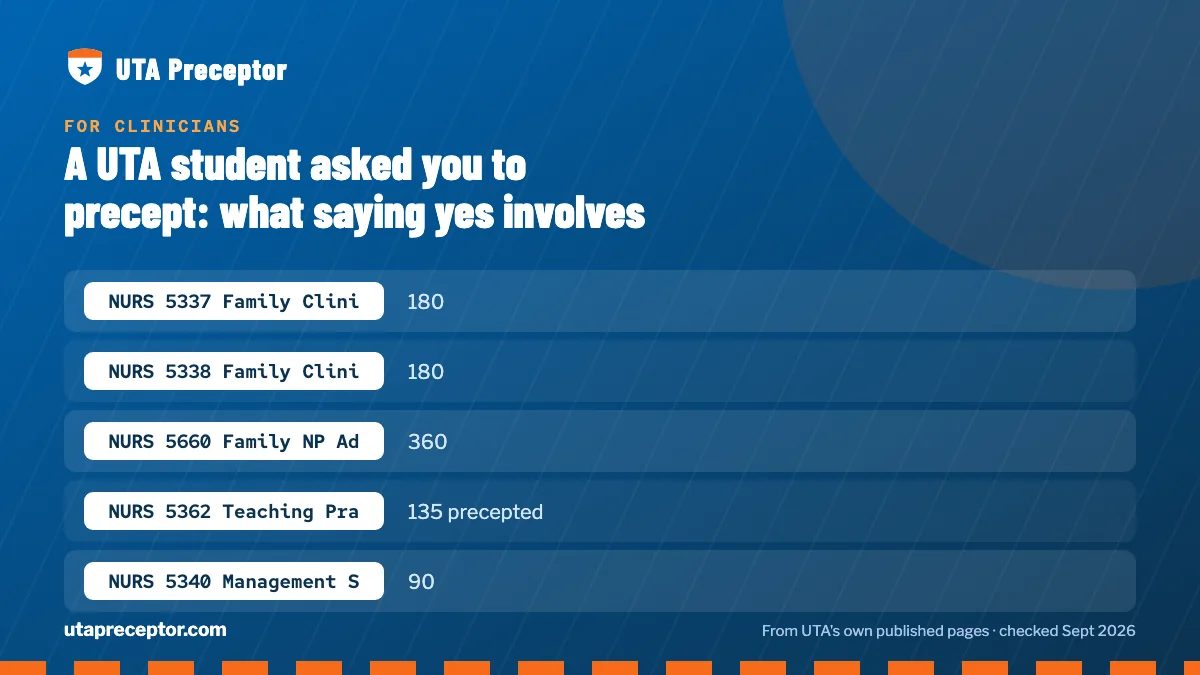
The biggest question is time: the course calendar sets the weeks, and every hour has to fit inside them. UTA's published figures give a sense of scale:
| Course | Hours | Weeks (online format) |
|---|---|---|
NURS 5337 Family Clinical Practice 1 | 180 | 11 |
NURS 5338 Family Clinical Practice 2 | 180 | 11 |
NURS 5660 Family NP Advanced Practicum | 360 | 13 |
NURS 5362 Teaching Practicum (Education) | 135 precepted | 10 or 11, by source |
NURS 5340 Management Seminar and Practice (Administration) | 90 | 10 |
Ask the student for
- Course number and total hours, the course's start and end dates, and the days they can attend
- The course's written clinical objectives
- Their course faculty's contact details
- The Preceptor Agreement and any other course forms
- Their Exxat profile or CV, and confirmation their clinical clearance is current
- Whether your site already has an affiliation agreement with UTA
Then check your side: your employer's policy on students, whether your patient mix fits the course setting, and any leave inside the course weeks. For NP students the minimum hours must be direct patient care, and observation doesn't count toward it, so plan for the student to see patients with you. Other tracks are on UTA clinical hours.
Saying no, or not this term
A prompt no helps a student more than a slow maybe. UTA's online FAQ suggests students start looking 12 to 16 weeks before their first clinical course, and each week spent waiting on one answer comes out of that window.
If the fit is right but the timing isn't, name a term that could work, or pass along a colleague who suits the course better. UTA's Department of Graduate Nursing also says it assists students having difficulty with placement.
Open to precepting UTA students?
We are the placement service built around UTA's clinical process, matching UTA students with preceptors whose practice fits their course. If you'd be open to hosting a UTA student, this term or later, tell us through the form below, choosing “I'm a preceptor (not a student)” as the program, or send a message in the chat.
Share your specialty, setting, county and the terms that could work. When a student's course fits your practice, a placement advisor contacts you with the details first, and nothing is arranged until you agree. We help the student prepare the Preceptor Agreement and paperwork so your part stays simple, and UTA's Clinical Coordinator and course faculty sign off on each placement.
Questions UTA students ask
How many hours a week does precepting a UTA student take?
It depends on the course. Spread evenly, a 180-hour FNP clinical course over 11 weeks comes to about 16 or 17 hours a week, and the 360-hour practicum over 13 weeks to nearly 28. A 2017 UTA Nursing Education syllabus put its 135-hour practicum at 12 to 14 hours a week.
Can I share a UTA student with a colleague?
Often, yes. A 2024 UTA FNP guidelines document, seen only in excerpt, prefers one preceptor but accepts two in each of the first two clinical courses, and allows up to three in the final practicum. Each must meet UTA's minimums, be approved and sign the Preceptor Agreement. Other tracks' limits aren't public.
I practice outside Texas. Can I precept a UTA student?
Possibly. UTA's NP programs take students from seven states only: Texas, Arkansas, New Mexico, Colorado, California, Florida and Virginia. Students also contact NursingSOA@uta.edu before approaching a preceptor outside their own state, and they need an RN license valid where you practice. More on out-of-state clinicals.
Can I precept a nurse who works on my team?
Not if you are their supervisor. UTA lets students do clinical hours at their employer, but not in their own department and not with their current supervisor as preceptor. A colleague in another department of your organization may be able to take them instead, if the course fits and the affiliation agreement covers the site.
What if I have to stop partway through the course?
Tell the student and their course faculty as soon as you know. Before your last day, confirm the hours the student has worked with you so they can be logged in Exxat, and complete any evaluation the course asks for. UTA approves a replacement preceptor through the same steps as the first.
Related pages
Last checked 2026-09-23
We check these pages against UTA's own sources. UTA's current handbook and your course faculty have the final word.
Hand us the search. Keep your term.
Tell us your UTA track, your county and when your clinical course opens. We look for a preceptor and a site that fit what UTA asks for, and we help you put the approval packet together.
- Matched to your track's population and setting
- Paperwork prepared the way UTA's clinical team expects it
- In person near you, or a virtual option where your course allows it
Start your placement plan
A placement advisor replies with what a UTA-ready preceptor and site look like for you.