UTA PNP-AC: finding a pediatric acute care preceptor and site
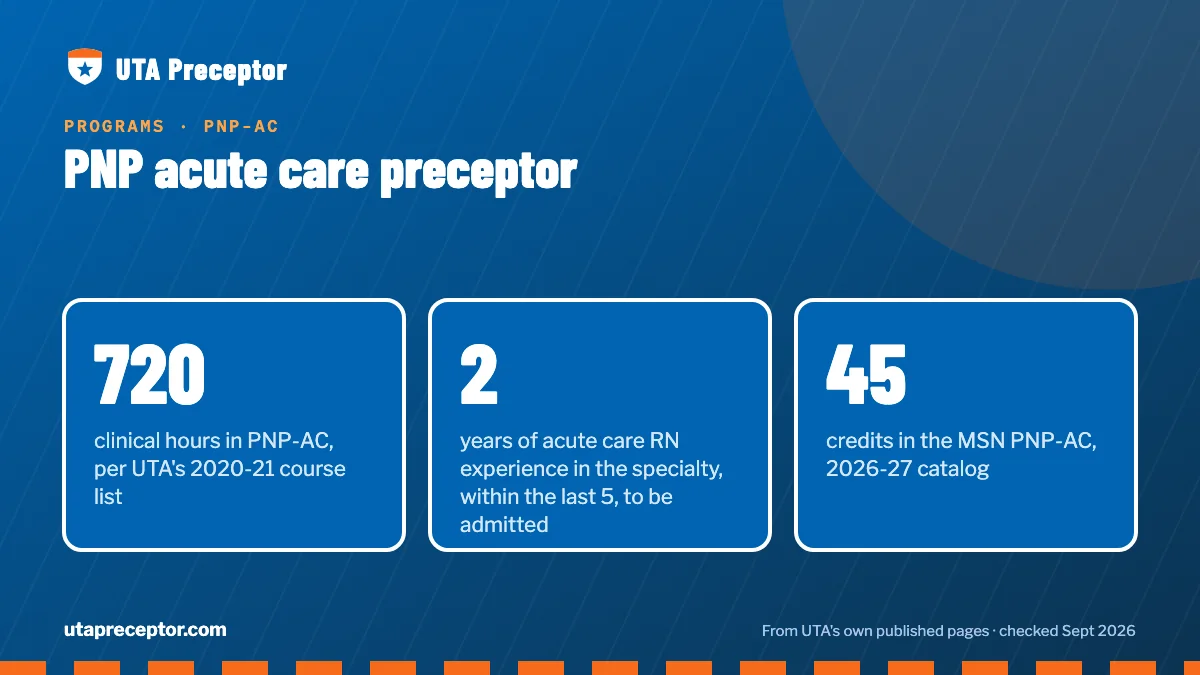
UTA's Pediatric Acute Care NP track sends you into hospitals, long term care facilities, emergency departments and specialty clinics, for patients from birth to 21, across three clinical courses and 720 hours. Almost every one of those settings sits inside a health system with its own student rules, so the site's agreement with UTA matters as much as the preceptor's yes.
Find a pediatric acute care site
Tell us which PNP-AC course is next, the hospitals within your driving range and your start date. A placement advisor replies with realistic options.
The settings UTA names for PNP-AC
UTA's PNP-AC page names four kinds of setting: “hospitals, long term care facilities, emergency departments, and specialty clinics.” The catalog describes the clinical courses as preceptorships in “selected acute and chronic care health practice sites.” In practice that means places like a pediatric inpatient unit, a pediatric emergency department or a pediatric subspecialty clinic, where children arrive sicker or more complex than in a primary care office.
The age range is the same as primary care, birth to 21, so a unit that sees only infants or only teenagers may cover part of what a course expects rather than all of it.
Several things are not on any public UTA page: which setting each course expects, how the 720 hours divide among the courses, whether a rotation can be split between two units, and which preceptor types each course accepts. UTA's online FAQ says acceptable categories exist for each clinical course; they live in the course materials, not on a public page. Read that list, then ask course faculty about anything it leaves open.
Formats and time to finish
PNP-AC is one of the NP tracks UTA runs in both formats, per the MSN and PMC handbook. UTA Online quotes “As few as 31-33 months” for the 45-credit accelerated version, which you take one intensive course at a time. The 2026-27 online calendar published on the PNP-AC page includes starts on 2/15/27 (apply by 1/22/27) and 3/8/27 (apply by 2/12/27).
The campus-based version follows the semester calendar with fall and spring starts, and UTA's department page frames a full-time load as 24 to 36 months. Its handbook notes that most campus-based courses are online with minimal campus presence, and UTA warns that some graduate programs schedule required courses and events on Saturdays, so ask the program director about yours.
Format changes the calendar, not the placement model. Online or on campus, you line up the preceptor and site and UTA approves them, and online students should know UTA describes their clinicals as depending on their own clinical arrangements. The 11 and 13-week online course lengths are laid out against the program calendar on the online clinical schedule.
Three courses, 720 hours
The acute care sequence pairs two 3-credit clinical practice courses with a 6-credit practicum. Prerequisites and catalog wording for each are on UTA PNP clinical courses; the planning view is below.
| Course | What it is | Online length | Needs first |
|---|---|---|---|
NURS 5373 | First pediatric acute care preceptorship | 11 weeks | NURS 5467, and NURS 5466 or concurrent |
NURS 5374 | Second acute care preceptorship | 11 weeks | NURS 5466; NURS 5373 or concurrent |
NURS 5680 | 6-credit advanced practicum | 13 weeks | NURS 5373 and NURS 5374 |
Three 4-credit pediatric didactics come first: NURS 5465 Primary Pediatric Care, NURS 5467 Pediatric Complex Care and NURS 5466 Pediatric Acute Care, each 8 weeks online. The 720-hour total is from UTA's 2020-21 course list, still linked from its program pages; no current UTA source assigns hours to each course, so your syllabus sets each target.
The acute care experience rule, and where you may study
Admission to PNP-AC asks for more than a license. The 2026-27 catalog says “Two years of clinical RN experience within the area of concentration in an acute care setting within the previous 5 years is required,” and UTA Online uses similar wording. You also need an unencumbered RN license for the clinical courses.
That rule shapes the search. Because admission requires recent acute care experience in the specialty, you may already work somewhere that could host you. UTA's FAQ permits employer sites that meet the course's clinical focus guidelines, with your own department and your current supervisor both ruled out. The details are on clinical hours at your employer.
The states are fixed. UTA's NP programs are open only to students in Arkansas, California, Colorado, Florida, New Mexico, Texas and Virginia, and per the handbook, a rotation in another state, a move or a travel contract all start with an email to NursingSOA@uta.edu.
North Texas pediatric systems
Children's Health in Dallas and Plano lists UTA twice on its master agreement list: a biparty agreement dated 2/20/2024 through 2/19/2032, and a triparty agreement that also involves UT Southwestern, dated 1/1/2025 through 12/31/2027. Student requests there are submitted through Ultimus by the hosting department, at least three weeks ahead for non-employees, and forms are not accepted from students directly. Its hosting page for graduate nurses and PAs returned a 404 in September 2026, so ask the department you hope to join how APRN students are routed now.
At UT Southwestern, APRN student placement runs through the Office of Advanced Practice Providers and a single online request form, one per semester, in fixed windows; for a fall rotation, for example, the window runs January 1 to March 31. You may name a preferred preceptor, but the office looks for an available one itself.
Cook Children's in Fort Worth says its agreements are specific to the college and degree program, and that a new one takes about three months. Its public education page lists residencies and externships, not NP-student rotations. The wider onboarding picture is on DFW and Texas hospital onboarding.
Houston, San Antonio and other Texas regions
Outside North Texas we found fewer published pediatric rules, and none of the systems below says it takes UTA PNP-AC students. Texas Children's in Houston expects licensed students, MSN and APRN among them, to send an Affiliation Agreement Inquiry at least half a year before the rotation. In San Antonio, CHRISTUS Children's wants a current affiliation agreement with your clinical program and a preceptor already secured, and preceptors employed by Baylor College of Medicine need an extra BCM approval that can take up to six weeks.
Other metros have children's hospitals as well: Dell Children's in Austin, Driscoll Children's in Corpus Christi and the Rio Grande Valley, and El Paso Children's Hospital. We have not seen a published NP-student process for these, so ask each one two questions before you pitch a preceptor: does it hold an agreement with UTA, and how does it take APRN students.
General hospitals with a pediatric unit or emergency department are another route, and they bring their own steps. Baylor Scott & White, for example, requires its online student orientation within 90 days before a rotation at any of its locations.
Do not let a preceptor's yes stand in for the system's. At a hospital, the agreement and the system's student process decide whether the rotation happens.
Lead time, credentials and who to ask
UTA's online FAQ sets 12 to 16 weeks before the first clinical course as the time to begin looking. For PNP-AC treat that as a floor: a six-month inquiry window or a three-month new agreement is longer than the whole recommendation. UTA's General MSN FAQ sets a later backstop, a preceptor by the time you reach Pharmacology, but a children's hospital's own clock can run longer than either.
Credentials add their own dates. UTA's clearance policy lists PALS among the costs students pay but does not say publicly which tracks must hold it, so confirm with your course and your site, and see CPR, ACLS and PALS. The background check and drug screen fall within the 30 days before your first clinical course, and hospitals often add orientation modules of their own.
For course-specific questions, UTA's directory lists a pediatric acute care mailbox for its Graduate Clinical Coordination Team: PediacuteNP@uta.edu.
Why PNP-AC students choose us
Hospital-based rotations reward an early, specific search. A placement advisor looks for pediatric acute care preceptors near you whose unit or clinic matches the course you are entering, and checks at the start whether the system has an agreement with UTA and an APRN student process that fits your dates. When a system is closed to new students, we tell you and move on to settings that are open.
For the approval request, we help you collect the items UTA's reviewers look for, from a CV and license check to the site's details and agreement paperwork. A unit can change its mind mid-course; if yours does, we reopen the search. UTA approves preceptors, sites and agreements, and we see that yours reach the reviewers complete. Read how it works or send the form below.
Questions UTA students ask
Can a pediatric hospitalist physician precept a UTA PNP-AC student?
UTA's public pages do not say which provider types each PNP-AC course accepts; those lists sit in the course materials. Texas's APRN education rule, 22 TAC §219.2, names physicians among qualified preceptors, but UTA's written criteria decide. UTA's floor still applies: an unencumbered, active license and a year or more practicing in the specialty role. Check the course list before you ask.
Do I need pediatric ICU experience to get into UTA's PNP-AC?
The catalog rule is two years of clinical RN experience within the area of concentration, in an acute care setting, within the previous five years. It does not name the ICU or any other unit. If your acute care experience is mixed or partly adult, ask UTA admissions how it will be read before you apply.
Can I do PNP-AC hours in a general emergency department that sees children?
Emergency departments are on UTA's list of PNP-AC settings, but UTA does not publish how much pediatric volume a mixed department must have. The course population is birth to 21, and UTA's handbook says simulation can never replace population-specific hours. Bring the department's pediatric visit mix to course faculty and get approval before you commit a preceptor.
Can I split a PNP-AC course between two preceptors?
UTA has not published current rules on splitting hours for the pediatric tracks. Earlier UTA syllabi allowed splits in some other tracks, but those are history, not policy. If you want two units or two preceptors in one course, ask course faculty first. Each preceptor still has to be approved and sign the paperwork UTA requires.
Does the PNP dual track use the same acute care courses?
Yes. UTA's 2026-27 degree plan for the pediatric dual track lists NURS 5373, NURS 5374 and NURS 5680, plus NURS 5372 and NURS 5685 from primary care, for 1,260 hours on the 2020-21 course list. UTA lists the dual among its campus-based programs. See dual NP tracks.
Related pages
Last checked 2026-09-23
We check these pages against UTA's own sources. UTA's current handbook and your course faculty have the final word.
Hand us the search. Keep your term.
Tell us your UTA track, your county and when your clinical course opens. We look for a preceptor and a site that fit what UTA asks for, and we help you put the approval packet together.
- Matched to your track's population and setting
- Paperwork prepared the way UTA's clinical team expects it
- In person near you, or a virtual option where your course allows it
Start your placement plan
A placement advisor replies with what a UTA-ready preceptor and site look like for you.