Finding a family practice preceptor for UTA's FNP track
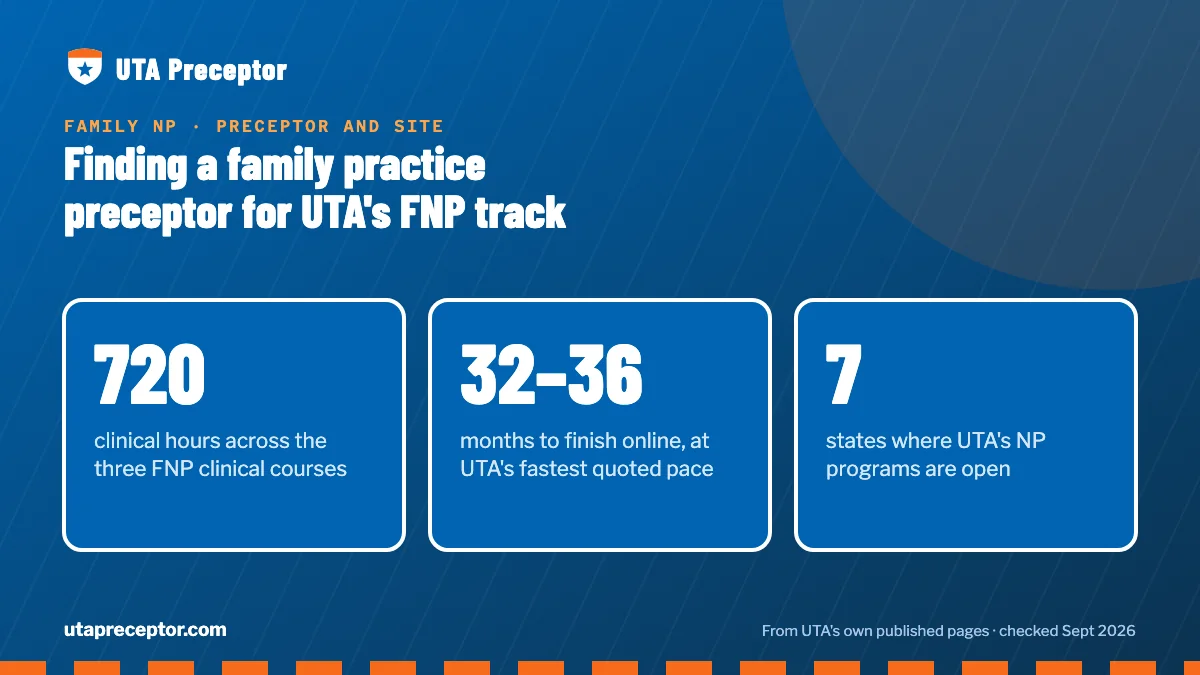
UTA's Family NP track runs 720 clinical hours through three primary care courses, and UTA asks you to locate the preceptor and site yourself, stepping in only if you run into difficulty. Online, clinical courses begin in your second year, so year one is when the search should happen.
Get your placement plan
Tell us your UTA track and where you live. A placement advisor replies with what a UTA-ready preceptor and site look like for you.
Campus or online: two formats, one clinical sequence
UTA teaches the 46-credit FNP MSN in two formats, and both lead to the same three clinical courses. Online, you take a single intensive course at a time and can start in any of several sessions each year; UTA Online quotes “As few as 32-36 months” to finish. On campus, classes blend online, hybrid and in-seat formats, cohorts begin in fall and spring, and a full-time student is expected to finish in 24 to 36 months.
For placement, the difference is spelled out in UTA's own comparison of the two. The campus format promises hands-on time in UTA's SMART Hospital during clinicals. The online format says clinicals “Will Depend on Your Own Clinical Arrangements,” and UTA Online places the first clinical course in the program's second year.
Admission sets no floor for RN experience. For unconditional admission the 2026-27 catalog wants a 3.0 GPA over your last 60 hours and an ACEN- or CCNE-accredited BSN, and clinicals need an unencumbered RN license, while the catalog pages for UTA's other NP tracks ask for two years of RN experience. If your nursing years were few or all inpatient, you may know few outpatient providers, which is one more reason to start early.
Three clinical courses, 720 hours
All 720 FNP clinical hours sit in three courses, and FNP is the one UTA NP track with published hours for each course. The course guides cover prerequisites, pace and paperwork, so this table only maps the sequence.
| Course | Title and guide | Online length | Clinical hours |
|---|---|---|---|
NURS 5337 | Family Clinical Practice 1 | 11 weeks | 180 |
NURS 5338 | Family Clinical Practice 2 | 11 weeks | 180 |
NURS 5660 | Family NP Advanced Practicum | 13 weeks | 360 |
Two details shape what you ask a preceptor for. The catalog lets you take NURS 5338 alongside NURS 5337, and UTA's Fall 2026 online schedule lists both for the same 9/21/2026 start, which doubles the weekly load. And NURS 5660 asks for twice the hours of either earlier course in 13 weeks, which is where one preceptor's calendar is most likely to run short.
UTA's handbook sets the counting rules: the national minimum has to be met with hands-on patient care, simulated or observed time can only add hours beyond it, and no NP track has hours waived.
The preceptor and practice a family track needs
Aim for a family primary care practice where you will see and manage patients yourself. The catalog places the first two courses in “selected primary health practice sites,” and the practicum is framed as family primary care advanced nursing practice. A practice whose panel runs from children to older adults can carry you through all three courses; one that sees a single age group may need a partner site.
UTA's published floor is short: an active provider license with nothing encumbering it, at least a year of clinical practice in the specialty role, and, on UTA Online's FNP page, “a licensed and certified preceptor.” What UTA does not publish is the list of acceptable preceptor types its FAQ says each clinical course has, or whether physicians and PAs qualify today. Those details sit in Exxat with UTA's preceptor guidelines.
UTA syllabi from 2016 and 2018 went further: the preceptor had to be an MD, NP, DO or PA, the setting outpatient primary care, and the hours had to include a 90-hour floor for each of three age groups (children, adults, older adults). That is history, not current policy, but it shows what reviewers have looked for. UTA preceptor requirements covers the rest.
Your employer's clinic can count if it fits the course. UTA's FAQ rules out two things there: hours inside the department you work in, and your current supervisor as your preceptor.
Where Texas FNP students find family practice sites
Federally qualified health center (FQHC) networks are one place to look: they deliver outpatient primary care, and the larger ones run many sites. HRSA's site data, refreshed in September 2026, shows sizable networks in every major Texas metro. Treat these as examples of the site type, not clinics known to host UTA students; the research behind this site did not examine their student policies, so ask before you assume.
- Dallas–Fort Worth: HHM Health (13 sites in HRSA's data), Prism Health North Texas (11), Health Services of North Texas (7) and Parkland's community sites (11).
- Houston: Legacy Community Health (66), Community Health Network (27) and Harris Health (12).
- San Antonio: CommuniCare Health Centers (30 in San Antonio, 4 in Hays County) and CentroMed (28).
- Austin: CommUnityCare Health Centers (36) and Lone Star Circle of Care (28 in Travis and Williamson counties).
- Border metros: in El Paso, Project Vida (48) and Centro de Salud Familiar La Fe (11); in the Rio Grande Valley, Nuestra Clinica del Valle (13) and Su Clinica (6).
Shortage regions change the math. DSHS projects Texas's highest unmet primary care physician demand for 2036 in the Rio Grande Valley (56%) and East Texas (51%), and it counted 20 counties with no NP at all in 2025. Fewer NPs nearby means fewer people to ask, so outside the big metros plan a wider radius from the start.
Clinics owned by a hospital system add that system's own onboarding and agreement steps to UTA's, and those steps can take weeks.
Which states the FNP track is open in
UTA's state authorization map lists its MSN nurse practitioner programs, FNP included, for seven states. Texas is one; the other six are Florida, Virginia, Colorado, California, Arkansas and New Mexico. Your state, for UTA, is whatever mailing address MyMav holds, and UTA's handbook says program completion “may only occur in a state in which CONHI can operate.”
The clinic has to be in one of those states too. Before you look for a preceptor across a state line, move or take a travel contract, UTA's handbook tells you to email NursingSOA@uta.edu. You must also be licensed as an RN where the clinic is: a compact license covers other compact states, and otherwise you pay for that state's license. Out-of-state clinicals covers the edge cases.
UTA Online advertises “Clinical experiences in your local area,” and inside those seven states that is the model: a site near where you live, found by you, approved by UTA.
Timing the search around year two
UTA gives two markers, and the earlier one governs. Its online FAQ counts back 12 to 16 weeks from clinical course one for the start of the search. A separate General MSN answer tells students to begin looking from their first term and to have a preceptor “no later than while in Pharmacology.” Check where NURS 5334, Advanced Pharmacology, sits in your MyMav degree plan; whichever date comes first is your real deadline.
The other dates hang off your first clinical course. Its MyRequest appears in Exxat once the course is within 12 months of starting, and each course's Wishlist has a close date. The background check and drug test have to fall inside the 30 days before it, and the Clinical Coordinator needs your preceptor's signed agreement in hand before your first shift. The placement timeline puts them in order.
Students report that family practice preceptors fill early. In a 2019 allnurses thread, one UTA FNP student said an advisor had recommended a six-month head start, and found many local FNPs already committed semesters ahead.
Online FNP clinicals start in year two, but the search belongs in year one. Waiting until the course is on your schedule risks moving it to a later start.
Why UTA FNP students choose us
UTA's own line is that students find their preceptor and the department offers help once a student hits difficulty, under a policy posted in Exxat; UTA placement assistance explains it. The placement desk works earlier than that. We search for a family practice preceptor and clinic near you that fit the course you are entering, then help you put together the approval packet: your preceptor's CV, proof the license is active, UTA's agreement forms and the clinic's details.
For NURS 5660 we can plan a second preceptor from the outset, and if a preceptor drops partway through a course, we keep searching on your behalf for someone to finish the hours with. UTA gives every approval, of preceptor, site and agreement alike, and the packet we help you build lets the Clinical Coordinator decide without chasing missing pieces. How it works sets out the order we follow, or use the form below with your start term and county.
Questions UTA students ask
Can one preceptor cover all three UTA FNP courses?
Possibly, if the preceptor has the capacity. UTA FNP guidelines revised in September 2024, seen only as a search snippet, said one preceptor is preferred and two are accepted in each Clinical Practice course, with up to three in the practicum. Each course still has its own MyRequest in Exxat, and the 360-hour practicum is where one schedule is most likely to run out. Check current limits in Exxat's preceptor guidelines.
Can I do FNP clinical hours at an urgent care or hospital clinic?
Ask first. UTA's current public pages list no excluded settings, but the catalog frames all three FNP courses around primary care, and UTA's 2016 and 2018 FNP syllabi put house-call practices, emergency care centers, hospitals and inpatient units on the “not approved” list. Put the question to your Clinical Coordinator before you commit to a site outside outpatient primary care.
Do I need a Texas RN license for UTA FNP clinicals in Texas?
Your RN license has to be unencumbered and good in the state where the clinic sits. In Texas, which joined the enhanced Nurse Licensure Compact in January 2018, a Texas license works, and so does a multistate license issued by your compact home state. UTA verifies licenses through NURSYS, and a student under any Board of Nursing investigation must report it to the Chair of Graduate Nursing.
How many hours a week do UTA FNP clinicals take?
UTA sets hours per course, not per week, so this is our arithmetic. Spread evenly, NURS 5660 works out to almost 28 hours a week for 13 weeks. Taking NURS 5337 and NURS 5338 together means 360 hours in 11 weeks, close to 33 a week. Any week lost to a late approval raises the rate for the weeks that remain.
Is the UTA FNP post-master's certificate the same preceptor search?
The clinical courses are the same: NURS 5337, NURS 5338 and NURS 5660, which add up to 720 hours using UTA Online's per-course figures. The certificate's other courses come from a gap analysis by the program director, and online certificate sections carry a NURSC prefix. UTA Online describes the certificate as taking as few as 5 courses.
Related pages
Last checked 2026-09-23
We check these pages against UTA's own sources. UTA's current handbook and your course faculty have the final word.
Hand us the search. Keep your term.
Tell us your UTA track, your county and when your clinical course opens. We look for a preceptor and a site that fit what UTA asks for, and we help you put the approval packet together.
- Matched to your track's population and setting
- Paperwork prepared the way UTA's clinical team expects it
- In person near you, or a virtual option where your course allows it
Start your placement plan
A placement advisor replies with what a UTA-ready preceptor and site look like for you.