How UTA approves your preceptor and clinical site
Every UTA preceptor and clinical site has to be approved by the Clinical Coordinator and/or your course faculty before the placement is yours. UTA doesn't publish a review checklist, but its own rules show what reviewers weigh: the preceptor's license and experience, the fit between site and course, the agency's affiliation agreement, your compliance and your state.
Put forward a preceptor who fits
Tell us your track and course. A placement advisor replies with what a preceptor and site that suit UTA's review look like.
Who signs off
UTA's online FNP page describes the step as “Approval of preceptors and clinical sites by the Clinical Coordinator and/or course faculty.” The “and/or” matters. Depending on your track and course, the decision may sit with the coordinator, with the faculty member teaching the course, or with both. You put the preceptor and site forward as a self-placement request in Exxat, as laid out in our placement process walkthrough.
UTA identifies these people by role. The Clinical Coordinator approves placements and also receives your Preceptor Agreement. The CONHI directory lists a separate coordination-team mailbox for each track, for example AGAcuteNP@uta.edu, PediprimaryNP@uta.edu or MSNeducation@uta.edu. For “issues regarding clinical placements” that stay stuck, the MSN and PMC Student Handbook escalates to your Program Director and then to the Associate Chair of Clinical Education.
What the reviewer is checking
UTA's published requirements, read together, show what a reviewer has to be satisfied about.
- The preceptor's license. UTA's Preceptor Resources page asks for an active, unencumbered provider license.
- Experience in the role. One year or more in the specialty role, per the same page. MSN Education preceptors must also work in nursing education, in a clinic, hospital or academic setting.
- The right kind of preceptor for the course. The online FAQ states that “Acceptable categories of preceptors are listed for each clinical course.” You won't find those lists on the public site; our UTA preceptor requirements page covers what is known.
- A setting that matches the course. Each clinical course has a setting description in UTA's catalog or program pages (see the table below).
- An affiliation agreement. UTA requires one with the agency before you can do clinicals there. See UTA affiliation agreements.
- Your own standing. Current clearance in Exxat, an unencumbered RN license, and a license that is valid in the state where the site sits.
- Employer limits. A workplace site is fine, but not your own department, and not with your current supervisor precepting. More on using your employer as a clinical site.
Matching the site to the course
Reviewers read your site against the course description. These are UTA's own setting phrases for the first clinical course in each NP track.
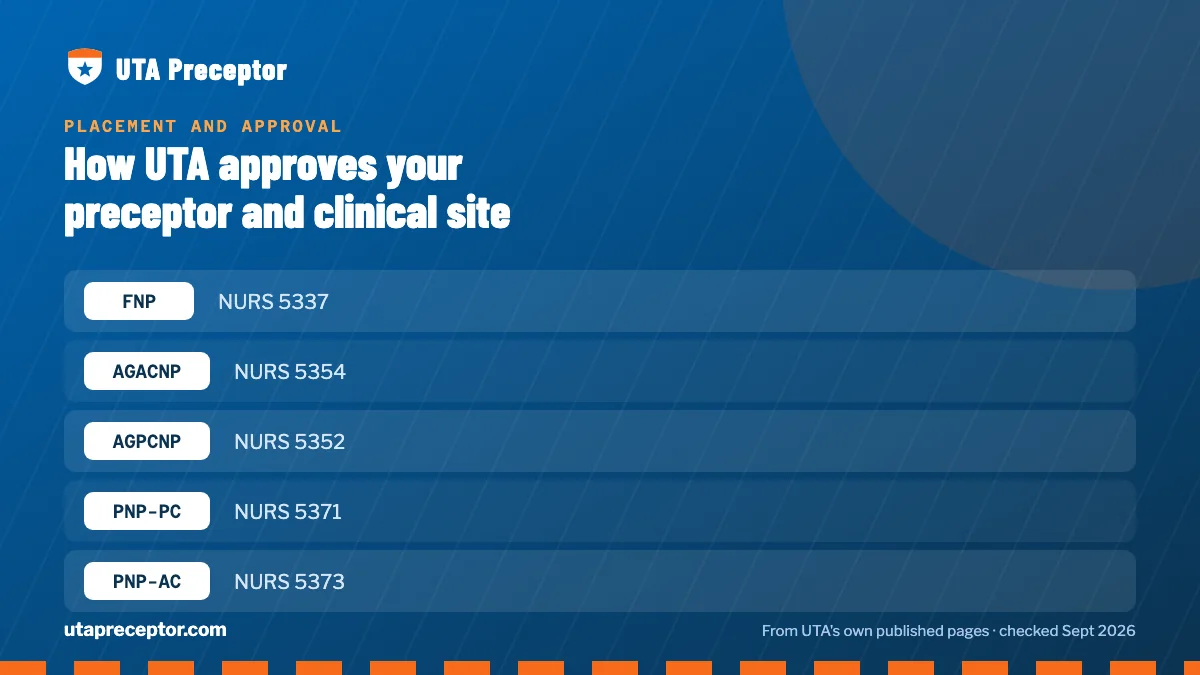
| Track | Course | Setting in UTA's words |
|---|---|---|
| FNP | NURS 5337 | “selected primary health practice sites” |
| AGACNP | NURS 5354 | “specialty practice and high acuity health care settings” |
| AGPCNP | NURS 5352 | “primary and long term health care settings” |
| PNP-PC | NURS 5371 | “selected primary health practice sites” |
| PNP-AC | NURS 5373 | “selected acute and chronic care health practice sites” |
| PMHNP | NURS 5324 | program page: inpatient psychiatric, community and forensic settings |
A site can match the words and still be a poor fit. A children's practice won't give you the adults and elders an adult-gerontology course is built around, and a hospital unit sits awkwardly against a course written around primary care. When the fit is borderline, ask your course faculty before you submit rather than after a denial.
What gets a request denied
Some denial triggers are written into UTA policy. Others follow directly from its requirements.
- An agency that won't accept your vaccine exemption. UTA's clearance policy says exemptions are good only for admission and the agency makes the final call. If it declines you, UTA says “the self-placement request will be denied,” and your clinical course shifts to the following semester.
- Noncompliance. A lapsed clearance item can lead to a denied placement, a clinical hold on registration or a delayed clinical course. An unfavorable background check or drug screen at any point carries the same consequences.
- An unapproved state. The handbook lists denied or delayed placement among the results of living, moving or working where CONHI cannot operate. See UTA out-of-state clinicals.
- No affiliation agreement with the agency.
- A preceptor outside the course's categories, or one without the license or year of experience UTA requires.
If a request has already come back denied, our page on a preceptor not approved walks through the usual fixes.
Don't log hours with a preceptor who hasn't been approved. Earlier UTA syllabi (2016–2018) said Clinical Coordinator approval had to come before any hours, and no current public page says otherwise.
What earlier UTA syllabi said about preceptors
Current public pages don't list preceptor types by track. Older course documents did, and they show how reviewers used to frame approval. Treat them as history, not current policy. Earlier UTA syllabi (2016–2018) said:
- FNP preceptors “must be an MD, NP, DO, or PA,” each with a year or more of experience, and FNP sites were outpatient primary care.
- For FNP, sites such as hospitals, inpatient units, house calls and emergency care centers were marked “not approved.”
- No FNP clinical course could have more than two preceptors.
- AGACNP practicum preceptors could be physicians, AGACNPs, ACNPs or master's-prepared PAs, with at least one rotation under an NP. FNPs, AGNPs and clinical nurse specialists holding prescriptive authority were considered only case by case.
- Students proposed a site and preceptor through an online survey.
No current public UTA page says whether MD, DO or PA preceptors are accepted today. The live rule sits in the Graduate Student Clinical Site and Preceptor Policy inside Exxat and in your course's list of preceptor categories.
What UTA does not publish
Three things you'd want before submitting aren't on any public UTA page: how long review takes, the checklist reviewers use, and the preceptor categories for your course. UTA keeps the Graduate Student Clinical Site and Preceptor Policy inside Exxat, where the Resources tile also holds its preceptor guidelines.
So build your own buffer. Submit as soon as the course appears in MyRequest, look for the category list in Exxat and on your course Canvas page, and email your track's coordination mailbox before you ask a clinician with unusual credentials. UTA's documents don't cite it, but Texas's rule for APRN programs, 22 TAC §219.10, makes faculty accountable for managing clinical learning experiences and requires written criteria for selecting preceptors. The decision rests with UTA, not with the site and not with you.
Why students choose us for a clean first submission
Most of what a reviewer needs is information about the preceptor and the site, gathered before you submit. That is the part we help with. We look for a preceptor with the license, specialty and practice setting your course calls for, and we help you assemble the preceptor's CV, license verification, practice details and the agreement forms your course uses, so the request is complete the first time you file it. If UTA turns a preceptor down, we go back to the search.
You submit through Exxat and UTA makes the call, with a request that already answers what the reviewer checks. To have a placement advisor look at your course and location, use the form below or reach the desk through our contact page. After approval, the next document is the Preceptor Agreement.
Questions UTA students ask
How long does UTA take to approve a preceptor?
UTA doesn't publish a turnaround time. The outer limits are public: the signed Preceptor Agreement has to be with the Clinical Coordinator by day one, and each course's Wishlist in Exxat closes on a set date. Filing as soon as MyRequest shows the course, rather than near the close, leaves room to put forward a second preceptor if the first is turned down.
Can a physician or PA be my preceptor at UTA?
Current public UTA pages don't say either way. The Preceptor Resources page asks only for an active, unencumbered provider license and a year in the specialty role. Earlier UTA syllabi (2016–2018) accepted physicians and PAs for FNP and AGACNP rotations, but today's categories are listed per course inside Exxat. Check yours before you approach a physician or PA.
Does my preceptor need to be board certified?
UTA's online FNP page describes “a licensed and certified preceptor,” while the Preceptor Resources page lists only license and experience. Neither page says which certifications count. If your preceptor is licensed but not nationally certified, raise it with your course faculty before you submit the request, not after.
Who do I contact if my placement request seems stuck?
Start with the Graduate Clinical Coordination Team mailbox for your track. If the course isn't showing in MyRequest at all, UTA routes degree-plan issues to MSNadvising@uta.edu and other Exxat problems to v4support@exxat.com. A placement dispute that coordinators can't settle goes up the handbook's chain: Program Director first, then the Associate Chair.
Can UTA turn down a site that already agreed to take me?
Yes. A site's willingness is only one part of approval. UTA still needs an affiliation agreement with the agency, a preceptor who meets its requirements, a setting that suits the course and a student whose clearance is current. The agency can also decline you on its own terms, for example over a vaccine exemption.
Related pages
Last checked 2026-09-23
We check these pages against UTA's own sources. UTA's current handbook and your course faculty have the final word.
Hand us the search. Keep your term.
Tell us your UTA track, your county and when your clinical course opens. We look for a preceptor and a site that fit what UTA asks for, and we help you put the approval packet together.
- Matched to your track's population and setting
- Paperwork prepared the way UTA's clinical team expects it
- In person near you, or a virtual option where your course allows it
Start your placement plan
A placement advisor replies with what a UTA-ready preceptor and site look like for you.