Your UTA DNP project site: entered, contracted, approved
UTA's DNP uses no preceptors, but it does need an approved project site. You enter the site into the clinical management system by the end of NURS 6323 Evidence Appraisal, UTA contracts with it, and you cannot implement your project there until the site shows as approved.
Plan your DNP project site
Tell us where you work, where your project might sit and when NURS 6323 ends for you. A placement advisor replies with how a project-site search would work around your job and that deadline.
The deadline: by the end of NURS 6323
UTA's DNP handbook requires every student to enter the project site into the clinical management system by the end of NURS 6323 Evidence Appraisal. That is also the course where you develop your DNP project prospectus, so the site and the idea take shape together.
The reason is lead time for the legal side. Entering early gives UTA's legal staff time “to obtain a contract with the project site,” and you cannot implement the project until that site is approved. A site that appears late leaves the contract less time before NURS 6620, when implementation begins.
UTA's clinical management system for graduate nursing is Exxat, the same place DNP students log practice hours. The Exxat guide covers access, purchase and support.
The site deadline falls in NURS 6323, well before implementation in NURS 6620. Treat it as a hard stop, not a target.
From prospectus to finished project
Your project moves through four courses, and the site has to be settled by the end of the first one. Lengths below are for the accelerated online format.
| Course | Title | Online length | What happens |
|---|---|---|---|
NURS 6323 | Evidence Appraisal | 8 weeks | Prospectus developed; project site entered in the clinical management system |
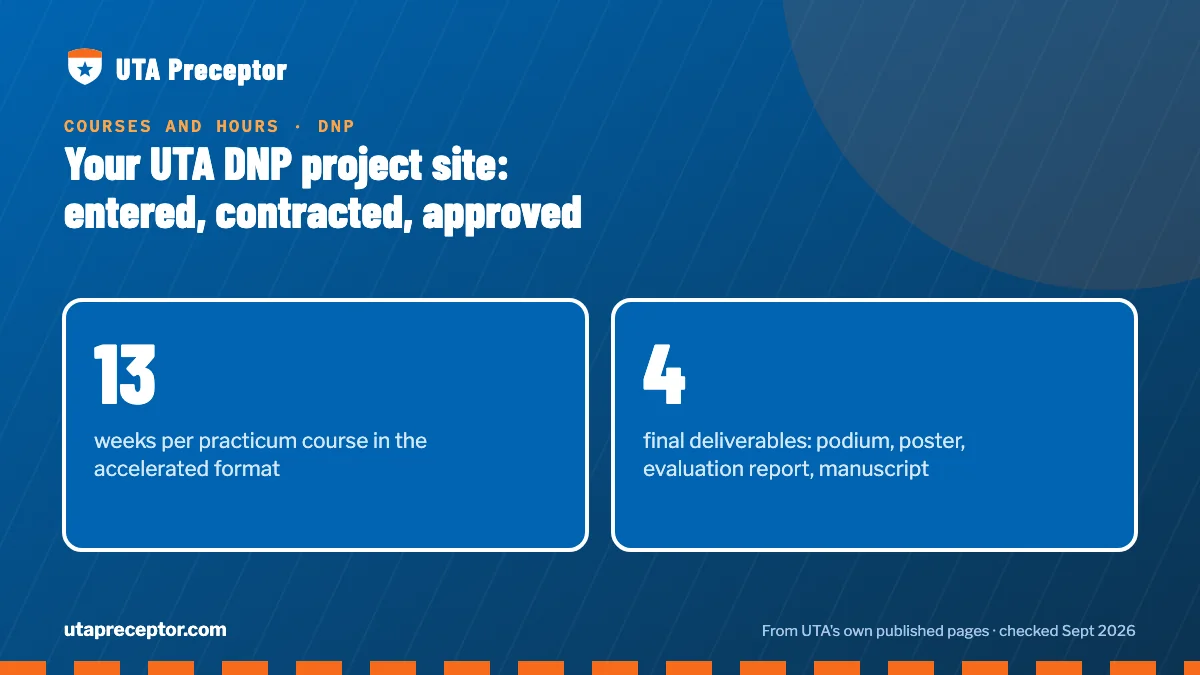
NURS 6326 | Project Proposal Development | 13 weeks | Full proposal written; reviewed by the Graduate Nursing Review Committee |
NURS 6620 | DNP Practicum I | 13 weeks | Project implemented at the approved site |
NURS 6621 | DNP Practicum II | 13 weeks | Project evaluated; virtual podium presentation and manuscript |
The program's final deliverables are a podium presentation, a poster presentation, a DNP Project Evaluation Report and a manuscript submitted for publication. How practice hours attach to these courses is on UTA DNP practice hours.
What an approved project site means
Three separate approvals have to line up before you can implement. None of them involves a preceptor.
- The site entry. You enter and investigate the site in the clinical management system. UTA says students may not implement “without having an approved project site in the clinical management system.”
- The contract. UTA's legal staff obtain a contract with the site. For how UTA's agency agreements work, see the affiliation agreement page.
- The site's own sign-off. The handbook warns: “The site may require additional IRB or administrative approval.” That is separate from anything UTA approves.
UTA does not publish how long a contract takes. As soon as you have a candidate site, ask your advisor and the site's contracts or legal contact what their timeline looks like, and whether the organization has signed agreements with UTA before.
GNRC review and the site's IRB
The Graduate Nursing Review Committee (GNRC), a subcommittee of UTA's IRB, reviews DNP proposals once a semester after NURS 6326. Once the GNRC approves, you enroll in NURS 6620 to implement.
Your site may run its own review as well. Hospitals and health systems with their own IRB, or organizations with a research or quality committee, can require approval before you collect data or change a process. Build that into your timeline, because UTA's approval does not replace theirs.
If your proposal passes NURS 6326 without GNRC approval, the catalog describes an alternate course, NURS 6333, in which faculty help you create the proposal. On completion, 180 practicum hours are applied to the practicums, the same credit an approved proposal earns.
Using your workplace as the project site
UTA's wording assumes some projects happen where students work. The catalog says it is the student's responsibility to tell the DNP program director and Academic Adviser after a job change, or if the project can no longer be completed at the work site.
That creates a trade-off. A workplace site brings access, data and goodwill, but your practice hours still have to fall outside your normal paid duties, and a job change mid-program can leave you needing a new site. If your employment feels uncertain, keep a second option in mind from the start.
No UTA source says in so many words that students find their own project site. The handbook does say you enter and investigate it, which in practice puts the first move on you. Ask your faculty project advisor early how much help the program gives with choosing a site.
Your mentor is faculty, not a preceptor
UTA's handbook says “Doctoral prepared (DNP/PhD) RN faculty may serve as DNP faculty project advisors.” That advisor approves your practice-hour objectives and the hours you log, and there is no external preceptor to recruit.
At the site you will likely have a contact who opens doors, such as a unit manager, a quality lead or an administrator. UTA does not describe a formal site-mentor role or set qualifications for one, so what that person does is between you, the site and your advisor.
Choose that contact with care all the same. The person who sponsors your project inside the organization can affect how quickly the contract, the site's own approvals and your access to data move.
How we help you land a project site
The DNP has no preceptor to place, so the search we run for DNP students is for the site itself. You, your advisor and UTA's legal staff carry the site from entry to contract to approval, and we lighten the front of that path by bringing you candidates that fit.
A placement advisor shortlists organizations that might host a project beyond your day job, then assembles the site details and contacts UTA needs when you enter it before NURS 6323 closes. If a job change forces a new site partway through, we pick that search up with you on the same basis. Your project stays your own, and UTA approves the site with the details it needs already in hand. To start, send the form below, or read the DNP program overview.
Questions UTA students ask
Can I change my DNP project site after NURS 6323?
UTA's public sources do not set out a change process. The catalog does require you to notify the DNP program director and your Academic Adviser if you change jobs or cannot complete the project at your work site. A new site would need its own entry and contract, so tell your advisor the moment a change looks likely.
Does UTA find DNP project sites for students?
UTA does not say either way. The DNP handbook has students enter and investigate the site, and the placement-assistance wording on UTA's NP pages is about preceptors, which the DNP does not use. Most of the early legwork falls to you, but ask your faculty project advisor what support the program offers before you assume you are on your own.
Can my DNP project site be outside Texas?
UTA's state map lists the DNP only for Arkansas, California, Colorado, Florida, New Mexico, Texas and Virginia. A site in another of those states may be possible, but check with UTA before you plan it, since state rules can limit where program work happens. Email NursingSOA@uta.edu early; out-of-state clinicals explains the state rules.
Is a DNP project site the same as an NP clinical site?
No. An NP clinical site comes with a preceptor, a Preceptor Agreement and preceptor approval by the Clinical Coordinator and/or course faculty. A DNP project site has a contract with UTA, UTA's own approval in the clinical management system and possibly the site's IRB, but no preceptor. The clinical placement process covers the NP path.
Related pages
Last checked 2026-09-23
We check these pages against UTA's own sources. UTA's current handbook and your course faculty have the final word.
Hand us the search. Keep your term.
Tell us your UTA track, your county and when your clinical course opens. We look for a preceptor and a site that fit what UTA asks for, and we help you put the approval packet together.
- Matched to your track's population and setting
- Paperwork prepared the way UTA's clinical team expects it
- In person near you, or a virtual option where your course allows it
Start your placement plan
A placement advisor replies with what a UTA-ready preceptor and site look like for you.