Affiliation agreements: the contract behind every UTA clinical site
UTA's College of Nursing and Health Innovation requires an affiliation agreement with a clinical agency before you can complete clinicals there. A willing preceptor at a site with no agreement can still leave you without a placement, because UTA doesn't publish how long a new agreement takes and some Texas systems aren't adding new ones.
Find a site that can take you
Tell us your track, county and start date. A placement advisor replies with how we'd check sites against UTA's rules.
What the agreement is and why UTA requires it
An affiliation agreement is a contract between UTA and the clinical agency where you train. UTA's online FNP page says the college “requires that an affiliation agreement be in place with clinical agencies” for you to complete clinicals, and notes that clinical sites may also require a written agreement or contract with CONHI.
The agreement carries more than signatures. UTA's Graduate Nursing Clinical Clearance Requirements policy says UTA “contracts with clinical agencies” and that its clearance requirements “are integrated into the affiliation agreement with each clinical agency.” That is why your immunizations, background check and drug screen matter to the site, not only to UTA.
It is also separate from what your preceptor signs. The individual clinician signs UTA's Preceptor Agreement; the agency itself is the party to the affiliation agreement. Both come on top of approval, which sits with the Clinical Coordinator and/or course faculty.
Why a site without one stalls you
A site with no agreement isn't necessarily a dead end, but it is a slow road. UTA doesn't publish how long a new agreement takes, who starts the request, or whether you may propose a site that has none. Earlier UTA syllabi (2016–2018) said students “may not be in clinical without having the appropriate affiliation agreement,” and the current online FNP page carries the same requirement.
Health systems publish their own timelines, and they aren't short. Cook Children's told its employees that new agreements “take about three months to fully execute.” University Health in San Antonio puts the average for a new agreement at six to eight weeks. Texas Children's asks licensed students, including MSN, APRN and DNP students, to file an Affiliation Agreement Inquiry no later than six months ahead of the start they want.
If your preceptor works somewhere UTA may not have an agreement with, raise it with your Clinical Coordinator the week you find out. Your clinical course starts on a fixed date whether the contract is ready or not.
Before you commit to a preceptor, ask two questions: does this agency have a current affiliation agreement with UTA, and does it cover your program? Some systems write agreements per college and degree program.
What Texas health systems publish
These are the systems' own public statements as of 2026. They change, so confirm with the site before you rely on any of them.
| System | What it says about agreements |
|---|---|
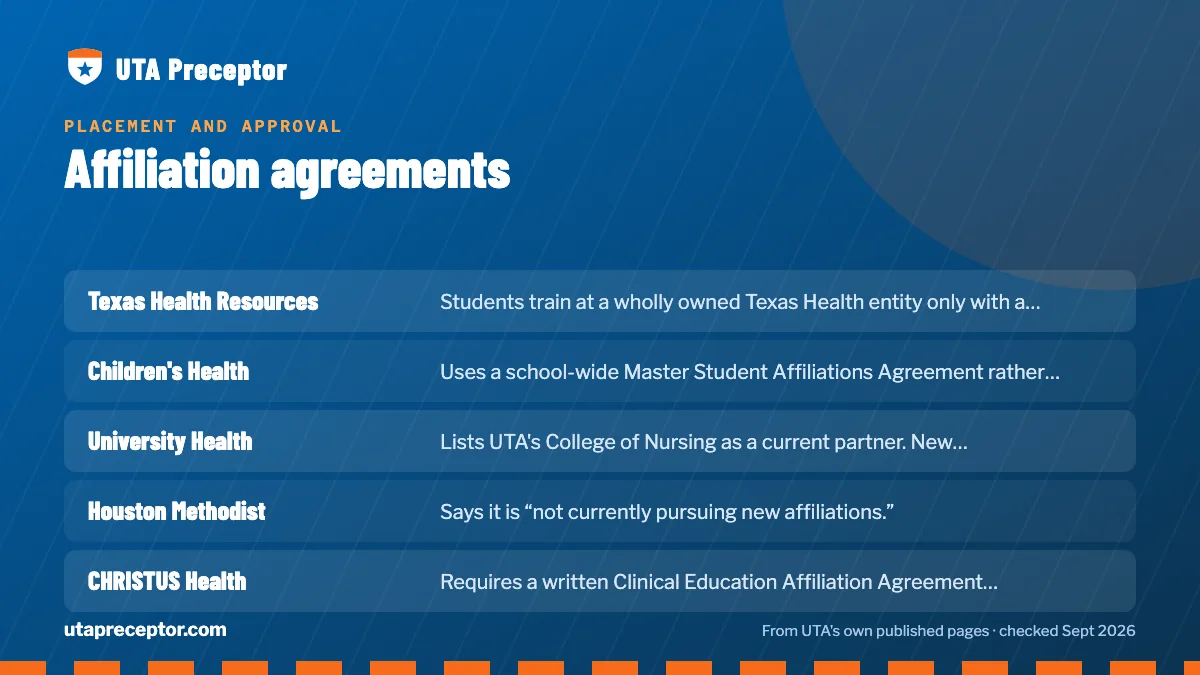
| Texas Health Resources | Students train at a wholly owned Texas Health entity only with a signed agreement. For students who aren't Texas Health employees, new agreement requests are considered only with a business case from the preceptor, signed by the entity president or CNO (archived page, April 2026). |
| Children's Health | Uses a school-wide Master Student Affiliations Agreement rather than department contracts. Its list shows a UTA biparty agreement dated 2/20/2024 to 2/19/2032. Its primary care clinic is “no longer accepting nurse practitioner students.” |
| University Health | Lists UTA's College of Nursing as a current partner. New agreements only for not-for-profit, Texas-based schools placing more than one student. |
| Houston Methodist | Says it is “not currently pursuing new affiliations.” |
| CHRISTUS Health | Requires a written Clinical Education Affiliation Agreement; CHRISTUS Good Shepherd tells students to confirm an active agreement with their school. |
| Cook Children's | Agreements are specific to the college and the degree program. |
Once an agreement exists, each system has its own onboarding: orientation modules, badges and request forms. Our DFW and Texas hospital onboarding page covers those steps.
What the agency can add on top of UTA's rules
Because clearance is written into the agreement, the agency has a say in who it accepts. UTA's clearance policy says clinical agencies “may develop additional requirements,” and UTA's Exxat compliance guide notes that your compliance items may be shared with clinical partners.
The sharpest example is vaccine exemptions. UTA takes two kinds of exemption paperwork, a medical declination waiver signed by a provider or, for conscience exemptions, a notarized affidavit from Texas DSHS, but says exemptions count only for admission to the university. The agency decides whether to take you. If it won't, UTA denies your self-placement request and pushes the clinical course back a semester. The full requirement list is on our UTA clinical clearance page.
Working at the agency doesn't exempt you from any of this. Cook Children's, for example, tells its own employees going back to school to confirm or initiate an affiliation agreement before a rotation. More on clinicals at your employer.
The Texas rule behind program–agency agreements
UTA's handbooks don't cite it, but Texas regulates these agreements for APRN programs. The rule is 22 Texas Administrative Code §219.10, “Management of Clinical Learning Experiences and Resources,” in the Board of Nursing's chapter on advanced practice nurse education, last amended effective December 9, 2018. Among other things, it says:
- Faculty set the criteria for choosing affiliating agencies, and select and evaluate them.
- Written agreements between the program and each agency spell out both sides' responsibilities, are developed jointly, are reviewed periodically and include termination notice.
- Preceptorships need their own written agreement, setting out what the program, the preceptor and, where it applies, the agency each do.
- Faculty remain responsible and accountable for managing students' clinical learning experiences.
Under that rule, choosing and evaluating agencies is a faculty job, which matches UTA's practice of approving every site itself.
DNP students: the project-site contract
DNP students don't use preceptors, but they still need a contract. The DNP Student Handbook sets a deadline: your project site has to be in the clinical management system before NURS 6323 Evidence Appraisal ends. The point is to leave the university's legal staff room “to obtain a contract with the project site.”
Until the site is approved in the system, you may not implement your project there, and the site may want its own IRB or administrative approval on top. If you change jobs and can't finish the project at your work site, the catalog says to tell the DNP program director and your Academic Adviser. Our DNP project site page covers the rest, including review by the Graduate Nursing Review Committee.
Checking a site before you commit, and why students choose us
The quickest way to lose a term is a willing preceptor at a site UTA can't use. Ask the preceptor or practice manager early whether the agency has a current agreement with UTA and whether it covers your program. Then confirm with your Clinical Coordinator, because only UTA can say what is on file.
That early check is built into every search we run. We raise the affiliation question with the site at the start, before you file a request, and tell you what we learn, so a site without an agreement surfaces before it can cost you a request. UTA confirms the agreement and approves the site, and the site details it needs are gathered by the time you submit. To see where this falls in your calendar, read the UTA clinical placement timeline, or use the form below.
Questions UTA students ask
Does a small private practice need an affiliation agreement with UTA?
UTA's public wording doesn't carve out small practices: it requires an agreement with clinical agencies before you complete clinicals there. Whether a solo clinic counts as an agency, and what form its agreement takes, isn't published. Ask your Clinical Coordinator as soon as you have the practice's legal name and address, before the preceptor spends time on your paperwork.
How do I find out whether a hospital already has an agreement with UTA?
Some systems publish lists. Children's Health posts its Master Student Affiliations Agreement list and University Health posts its education partners, and both name UTA. Elsewhere, ask the site's student placement or academic affiliation contact, then check with your Clinical Coordinator, since an agreement can exist without covering your program.
Can I start clinicals while the agreement is still being signed?
No. UTA requires the agreement to be in place for you to complete clinicals at the agency, and some systems, such as Texas Health Resources, say students can train only once a signed agreement exists. If the contract won't be done by your start date, talk to your Clinical Coordinator about another site or a later term.
Does the agreement rule apply if my site is outside Texas?
Yes. UTA's published requirement doesn't distinguish Texas agencies from out-of-state ones. An out-of-state site adds two more checks: it has to be in a state where UTA's program can operate, and you must hold an RN license valid there. Email NursingSOA@uta.edu before you look for a preceptor in another state.
Is getting the affiliation agreement my job or UTA's?
UTA doesn't say who starts one. The contract itself is between UTA and the agency, so you can't sign it for either side. What some Texas systems do put on students is the checking: CHRISTUS Good Shepherd, for example, tells students to confirm with their school that an active agreement exists. Find out early and flag any gap.
Related pages
Last checked 2026-09-23
We check these pages against UTA's own sources. UTA's current handbook and your course faculty have the final word.
Hand us the search. Keep your term.
Tell us your UTA track, your county and when your clinical course opens. We look for a preceptor and a site that fit what UTA asks for, and we help you put the approval packet together.
- Matched to your track's population and setting
- Paperwork prepared the way UTA's clinical team expects it
- In person near you, or a virtual option where your course allows it
Start your placement plan
A placement advisor replies with what a UTA-ready preceptor and site look like for you.