UTA's online RN-to-BSN: short courses, no preceptor
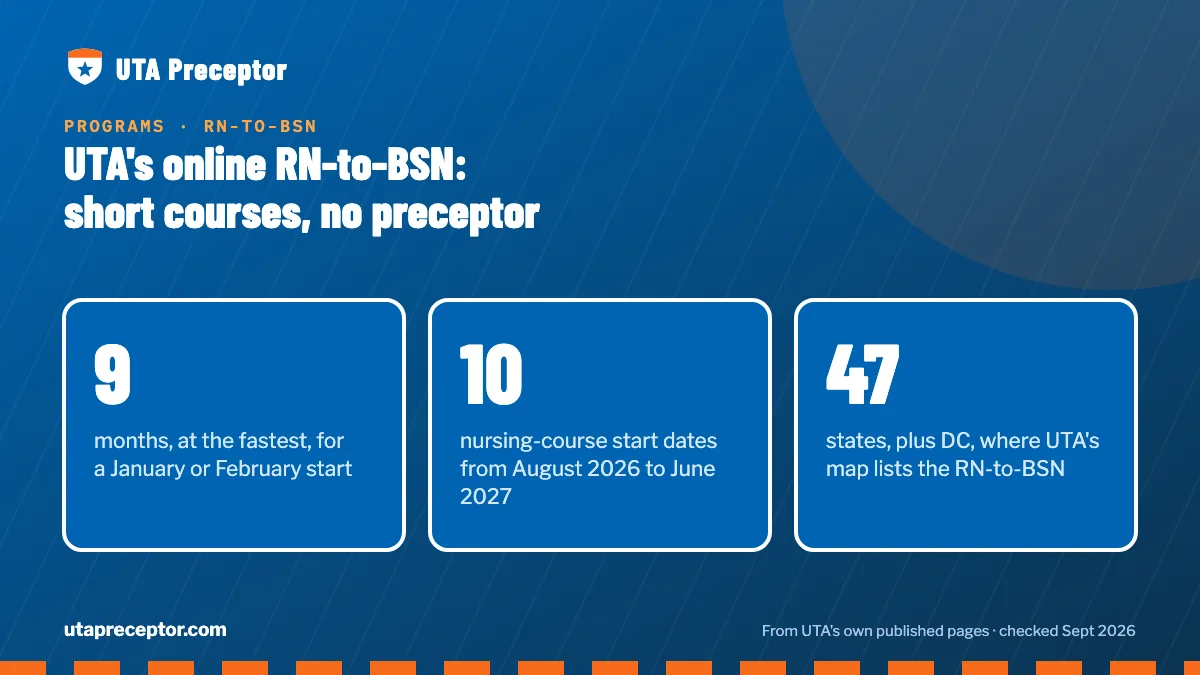
UTA's online RN-to-BSN lets a working nurse finish the nursing coursework in as few as 9 months, one short course after another. Five of its courses put your learning to work on the job or in your community, and none of them requires you to find a preceptor. What you do need is a license in good standing and an address in a state UTA enrolls from.
Check your RN-to-BSN setup
Tell us which course is next and what, if anything, you are missing. A placement advisor replies honestly about whether outside help makes sense for you.
How the program is put together
UTA runs the RN-to-BSN in two formats, accelerated online and campus-based, and the catalog notes that it is not a limited-access program. The campus version meets in person on Wednesdays, juniors during the fall semester and seniors during the spring. Everything below concerns the online format.
Online, each nursing course lasts 5 weeks except the capstone, NURS 4685, which lasts 7. Medical Terminology (NURS 3309) and the general-education courses run 8 weeks. UTA describes the nursing coursework as 9 classes worth 32 credits, alongside 51 credit hours of general education and 9 of upper-division electives, one of which has to be a nursing course.
The credit figures do not all agree. The online program page shows 35 credit hours in its header, while the catalog puts the full degree at 121 hours and awards 29 hours for associate degree nursing coursework on admission. Your degree plan, not a program summary, is the number to work from.
Start dates and the pace
UTA's quickest timeline is 9 months if you begin in January or February, and 10 months if you begin in any other month. Reaching it means taking the 5-week courses back to back, so a course that depends on workplace access or a community contact can open before you have had time to arrange either.
The online calendar lists ten nursing-course start dates between August 2026 and June 2027, then keeps going:
- 2026: August 17, August 31, September 21 and November 2
- 2027, first half: January 11, January 25, February 22, March 29, May 17 and June 28
- 2027, second half: August 23, September 6, October 4 and November 8
With courses this short, look two courses ahead rather than one. If the course after next is a community course, start contacting organizations while you are still finishing the current one.
Where the practice work happens
UTA's program FAQ says the RN-to-BSN has no traditional supervised clinical experiences. Five nursing courses include application-based practice instead, and one elective places you in your work environment for a set number of hours.
| Course | Setting UTA names | Online length |
|---|---|---|
NURS 3315 Holistic Health Assessment Across the Lifespan | Workplace | 5 weeks |
NURS 3325 Holistic Care of the Older Adult | Community | 5 weeks |
NURS 4455 Nursing Leadership & Management | Workplace | 5 weeks |
NURS 4465 Population and Community Health Nursing | Community | 5 weeks |
NURS 4685 Capstone | A focus you pick: management, clinical or education | 7 weeks |
NURS 3300 Cooperative Nursing Work Experience (elective) | On the job, 120 hours minimum | 5 weeks |
UTA publishes no hour count for the five core courses. What past syllabi asked students to do in each one, and how to prepare each setting, is laid out on RN-to-BSN practice experiences.
Who you need, and who you don't
You do not need a preceptor. UTA's program FAQ ties that directly to the format: because the practice work happens at your job or in your community, there is no preceptor for you to line up. Students may finish that work with a report or a project shared with faculty and classmates.
What you need instead are settings and a few cooperative people: an employer that lets you apply assessment and leadership coursework on the job, a community organization that serves older adults or a defined population, and a topic you care about for the capstone. For the NURS 3300 co-op, earlier UTA syllabi also asked for a supervisor who would evaluate you and verify your hours.
Unlike UTA's nurse practitioner tracks, which limit clinical hours at your own employer, the RN-to-BSN is built around your job. UTA's online page says clinical requirements are met through application-based assignments completed in your workplace.
Don't spend weeks recruiting a preceptor for the RN-to-BSN. UTA does not ask for one; spend that time lining up workplace access and a community contact.
Which states can enroll
UTA's state-authorization map lists the RN-to-BSN for 47 states and the District of Columbia. The three states left off are Tennessee, Washington and Wisconsin, and Puerto Rico is not listed either. UTA works out your state from the mailing address on file in MyMav.
According to UTA's state-authorization page, the RN-to-BSN does not lead to licensure; you study on the RN license you already hold. Its list is far longer than the seven states open to UTA's nurse practitioner programs, and far longer than the single state, Texas, listed for UTA's prelicensure BSN.
Moving mid-program is where state rules bite. UTA's online page warns that enrolled students living in an ineligible state need UTA's approval to continue without interruption, and it does not promise that approval. Check the state guide before you relocate, and ask NursingSOA@uta.edu, UTA's state authorization contact, if your new state is in doubt. Out-of-state clinicals sets the RN-to-BSN list beside UTA's other programs.
Not the same as UTA's online BSN
UTA also runs an online BSN, and search results mix the two up. That program is a 51-credit accelerated prelicensure BSN, meaning it prepares students for their first nursing license, and its clinicals work in a completely different way.
In the online BSN, UTA places students in supervised clinical experiences at select partner hospitals in Texas metropolitan areas, taking partnerships and submitted preferences into account, and UTA's map lists that program for Texas only. In the RN-to-BSN, nobody places you, because there is no supervised clinical to place: your job and your community carry the practice work.
If something you are reading describes assigned hospital clinicals, or priority for students employed by a partner hospital system, it is describing the BSN rather than the RN-to-BSN.
What UTA does not publish for this program
A few things you might expect to find are missing from UTA's public pages. Ask your academic advisor or course faculty instead of guessing, ideally before the course in question opens.
- Hour counts for the practice work in the five core nursing courses.
- Whether a background check, immunizations, a drug screen or a tracking platform applies to this program at all. The clearance list in the undergraduate handbook is written for prelicensure BSN students.
- Whether a community organization you work with needs an agreement with UTA or any formal sign-off.
- Whether the catalog's medical insurance rule for students in clinical courses reaches these application-based courses.
- Current syllabi. The public ones date from 2016 to 2018, so assignment details drawn from them may have changed.
Where outside help fits
For most students in this program, the honest answer is that you will not need a placement service. There is no preceptor to find, and a nurse with a current job already has the main setting these courses rely on.
A placement advisor can be useful in a few specific cases. You may have moved recently and know no local agencies for NURS 3325 or NURS 4465, or you may be between nursing jobs when a workplace course comes up. In those cases we can identify community organizations or settings near you that match the course description, so you can make contact before a 5-week course opens. Your faculty judge the work, and we promise no outcome.
If you plan to continue into one of UTA's nurse practitioner tracks through the RN-to-MSN, the graduate clinical courses are where a preceptor search really begins. Use the form below if either situation applies, or read how our process works first.
Questions UTA students ask
Does UTA's RN-to-BSN require a Texas nursing license?
No. The catalog asks for a current, unencumbered RN license in the U.S.A., and the online page asks for proof of an active, unencumbered license that can be verified through Nursys or a state board of nursing. The undergraduate handbook adds that the license must stay unencumbered for you to remain an active student.
Can I enroll in UTA's online RN-to-BSN if I am not a U.S. citizen?
Possibly. UTA's online page says the program is open to U.S. citizens, lawful permanent residents and people who hold an H1-B visa or another valid U.S. work visa. Other statuses are not listed. If your immigration status is changing, confirm eligibility with UTA admissions before you apply.
What is the TSI requirement for UTA's RN-to-BSN?
UTA's online page says the Texas Success Initiative (TSI) must be completed. It will not stop you being admitted, but you have to satisfy it during your first semester. Ask your academic advisor in your first weeks how you can meet it, so it does not sit unresolved while your nursing courses move quickly.
Is the NURS 3300 co-op course required?
UTA lists it as an elective. The program includes 9 hours of upper-division electives, one of which must be a nursing course, and the co-op is one option. It asks for a minimum of 120 hours on the job within a 5-week course, about 24 hours a week by our arithmetic, so it suits nurses with steady hours at work.
Does UTA help RN-to-BSN students find community agencies?
UTA's published placement-assistance wording appears on its graduate program pages, not the RN-to-BSN pages, and nothing public describes help with community settings for this program. Your course faculty are the right first contact if you cannot find a suitable workplace or community setting, and they can tell you what the assignment will accept.
Related pages
Last checked 2026-09-23
We check these pages against UTA's own sources. UTA's current handbook and your course faculty have the final word.
Hand us the search. Keep your term.
Tell us your UTA track, your county and when your clinical course opens. We look for a preceptor and a site that fit what UTA asks for, and we help you put the approval packet together.
- Matched to your track's population and setting
- Paperwork prepared the way UTA's clinical team expects it
- In person near you, or a virtual option where your course allows it
Start your placement plan
A placement advisor replies with what a UTA-ready preceptor and site look like for you.