The six clinical policies UTA posts in Exxat
UTA's MSN and PMC handbook tells graduate students to follow six clinical policies posted in the clinical management system, Exxat. Only one of them, the Clinical Clearance Requirements, turned up on UTA's public website. Here is what each one governs and where to read the rest.
Match your search to UTA's rules
Tell us your track and course. A placement advisor replies with what a preceptor and site that fit UTA's policies look like for you.
Six policies, one place to read them
The MSN and PMC Student Handbook (Academic Year 2024-2025, revised January 2025) lists the clinical policies students must follow and says they are posted in the clinical management system. UTA's Exxat page says Exxat “houses all policies, procedures, and resources” for clinical compliance and self-placement requests.
- UTA MSN Clinical Practicum Acknowledgement
- Graduate Student Clinical Placement Policy and Procedure
- Graduate Student Clinical Performance Policy
- Graduate Student Clinical Site and Preceptor Policy
- Students Experiencing Difficulties with Clinical Placements
- Graduate Nursing Clinical Clearance Requirements Policy
The DNP Student Handbook lists the same set minus the first. Log in at steps.exxat.com with UTA single sign-on and start with the Resources tile. Some UTA program pages still say these policies live in “InPlace”; archived copies suggest that sentence is older than UTA's Exxat page. More on the system is on Exxat at UTA.
What each policy governs
UTA does not publish the text of five of the six, so the middle column is based on each title and on the public UTA text that covers the same ground. The Exxat version is the one that binds you.
| Policy | What it governs | Read more |
|---|---|---|
| UTA MSN Clinical Practicum Acknowledgement | What MSN students accept about clinical placement before they start, including who searches first | Section below |
| Graduate Student Clinical Placement Policy and Procedure | The self-placement route: a MyRequest in Exxat, faculty and coordinator review of the preceptor and site, the Preceptor Agreement and affiliation agreements | Exxat MyRequest |
| Graduate Student Clinical Performance Policy | Clinical conduct, evaluation and clinical failure | Section below |
| Graduate Student Clinical Site and Preceptor Policy | Who may precept and which sites qualify | Preceptor requirements |
| Students Experiencing Difficulties with Clinical Placements | How UTA assists a student who cannot secure a placement | Placement assistance |
| Graduate Nursing Clinical Clearance Requirements Policy | Immunizations, background check, drug screen, CPR, FERPA release and deadlines | Clinical clearance |
The one you can read now: Clinical Clearance Requirements
The clearance policy is a public PDF linked from UTA's program pages, showing “Last Date of Approval: 1/7/2022”. Its scope is MSN Education, MSN Nurse Practitioner and DNP students; MSN Administration is not named.
- Timing: the policy starts a 60-day compliance clock at admission, while UTA's Exxat page starts it with your first graduate course and sets the background check and drug screen aside. Go by whichever date comes first.
- The requirements are built into each affiliation agreement, and agencies “may develop additional requirements”.
- A medical exemption needs a declination waiver signed by a provider; a conscience exemption needs a notarized Texas DSHS affidavit, even if you live outside Texas.
- If an agency refuses your exemption, UTA denies the self-placement request and your course slides back a semester.
- You pay all clearance costs, from vaccines and titers to the background check and drug screen.
- Noncompliance can mean a registration hold, a delayed course, a denied placement, removal from the site or course failure.
The item-by-item vaccine list is not in the public PDF. It is tracked in Exxat.
Performance: where clinical failure is defined
The Performance policy text is not public, but the handbook and UTA's current-student page set out the rules around it. Faculty “will investigate all allegations and concerns of all unsafe clinical behavior”, and being dismissed from a site by your preceptor for unsafe behavior counts as a clinical failure.
Each clinical course ends with your instructor scoring you on the Clinical Evaluation of Student tool, where a pass is 80%. The standard tightens across the sequence: “Meets Expectation with Moderate Assistance” is the Clinical Practice 1 target and “Meets Expectation with Minimal Assistance” the Clinical Practice 2 target, each on 80% of scored items.
The handbook also treats falsified information in a placement-assistance request as reportable to the Board of Nursing. Accurate hours, logs and requests are part of your clinical record, not just paperwork.
The Acknowledgement and the Difficulties policy
These two shape what you can expect from UTA during the search, and we could not read either in full. A student-shared copy of the Acknowledgement from about 2022, visible to us only in part, points students to their professional network first and places responsibility on the College when a student runs into difficulty.
That fits UTA's public line that the Department of Graduate Nursing helps students who are experiencing difficulty with placement. What neither public source gives is the working detail: how to ask, what evidence to show and how long it takes.
That detail is why the Exxat versions are worth reading before your first clinical term, not after a problem starts. The MSN Education online page says placement policies are available in Exxat upon admission, so there is no reason to wait.
The handbook says you must follow these policies. Read all six in Exxat before your first clinical term, not after a problem.
Using the policies when something goes wrong
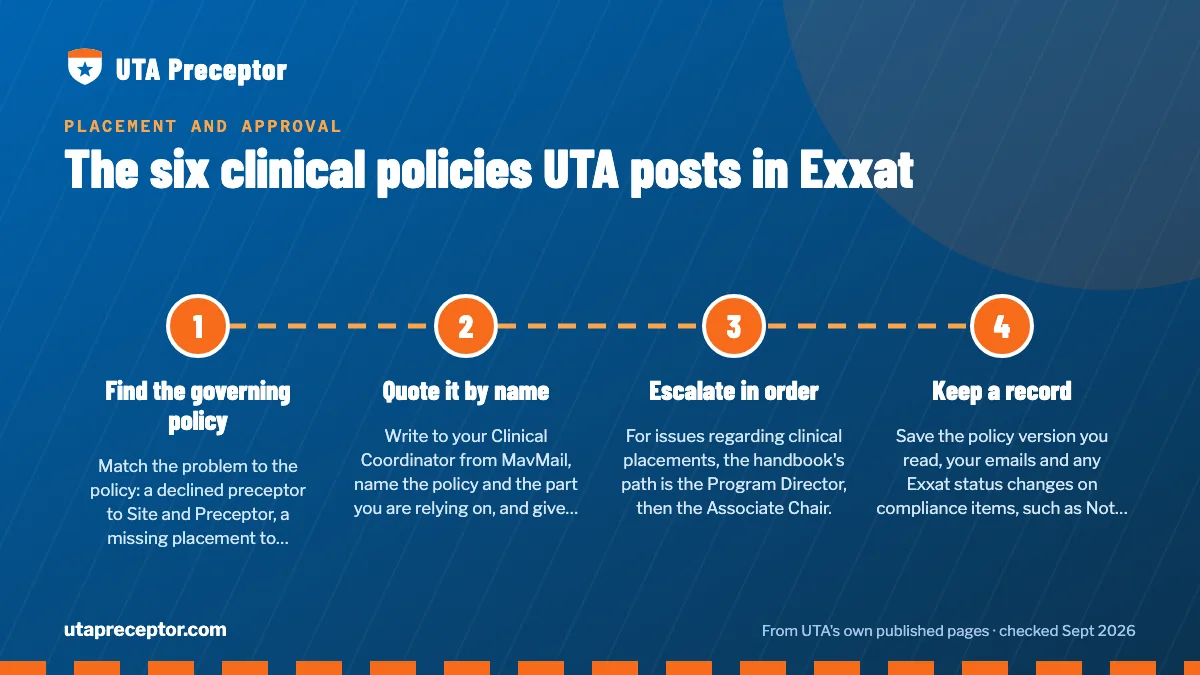
When a preceptor cancels, a site stalls or a request is denied, the matching policy tells you what UTA expects next. Use it as your script.
- Find the governing policyMatch the problem to the policy: a declined preceptor to Site and Preceptor, a missing placement to Difficulties, an expired immunization to Clearance.
- Quote it by nameWrite to your Clinical Coordinator from MavMail, name the policy and the part you are relying on, and give your course number and dates.
- Escalate in orderFor issues regarding clinical placements, the handbook's path is the Program Director, then the Associate Chair.
- Keep a recordSave the policy version you read, your emails and any Exxat status changes on compliance items, such as Not Approved or Expiring.
When you work with our placement desk, we ask what your course's policies say about preceptor types and sites, so our search matches the version UTA will apply. If a preceptor has already pulled out, preceptor dropped out walks through the next steps.
Questions UTA students ask
Where do I find UTA's graduate clinical placement policies?
In Exxat, UTA's graduate clinical management system. Log in at steps.exxat.com with UTA single sign-on and open the Resources tile, which holds UTA's compliance and self-placement material. The MSN Education online page says the placement policies are available upon admission, so you can read them well before your first clinical course.
Are UTA's clinical policies available to the public?
Mostly not. The Graduate Nursing Clinical Clearance Requirements policy is posted publicly as a PDF. We found no public copy of the other five, including the Clinical Site and Preceptor Policy and the Difficulties policy; they are posted in Exxat for enrolled students. Prospective students can ask their program's advising contact how placement works.
Do UTA DNP students follow the same clinical policies?
Largely. The DNP Student Handbook lists five of the six: everything except the UTA MSN Clinical Practicum Acknowledgement. DNP students do not use preceptors, so the site rules matter mainly for the DNP project site, which has to be in Exxat before NURS 6323 Evidence Appraisal ends.
What happens if a preceptor dismisses me from a UTA clinical site?
If the dismissal is for unsafe behavior, the handbook counts it as a clinical failure, and faculty investigate concerns about unsafe clinical behavior. A preceptor ending the arrangement for their own reasons is a different situation. Either way, tell your Clinical Coordinator the same day and follow the placement policies in Exxat.
Is UTA's clinical system Exxat or InPlace?
Current UTA sources point to Exxat. UTA's Exxat page describes it as the system for compliance, self-placement requests, logbooks and timesheets, and newer online program pages name it. Several uta.edu program pages still say InPlace, but archived copies show that sentence dates back to at least May 2021, well before the first archived copy of UTA's Exxat page in October 2022.
Related pages
Last checked 2026-09-23
We check these pages against UTA's own sources. UTA's current handbook and your course faculty have the final word.
Hand us the search. Keep your term.
Tell us your UTA track, your county and when your clinical course opens. We look for a preceptor and a site that fit what UTA asks for, and we help you put the approval packet together.
- Matched to your track's population and setting
- Paperwork prepared the way UTA's clinical team expects it
- In person near you, or a virtual option where your course allows it
Start your placement plan
A placement advisor replies with what a UTA-ready preceptor and site look like for you.