Finding an adult and older-adult primary care preceptor at UTA
UTA's Adult-Gerontology Primary Care NP track needs preceptors who manage adolescents, adults and older adults in primary care or long-term care, across three clinical courses and 720 hours. The population is narrower than a family practice, which helps you pitch the right practice and hurts if you pick the wrong one.
Get your placement plan
Tell us your UTA track and where you live. A placement advisor replies with what a UTA-ready preceptor and site look like for you.
Formats, time to finish and the admission rule
UTA runs the 41-credit AGPCNP MSN in both of its formats. Online, courses come one at a time with several starts a year, and the quickest finish UTA Online advertises is “As few as 29-33 months”; clinicals, in UTA's words, “Will Depend on Your Own Clinical Arrangements.” The campus-based version admits students in fall and spring, pairs online work with some in-person class time, and gives full-time students a 24- to 36-month window.
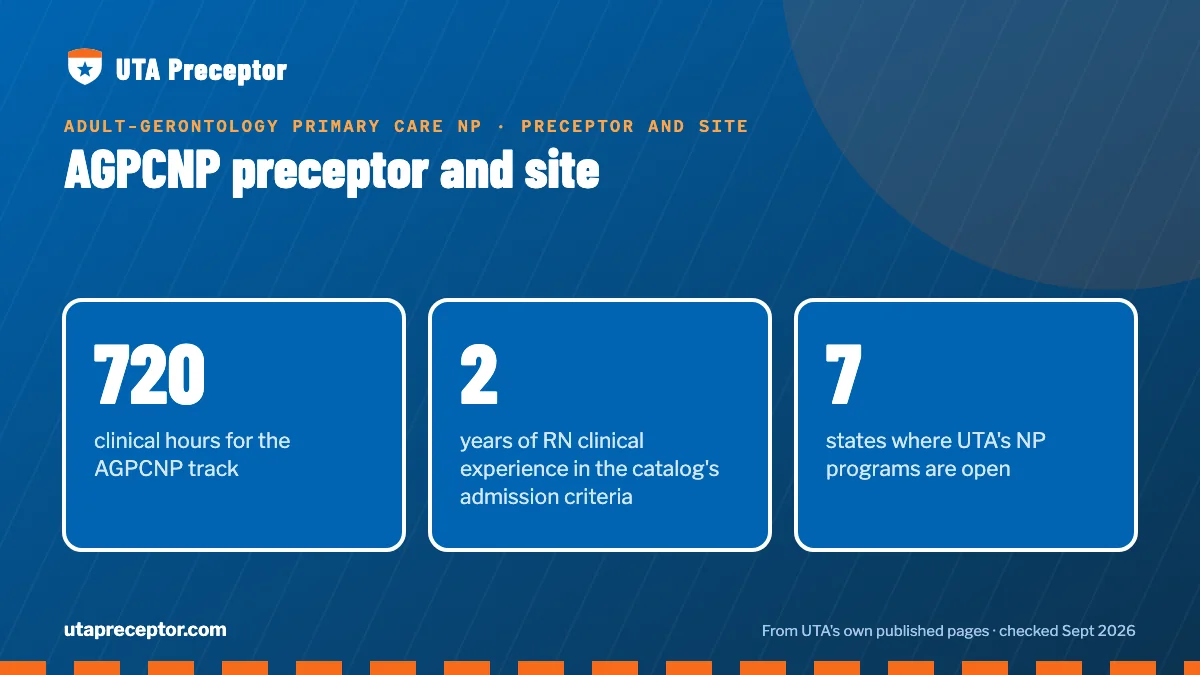
The catalog's admission list for AGPCNP includes two years of clinical work as an RN, along with CPR and statistics. It does not say the experience has to be in primary care, and UTA Online's AGPCNP admission list does not mention experience at all. You may therefore start the program from a hospital job with few outpatient contacts, and the search has to build them.
The clinical sequence and its 720 hours
Three courses carry every AGPCNP clinical hour. The table maps them; the AGPCNP clinical courses guide covers prerequisites, the certificate and the dual track.
| Course | Title | Online length | Where the catalog sets it |
|---|---|---|---|
NURS 5352 | Adult Gerontology Primary Care Clinical Practice 1 | 11 weeks | Primary and long-term care settings |
NURS 5353 | Adult Gerontology Primary Care Clinical Practice 2 | 11 weeks | The same settings, continued |
NURS 5645 | Adult Gerontology Primary Care NP Advanced Practicum | 13 weeks | Adult-gerontology primary care practice |
UTA's figure for the track is 720 clinical hours, from a 2020-21 course list that UTA's program page still links. No UTA source splits it by course, and FNP's 180, 180 and 360 are not a safe template; the syllabus in Canvas gives the number you are graded against. What counts is the same as in every UTA NP track: direct patient care toward the minimum, and no waived hours.
An adult and older-adult preceptor, in primary or long-term care
In the catalog, the first two courses cover patients from adolescence through old age with “common episodic acute and chronic health care needs,” seen in “primary and long term health care settings.” That opens two kinds of site: an outpatient practice with a largely adult panel, and a long-term care facility where an NP or physician manages residents. Either can carry a course once the preceptor and site are approved.
For AGPCNP, as for every track, UTA's public preceptor rules stop at two items: the provider's license must be current with no encumbrance on it, and they need at least 12 months of clinical experience in the specialty role. For this track even the historical record is quiet, since none of the older UTA syllabi in our research names AGPCNP preceptor types, and the per-course lists stay inside Exxat. UTA preceptor requirements covers what is public.
Texas rule adds one useful test. The Board of Nursing's preceptor definition requires ongoing practice in the role and population the student is training for, which favors clinicians whose own work is adult and older-adult primary or long-term care. Whether UTA accepts a family NP or a physician for a given course is on that course's list, so ask before you pitch.
Your own employer is an option when its setting matches the course, with UTA's two exclusions: not the department you work in, and not your current supervisor.
Where Texas AGPCNP students look
Three site types recur across the Texas regions in the research behind this site. None of the names below is a claim that an organization takes UTA students; they show where adult primary care happens.
- VA health care systems, whose patients are veterans: VA North Texas in Dallas–Fort Worth, the Michael E. DeBakey VA Medical Center in Houston, South Texas Veterans Health Care System in San Antonio, Central Texas Veterans Health Care System in Temple and Waco, and VA systems or clinics in El Paso, Lubbock, Amarillo, Tyler and the Valley.
- Community health center networks, the same FQHCs listed on our FNP preceptor page. There, the preceptor's own panel matters more than the clinic's name.
- Long-term care facilities, which the catalog names outright for
NURS 5352andNURS 5353. Each needs an affiliation agreement with UTA, like any clinical agency.
Supply is thinnest where the need is highest. DSHS counted 40 Texas counties with no primary care physician and 20 with no NP in 2025, and it projects East Texas's unmet primary care physician demand at 51% by 2036. HRSA's data shows whole-county primary care shortage designations in 27 of the 44 counties in DSHS Region 1, around Lubbock and Amarillo.
Competition is real too. In the state's 2025 survey of graduate nursing programs, lack of preceptors was the most heavily ranked reason for turning away qualified applicants, and 27 Texas programs offer a master's FNP whose students also need primary care preceptors.
Which states the AGPCNP track is open in
The AGPCNP sits under UTA's MSN nurse practitioner listing on its state map, which names seven states: Arkansas, California, Colorado, Florida, New Mexico, Texas and Virginia. The same limit applies to where your clinical site is, and UTA counts the mailing address in MyMav as your state.
If a good adult practice sits across a state line, email NursingSOA@uta.edu before you approach it; UTA's handbook asks for that before you seek a preceptor in another state, move or take a travel job, and it covers students near a border who want clinicals outside their home state. You also need an RN license valid in the site's state, through a compact license or by getting that state's license yourself. Out-of-state clinicals has the detail.
When to start the AGPCNP search
Have a preceptor lined up by your Pharmacology course at the latest. That is UTA's General MSN deadline, and UTA's online FAQ adds a separate recommendation: open the search 12 to 16 weeks before the first clinical course begins. For AGPCNP that course is NURS 5352, which the catalog lets you take alongside NURS 5462, so check in MyMav how close your specialty coursework and first clinical course sit.
Long-term care placements carry their own lead time. A facility new to UTA needs an affiliation agreement before you can start, and UTA does not publish how long a new one takes. The Texas health systems that do publish a figure range from 6 to 8 weeks on average at University Health to about three months at Cook Children's.
The placement timeline orders UTA's own steps, from the MyRequest in Exxat through to a Preceptor Agreement signed and handed in before you see a patient.
Before you commit to a family practice, ask what share of its panel is adolescents, adults and older adults. Those are the patients UTA's AGPCNP courses are built around.
What AGPCNP students get from us
The placement desk looks near you for a clinician whose patients are mostly adolescents, adults and older adults, in a clinic or a long-term care facility, and asks about the patient mix before we suggest anyone. We help gather the documents UTA's reviewers ask for (resume, license check, agreement forms, facility details), and if a preceptor leaves before your hours are done, we start a replacement search. If you want both a clinic and a long-term care facility across the three courses, we can plan the order from the start so the two rotations don't compete for the same weeks.
UTA makes the call on every preceptor, site and agreement; the file we help you build answers its patient-mix and document questions before it has to ask. How it works describes each step on our side; the form below takes your course number and county.
Questions UTA students ask
Can a family nurse practitioner precept UTA AGPCNP students?
UTA hasn't said publicly. Its preceptor rules ask for a license in good standing plus a year of experience in the specialty role, and each course's list of acceptable preceptor types sits in Exxat. Texas Board of Nursing rules look for current practice in the role and population focus. If the FNP's patients are mostly adults, check with your Clinical Coordinator first, then approach the FNP.
Can I do AGPCNP clinicals at a VA clinic?
UTA's public pages don't mention VA facilities either way. A VA clinic goes through the same UTA steps as any site: a preceptor who meets UTA's minimums, approval by the Clinical Coordinator and/or course faculty, and an affiliation agreement with the agency. The research behind this site did not cover the VA's own rules for NP students, so ask the facility early how it handles them.
How is the AGPCNP different from UTA's adult-gerontology dual track?
The dual adds acute care. UTA lists it as campus-based, with 54 credits and 1,260 clinical hours on its 2020-21 course list, and its clinical courses pair NURS 5353 and NURS 5645 with the three acute care courses. It also asks for two years of recent acute care RN experience. The dual NP tracks page explains the sequence.
Which certification exams match UTA's AGPCNP in Texas?
The Texas Board of Nursing lists two adult-gerontology primary care exams: ANCC's A/GPCNP and AANPCB's A-GNP, with no preference between certifiers. Certification must stay current, and new graduates cannot practice as APRNs in Texas until they are both certified and licensed. The license application includes documentation of your clinical hours from your program.
Do UTA AGPCNP students have to come to campus?
Not in the accelerated online format: UTA's comparison table calls its coursework “100% Online” and says there is no requirement to attend class on campus. The campus-based format mixes online, hybrid and in-seat courses, and its hybrid courses typically hold about three in-person meetings. UTA also notes that some graduate programs schedule required courses or events on Saturdays, so ask the program director.
Related pages
Last checked 2026-09-23
We check these pages against UTA's own sources. UTA's current handbook and your course faculty have the final word.
Hand us the search. Keep your term.
Tell us your UTA track, your county and when your clinical course opens. We look for a preceptor and a site that fit what UTA asks for, and we help you put the approval packet together.
- Matched to your track's population and setting
- Paperwork prepared the way UTA's clinical team expects it
- In person near you, or a virtual option where your course allows it
Start your placement plan
A placement advisor replies with what a UTA-ready preceptor and site look like for you.