How it works, in the order UTA works
You tell us your UTA track, course and start date. We find a preceptor and site that fit, check them against UTA's published minimums and assemble what the Clinical Coordinator reviews. You then file the request in Exxat, UTA gives the final approval, and if a preceptor ever drops, we are straight back on the search.
Get your placement plan
Tell us your UTA track and where you live. A placement advisor replies with what a UTA-ready preceptor and site look like for you.
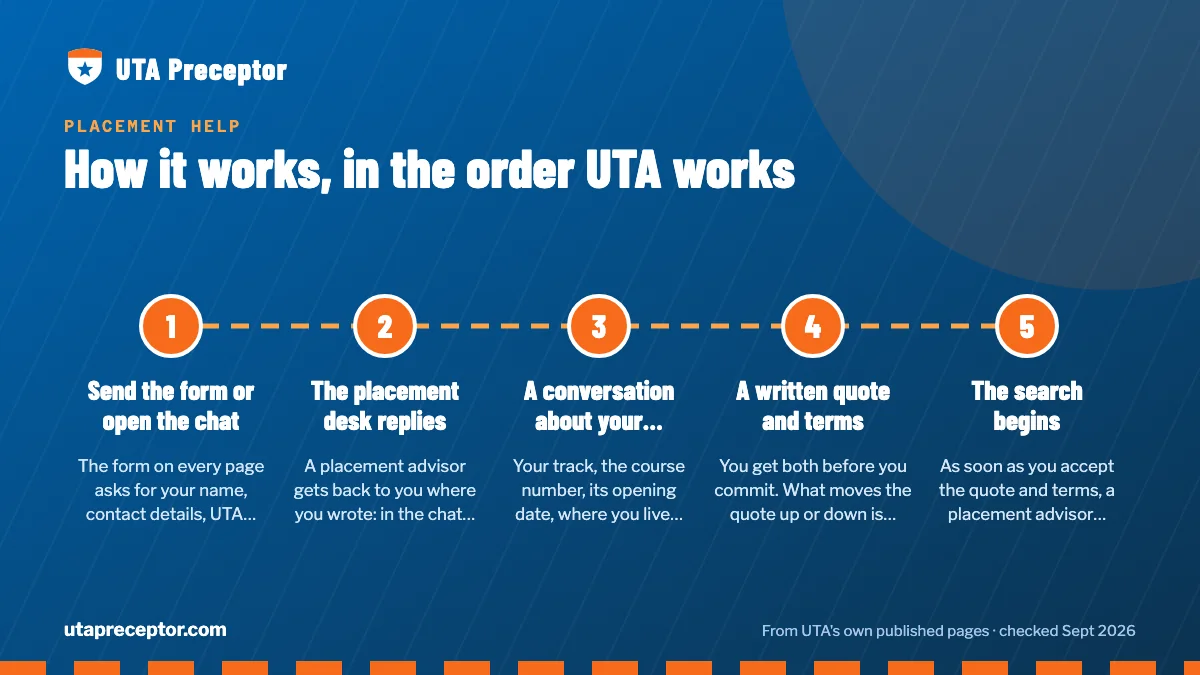
Getting started: from first message to written quote
Before any searching starts, you see in writing exactly what you are getting, and the choice to go ahead is yours.
- Send the form or open the chatThe form on every page asks for your name, contact details, UTA program, when your clinicals start, and your city and state. The chat suits a quick question first.
- The placement desk repliesA placement advisor gets back to you where you wrote: in the chat, or by text or email.
- A conversation about your placementYour track, the course number, its opening date, where you live and how far you can travel, and whether your faculty would consider anything virtual.
- A written quote and termsYou get both before you commit. What moves the quote up or down is explained on our cost page.
- The search beginsAs soon as you accept the quote and terms, a placement advisor starts work on your course.
Step 1: your track, course and term
The course number drives everything that follows. UTA's online FAQ notes that acceptable preceptor categories differ from one clinical course to the next, and the population changes by track: family primary care for FNP, adults and older adults in acute or primary care for the AG tracks, birth to 21 for the pediatric tracks, and psychiatric settings for PMHNP.
Hours and weeks matter as much as the specialty. An FNP student placing NURS 5660 needs a preceptor who can host 360 hours across a 13-week online course, which is a different request from the 180 hours of NURS 5337 in 11 weeks.
Step 2: the search for a preceptor and site
In-person placement near you is the main route, and it is where most of our effort goes. We look for a preceptor whose practice matches your track's population and setting, at a site within reach of where you live, with room to host your hours across the weeks your course runs.
Some limits on location come from UTA. Its NP programs, post-master's NP certificates and DNP are limited to seven states: Texas and its neighbors Arkansas and New Mexico, plus California, Colorado, Florida and Virginia. UTA asks students to contact its state authorization team before seeking a preceptor in another state, and out-of-state clinicals has the detail.
A virtual option is possible where your course and faculty approve it. UTA counts direct patient care toward the minimum clinical hours, simulation and observation never count toward it, and UTA publishes nothing on telehealth, so any virtual arrangement needs faculty approval first. Virtual clinical options explains what that can and cannot mean.
Step 3: checking the preceptor and site against UTA's minimums
Before a candidate reaches you, we check them against what UTA publishes. UTA's Preceptor Resources page asks for two things together: an active, unencumbered provider license, plus a year or longer of clinical practice in the specialty role.
What we check on every candidate
- License: active and unencumbered, confirmed on the issuing board's public lookup.
- Time in role: a year or more in the specialty role itself, not years as an RN before it.
- Fit: a setting and patient population that match your course.
- Relationship: not your current supervisor, and not your own department if the site is your employer. UTA rules out both.
- Site status: whether the site already has an affiliation agreement with UTA, or is willing to work toward one.
Each course keeps its preceptor-type list inside Exxat, so we ask you to compare each candidate with your course's list. The full rules are on UTA preceptor requirements.
Step 4: the packet UTA reviews, and who submits it
Once a preceptor says yes, we help you gather what UTA's Clinical Coordinator reviews. You then submit the request through MyRequest in Exxat, and the Clinical Coordinator, your course faculty or both approve it.
What we help you assemble
- The preceptor's CV or resume.
- Verification of the preceptor's license.
- The Preceptor Agreement, which the preceptor signs and the Clinical Coordinator must receive by your first clinical day at the latest. See the Preceptor Agreement.
- The site details UTA needs for its affiliation agreement with the clinical agency.
Every course in MyRequest carries its own Wishlist close date and a set number of requests you can make, so a request that has everything it needs on the first pass protects your term. The mechanics are on Exxat MyRequest.
You file the request in Exxat with every piece already in place, and your Clinical Coordinator and course faculty give the final approval.
Step 5: UTA's decision, your hours, and a preceptor who drops
UTA gives the final approval on the preceptor and site, and our job is to make sure what reaches it is complete and fits its rules. If UTA ever declines a candidate, bring the placement desk the reason it gave, so the next candidate is chosen with that reason in mind.
Once your course starts, you record your own timesheets and logbook entries in Exxat. Only direct patient care builds toward the minimum and UTA waives no hours, so a preceptor with steady weekly shifts beats one with a few to spare.
Preceptors sometimes leave mid-term. If yours drops, we search again for a replacement that fits the same course, and you tell your course faculty straight away so the change is on record. Preceptor dropped out walks through that week.
What you get at every step
The same standard runs through every placement.
- A search built around your course number, population and setting, not a generic list of names.
- Every candidate checked against UTA's license and time-in-role minimums before you hear the name.
- The Preceptor Agreement and supporting documents ready ahead of your first clinical day.
- Paperwork that is accurate and verifiable, so everything you file with UTA is true and yours.
- A placement advisor on call all term, ready to restart the search if a preceptor drops.
Accuracy matters as much as speed. UTA's MSN and PMC Student Handbook names falsification in a placement-assistance request among the events reportable to the Board of Nursing, so every document we help prepare is checked against its source.
Questions UTA students ask
How long does it take to find a UTA preceptor?
It depends on your track, location and start date, and an early start gives the widest choice of candidates. UTA's online FAQ puts the ideal head start at 12 to 16 weeks, and UTA's own review comes on top of that. If your course opens sooner, say so in your first message and the search is planned around the weeks left; need a preceptor fast explains how.
What should I have done in Exxat before the search starts?
Your clinical clearance should be current, since UTA can hold or deny a placement for noncompliance. Most items have a 60-day deadline from the start of your first graduate course. The exceptions are the background check and drug screen: they belong in the final 30 days leading up to your first clinical course, so leave those two until then.
Is your service only for nurse practitioner students?
It covers much more. Alongside the NP tracks, dual tracks and post-master's NP certificates, we help DNP students find a project site and MSN Nursing Education and Administration students with their practicums. RN-to-BSN students are the exception: UTA says no specific preceptor is needed for them, because their practice work happens at work or in the community.
What if my faculty won't approve a virtual arrangement?
Then the search is in person, near where you live. In-person placement is the main route for every UTA track and skips the extra approval a virtual arrangement needs. Send the placement desk your faculty's reply, ideally in writing, so the search is planned around it from the start.
Will I know who the preceptor is before anything goes to UTA?
Yes. Because you submit the request in Exxat yourself, you see the preceptor's name, credentials, practice and site before UTA does. That is your chance to compare the candidate with your course's list of acceptable preceptor types and raise any question with the placement desk first.
Related pages
Last checked 2026-09-23
We check these pages against UTA's own sources. UTA's current handbook and your course faculty have the final word.
Hand us the search. Keep your term.
Tell us your UTA track, your county and when your clinical course opens. We look for a preceptor and a site that fit what UTA asks for, and we help you put the approval packet together.
- Matched to your track's population and setting
- Paperwork prepared the way UTA's clinical team expects it
- In person near you, or a virtual option where your course allows it
Start your placement plan
A placement advisor replies with what a UTA-ready preceptor and site look like for you.