Your RN license and UTA clinicals
UTA requires an unencumbered RN license for every graduate clinical course, and that license has to count in whichever state hosts the clinical. If that state is in the Nurse Licensure Compact and you hold a multistate license, you are covered; otherwise you get that state's license at your own expense.
Get your placement plan
Tell us your UTA track and where you live. A placement advisor replies with what a UTA-ready preceptor and site look like for you.
The rule: unencumbered, and in the right state
The 2026-27 catalog puts it in one line on every MSN page: "All graduate nursing students must have an unencumbered Registered Nursing License" for clinical courses, as designated by the Board of Nursing. The Graduate Nursing Clinical Clearance Requirements policy repeats that RN licenses must be unencumbered.
The MSN and PMC Student Handbook adds the location rule: you need a license to practice in every state where you complete clinical work. Your license has to match the clinical site's state, not only your home address.
Texas law shows why the license carries so much weight for you. The Nursing Practice Act's student exemption covers practice in programs that lead to an initial nursing license. As a graduate student you are already an RN, and UTA ties every clinical course to that license rather than to student status alone.
Compact licenses and Texas
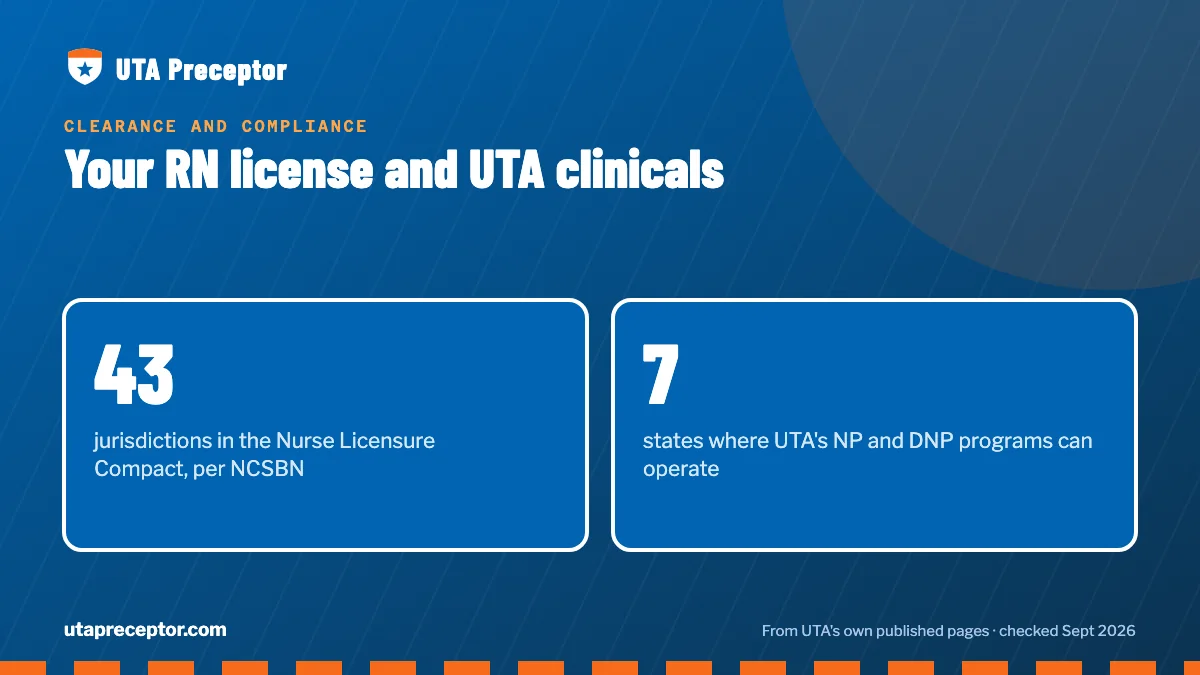
Texas has been part of the enhanced Nurse Licensure Compact since January 19, 2018, and its Board of Nursing confirms the state is still a member. NCSBN puts the compact at 43 jurisdictions.
UTA's handbook applies that directly. If your clinical site is in a UTA-approved state other than your home state, you need a license in that state, at your own expense, if it is not a compact state or if you do not hold a compact RN license. Put the other way, a multistate license from your compact home state covers clinicals in another compact state; a single-state license does not.
If you hold a multistate license from another compact state and train in Texas on that privilege, the Texas BON offers an optional online course, Nursing Regulations for Safe Practice, written for nurses in exactly that position. The Texas page covers the rest of what living in Texas means for your placement.
The APRN Compact is a separate agreement. The Texas BON says Texas has not implemented it; that matters for your license after graduation, not for clinicals.
Clinicals outside your home state
When a site is in another state, licensure is only half the question. UTA's NP and DNP programs reach seven states in all; outside Texas, the list runs Virginia, Florida, Colorado, California, New Mexico and Arkansas. Per the handbook, a student can finish the program only where CONHI is able to operate, and UTA files you under whichever state your MyMav mailing address shows.
Before you take a travel assignment, look for a preceptor in another state or move, email NursingSOA@uta.edu. Students near a state border who want to train across it fall under the same rule. The out-of-state clinicals page covers state authorization in full.
Get the state question answered first and the license second. There is no point paying for a new state license to train at a site in a state where UTA cannot operate.
How UTA verifies your license
UTA verifies RN licenses through NURSYS, according to its FNP program page. Make sure the name and license details on your NURSYS record match the ones on your UTA account and your clearance uploads, so the records line up when UTA checks.
Keep the license active through the whole course, not just on the first day. The requirement is tied to clinical courses, so a renewal date that falls mid-course needs handling before the course begins.
Your preceptor's license is checked too. UTA expects each preceptor to have an active provider license carrying no encumbrance, with at least one year spent in the specialty role; the preceptor requirements page covers that side.
Encumbrances and Board of Nursing investigations
Unencumbered is the word that matters. The clearance policy requires students under any Board of Nursing investigation to report it to the Chair of Graduate Nursing, and it sits in the same policy whose noncompliance penalties run from a clinical hold on registration to course failure. The clinical clearance page lists them.
If something is open with a board, report it as the policy requires and ask how it affects your next clinical course before you line up a preceptor. Raising it before a preceptor commits keeps more of your options open than raising it after a site has started onboarding you.
An active license that is under Board of Nursing investigation still has to be reported. The policy sends any investigation to the Chair of Graduate Nursing.
DNP and post-master's students
The DNP catalog raises the bar: "All NP students must have an unencumbered APRN and RN license" for practicum courses. APRN applicants to the DNP also need current national certification with an unencumbered APRN license in any U.S. state or territory.
Post-master's certificate students follow the certificate catalog pages, which require an unencumbered RN license for clinical courses. The post-master's certificate page explains how those programs are built.
After graduation, your Texas APRN license depends on a current Texas RN license or a multistate RN privilege, and the BON no longer issues interim approval to new graduates who have not passed certification. The RN license you keep clean for clinicals carries straight into that application.
Why our searches start from your license
Every search we run starts from two facts: the states where you hold a license and the states where UTA can operate for your program. The preceptors we put forward sit inside that overlap, so the license question is settled before a name ever reaches you. For students near a state border, UTA's answer comes first, and once UTA says yes, we widen the search across the line.
When a strong option turns up in another state, we raise the license and NursingSOA questions with you before anything is signed. UTA confirms licensure itself, through NURSYS and its own review, and we build your placement around a license that already fits the site's state. Start with your track and state.
Questions UTA students ask
Do I need a Texas RN license for clinicals in Texas?
Not necessarily. What UTA's handbook asks for is a license that works in the clinical site's state. Because Texas belongs to the Nurse Licensure Compact, a compact home state's multistate license already stretches to Texas clinicals. Holding just a single-state license from a non-member state changes that: you would pay for a Texas license yourself.
Do I need an APRN license to do NP clinicals?
Not as an MSN or post-master's student; the catalog ties clinical courses to an unencumbered RN license. You cannot practice as an APRN in Texas until you are certified and licensed. DNP students who are already NPs are different: the DNP catalog requires an unencumbered APRN and RN license for practicum courses.
Does UTA check my license, or do I upload it?
UTA's FNP page says it verifies licenses through NURSYS. Whether you also upload a license item to Exxat depends on the compliance list for your program, which is where UTA tracks clearance items. Either way, keep your NURSYS details current and your license unencumbered for every clinical course you take.
I am a travel nurse. What do I do before taking an out-of-state contract?
Email NursingSOA@uta.edu before you accept it. UTA's handbook requires that before a travel assignment, a preceptor search in another state or a move. UTA's NP and DNP programs operate only in seven states, and you must be licensed wherever you do clinicals, so both questions need answers before you plan hours there.
Does my preceptor need a Texas license?
UTA's test has three parts: an unencumbered, active provider license, twelve months or longer in the specialty role, and practice in a state where UTA can operate for you. The Texas rule defining a qualified APRN preceptor says active, unencumbered license without naming Texas. Confirm specifics with your clinical coordinator before the preceptor signs.
Related pages
Last checked 2026-09-23
We check these pages against UTA's own sources. UTA's current handbook and your course faculty have the final word.
Hand us the search. Keep your term.
Tell us your UTA track, your county and when your clinical course opens. We look for a preceptor and a site that fit what UTA asks for, and we help you put the approval packet together.
- Matched to your track's population and setting
- Paperwork prepared the way UTA's clinical team expects it
- In person near you, or a virtual option where your course allows it
Start your placement plan
A placement advisor replies with what a UTA-ready preceptor and site look like for you.