Liability and health insurance for UTA clinicals
You need two kinds of cover for UTA clinicals. Professional liability insurance comes through UTA and is billed as a student fee each Fall. Medical insurance is yours to carry, and it must include emergency care and follow-up for needle sticks, because UTA will not pay for that treatment.
Get your placement plan
Tell us your UTA track and where you live. A placement advisor replies with what a UTA-ready preceptor and site look like for you.
Two kinds of cover, two different jobs
Liability cover is about claims arising from your clinical work as a student. Medical insurance is about your own treatment if you are hurt or exposed at the site. UTA arranges the first and bills you for it through a fee. The second is your responsibility, and UTA asks you to verify you have it.
Both come up again at the site. Several Texas systems ask the school to confirm insurance before a student starts, so a gap in either one can stall a placement that is otherwise ready. The medical insurance check applies to newly admitted students, so it belongs in your first weeks in the program, not the week before clinicals.
Both also sit inside the wider clearance process, with its 60-day deadline and Exxat tracking. The clinical clearance page covers that process as a whole; this page covers the two insurance items and the costs around them.
Professional liability insurance through UTA
The MSN and PMC Student Handbook and the DNP handbook say the same thing: the Liability Insurance Policy "is provided through UTA" and is covered by a student fee each year, assessed in the Fall registration.
The rule behind it comes from the UT System. Regents' Rule 50501 says nursing students must show professional liability (malpractice) coverage before official registration, in a minimum amount set by the institution's president. UTA does not publish the graduate coverage amount or the fee on its public pages. For DNP students the timing is explicit: professional liability insurance is on the DNP handbook's list of items due before the project implementation course.
One more line is worth knowing, though it comes from UTA's BSN handbook rather than the graduate ones: coverage bought through the undergraduate department is valid only in the student role, not the employment role. If your clinical site is also your employer, keep the two roles separate. UTA's online FAQ adds that you cannot be paid by your employer or your preceptor for clinical hours. The employer clinical site page covers UTA's other limits there.
Medical insurance with ED and needle-stick cover
All newly admitted graduate nursing students must verify medical insurance, and the MSN and PMC handbook is specific about what it must include: "Emergency Department coverage and follow-up treatment for needle sticks and blood borne diseases."
The graduate catalog explains why that wording matters. It says UTA "will not cover initial and follow up treatment" for needle-stick injuries or exposure to bloodborne disease. If your plan has a gap there, the cost of testing and treatment after an exposure falls on you.
Check your plan documents for both pieces before you upload proof. A plan that covers emergency visits but excludes follow-up testing and treatment does not meet the requirement as the handbook writes it.
If you have a needle stick or exposure
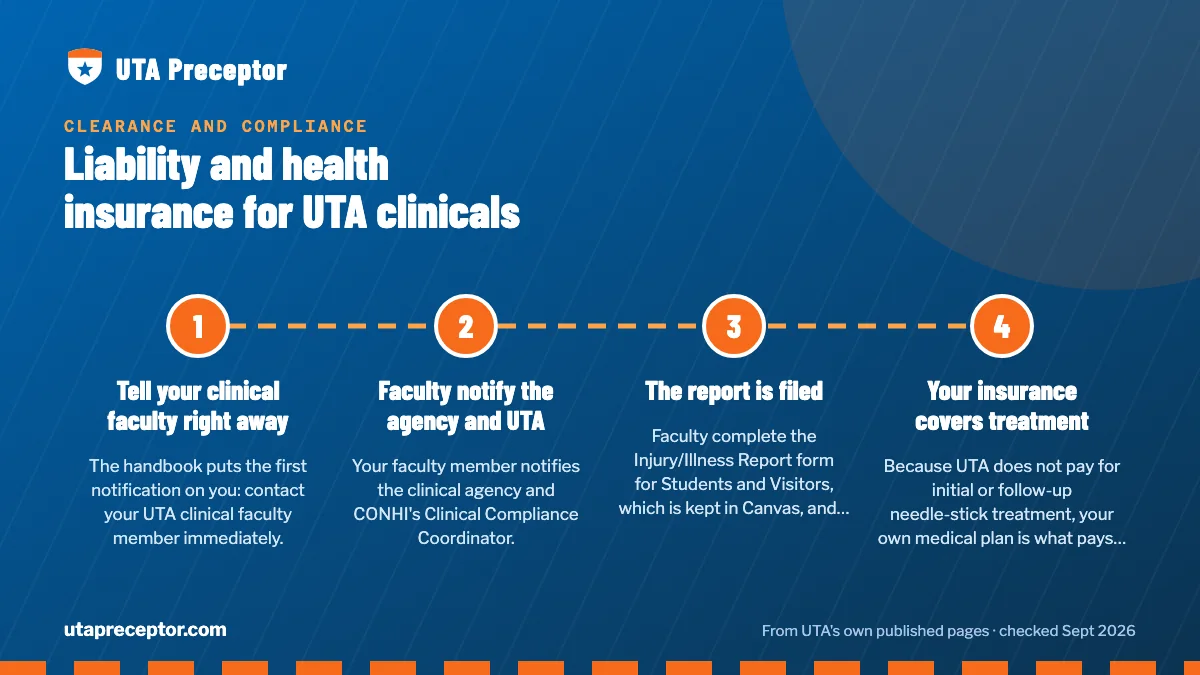
The graduate handbook sets out who does what after a bloodborne pathogen exposure. The first step is yours.
- Tell your clinical faculty right awayThe handbook puts the first notification on you: contact your UTA clinical faculty member immediately.
- Faculty notify the agency and UTAYour faculty member notifies the clinical agency and CONHI's Clinical Compliance Coordinator.
- The report is filedFaculty complete the Injury/Illness Report form for Students and Visitors, which is kept in Canvas, and forward it to UTA Environmental Health and Safety. A Faculty Student Incident Check List is part of the same process.
- Your insurance covers treatmentBecause UTA does not pay for initial or follow-up needle-stick treatment, your own medical plan is what pays for testing and care.
What clinical sites ask to see
In the examples we found, the school confirms your insurance to the hospital rather than you showing a card, but the hospital does ask.
- UT Southwestern wants a school attestation letter, 30 days before your start, covering professional and general liability insurance among other items.
- University Health in San Antonio has the school coordinator attest that you have basic health insurance.
- Houston Methodist uses the Texas Medical Center verification form, which lists malpractice insurance and personal health insurance.
- The DFW Hospital Council Foundation's standard student orientation checklist lists liability insurance.
Each system's wider onboarding, from orientation modules to application windows, is on the DFW hospital onboarding page.
Parking and other costs around clinicals
The graduate catalog notes that "some clinical agencies charge a nominal fee for parking passes." It is a small line, but if your site is a large hospital campus, ask about parking during onboarding so it does not surprise you on your first day.
Insurance and parking sit alongside the other costs UTA assigns to students: the Exxat purchase on entry to the graduate program, and every clinical clearance item from vaccines to the drug screen. UTA publishes no amounts for any of these on its public pages, so plan for them without assuming a figure.
Your clinical hours themselves are unpaid. UTA's online FAQ is clear that students cannot be paid by an employer or clinical site preceptor for clinical hours, which is worth remembering when you budget for an 11-week or 13-week course. The online clinical schedule page shows how those courses fall.
Why students choose us for site paperwork
Coverage itself runs between you, UTA and your insurer, and confirmation to a site comes from UTA, as the hospital examples above show.
Where we make the difference is timing. For every site we propose, we find out whether it wants a school letter or attestation before your start and flag that lead time while there is still room to meet it, and we ask about site costs such as parking so they are known in advance. Ask a placement advisor about your track.
Questions UTA students ask
Do I need to buy my own malpractice insurance for UTA clinicals?
UTA's graduate handbooks say the liability policy is provided through UTA and paid by a yearly student fee assessed in Fall registration. Nothing in UTA's public sources asks graduate students to buy a separate policy for clinicals. When a site asks for proof of coverage, the school attests to it in the examples we found, as UT Southwestern's letter shows.
How much is the UTA liability insurance fee?
UTA does not publish the graduate fee or the coverage amount on its public pages. The handbooks say only that a student fee covers it each year and that it is assessed in Fall registration. Look for it in MyMav, UTA's registration and payment system, when your Fall charges post.
Does my employer's coverage count if I do clinicals where I work?
UTA's public sources do not say. The only UTA statement on roles is in the BSN handbook, which says student coverage applies only in the student role, not the employment role. Treat your clinical hours as student time: UTA's FAQ says you cannot be paid for them by your employer or preceptor. Ask your coordinator if the site raises it.
Will UTA pay for a needle stick at my clinical site?
No. The graduate catalog says UTA will not cover initial and follow-up treatment for needle-stick injuries or bloodborne exposure. That is why your medical insurance must include emergency department coverage and follow-up for needle sticks. Report any exposure to your clinical faculty right away so the incident is documented through UTA's process.
Do the insurance rules apply to DNP students?
For liability, yes: the DNP handbook lists professional liability insurance among the items needed before the project implementation course, paid through the same yearly student fee. The medical insurance rule appears in the MSN and PMC handbook, worded for all newly admitted graduate nursing students; confirm with the DNP program how it applies to you.
Related pages
Last checked 2026-09-23
We check these pages against UTA's own sources. UTA's current handbook and your course faculty have the final word.
Hand us the search. Keep your term.
Tell us your UTA track, your county and when your clinical course opens. We look for a preceptor and a site that fit what UTA asks for, and we help you put the approval packet together.
- Matched to your track's population and setting
- Paperwork prepared the way UTA's clinical team expects it
- In person near you, or a virtual option where your course allows it
Start your placement plan
A placement advisor replies with what a UTA-ready preceptor and site look like for you.