What the best UTA placement service does, and how we do it
The best placement service for UTA students does five things well: it puts everything in writing, it knows UTA's clinical process in detail, it screens candidates before you meet them, it hands the Clinical Coordinator a complete packet, and it stays on call when a preceptor drops. Here is each standard, and how we meet it.
See how we would handle your placement
Tell us your track, course and start date. A placement advisor replies with how we would run your search, and you see our quote and terms in writing before you commit.
Clear terms, in writing, before you commit
A strong service tells you exactly what you are getting before you pay. With us, a placement advisor talks through your course, dates and location first, and then you receive a written quote and terms. The search begins once you accept them.
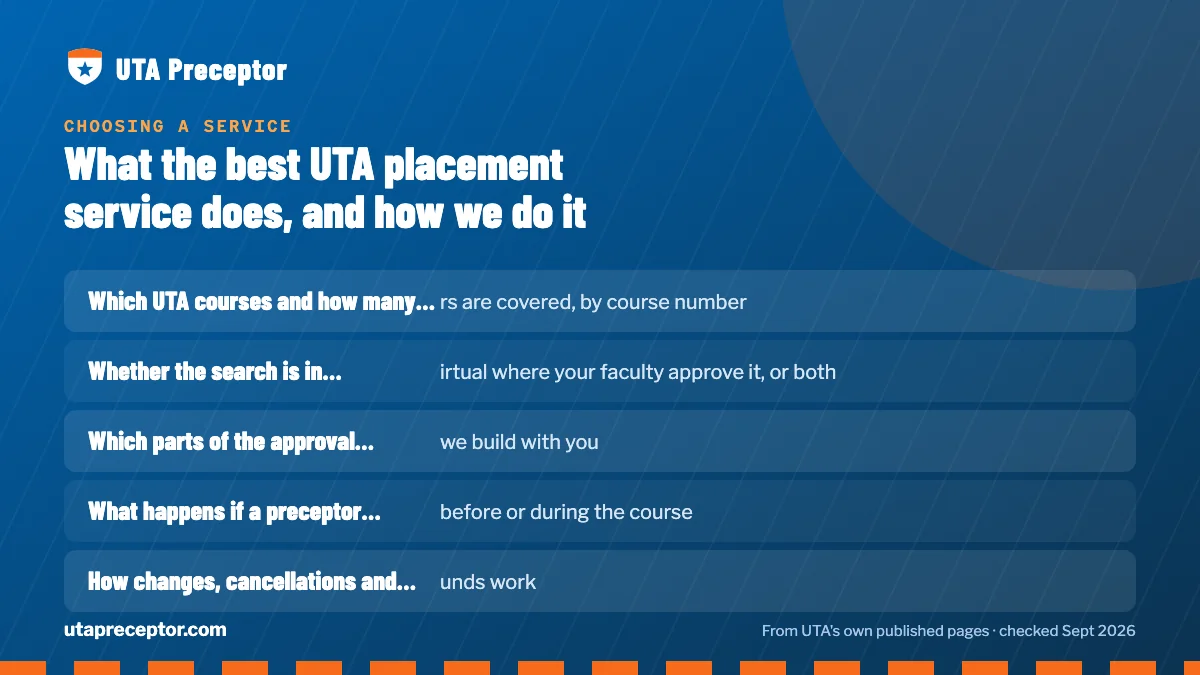
Your quote and terms spell out
- Which UTA courses and how many hours are covered, by course number
- Whether the search is in person, virtual where your faculty approve it, or both
- Which parts of the approval packet we build with you
- What happens if a preceptor drops before or during the course
- How changes, cancellations and refunds work
Clear terms mean you know where you stand at every point, including the week a plan changes. What shapes the cost explains what goes into a quote.
Deep knowledge of UTA's clinical process
UTA's rules are specific, and a service built around them gets them right from the first candidate. This is what we work to on every UTA placement:
- Exxat MyRequest. You submit a self-placement request for each course, each Wishlist closes on a set date and UTA caps requests per course, so every candidate is planned around those dates.
- Preceptor minimums. An active and unencumbered provider license, specialty-role experience of one year or longer, and a check against your course's list of acceptable preceptor categories.
- The Preceptor Agreement. Every preceptor signs it, and it must be in the Clinical Coordinator's hands on or before your first clinical day, so we line it up early.
- Affiliation agreements. We confirm whether a site has one with UTA, or can sign one, before the site is offered to you.
- State authorization. UTA's NP programs are open in seven states, and students write to NursingSOA@uta.edu before looking beyond them, so searches are planned inside those lines.
- Hours. UTA builds its minimum from direct patient care alone, keeps simulation and observation outside it and waives no hours, so we look for preceptors with steady shifts across your course weeks.
Every one of these can be checked against UTA's own pages. UTA's preceptor requirements and out-of-state clinicals are good places to start.
Candidates screened before you hear their names
The best search is a screened one. Before a preceptor reaches you, we confirm their license on the issuing board's public lookup, their time in the specialty role, a practice setting and patient population that fit your course, and the site's affiliation status. We also check the relationship: your own department and your current supervisor are both off the table under UTA's rules, even at an employer site.
That screening is what keeps a request from coming back. The usual reasons for a decline, from a preceptor outside the course's categories to a site without an agreement, are settled before anything goes into Exxat. Preceptor not approved shows what those reasons look like.
A packet built for the Clinical Coordinator
Your Clinical Coordinator and/or course faculty give the final approval on every preceptor and site. The best service makes sure what reaches them arrives complete and matches UTA's rules on the first pass, and that is how we build every packet: the preceptor's CV or resume, proof of an active license, the signed Preceptor Agreement, and the site information UTA needs for its affiliation agreement.
You file the request through MyRequest with every piece in place, which protects both your request count and your Wishlist date. Accuracy is part of the standard too. Everything in the packet is verified against its source, because UTA's handbook takes falsified placement information seriously enough to report it to the Board of Nursing.
A preceptor's yes starts the approval. The placement is set when UTA has signed off on both preceptor and site and holds the signed Preceptor Agreement.
Straight answers on virtual options
Some students ask about virtual clinicals, and a service that knows UTA answers plainly. UTA's handbook keeps simulation and observation out of the direct-care minimum, and UTA's sources are silent on telehealth.
So the search starts in person, near where you live, and a virtual arrangement comes in where your course and faculty approve it. When one is approved, the preceptor goes through the same screening as any other. Virtual clinical options sets out the detail.
On call when a preceptor drops
Preceptors pull out for ordinary reasons, such as a job change, a new employer policy or a heavier patient load. The best service treats that as part of the job. When it happens, a placement advisor restarts the search for the same course as soon as you tell us, with a colleague at the same site as an early call, since the agency's agreement with UTA may already cover you.
A mid-term replacement also goes through UTA's approval, with a fresh Preceptor Agreement signed before you work a shift together, so we build that packet again with you. Preceptor dropped out covers the UTA side of a change mid-course, and how it works sets out every step. Put any question on this page to the placement desk, using the form below or the chat.
Questions UTA students ask
What makes a preceptor placement service good for UTA students?
Working knowledge of UTA's process, written terms before you commit, candidates screened against UTA's minimums, a packet that reaches the Clinical Coordinator complete, and a person on call when a preceptor pulls out. Those are the standards our service is built on, and each section of this page shows how we meet one of them.
What should I send a placement service at the start?
Your track, course number, start date, county and what you've tried so far are enough to begin. Preparing the packet later draws on your Exxat profile or CV and on your preceptor's details, which are gathered once the preceptor agrees. The more you share about past leads, the faster the search moves past them.
What happens if UTA declines a preceptor?
Ask UTA for the reason and bring it to the placement desk, so the next candidate is chosen with it in mind. Reasons can include a preceptor outside your course's acceptable categories, a site without an affiliation agreement or a setting that doesn't fit the course. The new search starts from that reason, not from scratch.
How early should I bring in a placement service?
Early enough that UTA's own steps still fit. UTA's online FAQ suggests giving the search 12 to 16 weeks, and each course's Wishlist in Exxat has a close date. Bringing help in before that window gives the search room for a backup candidate as well as a first choice.
Can a placement service help if I already have a lead?
Yes. Tell the placement desk about the lead first. We check the clinician against UTA's minimums and your course's setting, and if they fit, we help you build the packet around them. If they turn out not to fit, the search carries on from there with that lead already ruled in or out.
Related pages
Last checked 2026-09-23
We check these pages against UTA's own sources. UTA's current handbook and your course faculty have the final word.
Hand us the search. Keep your term.
Tell us your UTA track, your county and when your clinical course opens. We look for a preceptor and a site that fit what UTA asks for, and we help you put the approval packet together.
- Matched to your track's population and setting
- Paperwork prepared the way UTA's clinical team expects it
- In person near you, or a virtual option where your course allows it
Start your placement plan
A placement advisor replies with what a UTA-ready preceptor and site look like for you.