Virtual clinical options: what can count at UTA
UTA's minimum clinical hours must be direct patient care. Simulation and observation never count toward that minimum, and UTA publishes nothing on telehealth. A virtual arrangement is therefore possible only where your course and faculty approve it, and in-person placement near you stays the main route.
Get your placement plan
Tell us your UTA track and where you live. A placement advisor replies with what a UTA-ready preceptor and site look like for you.
The rule that decides: direct patient care
UTA's MSN and PMC Student Handbook settles the core question in one sentence: “The minimum number of hours must be direct patient care experiences.” National standards call for at least 500 clinical hours in NP programs and 600 in Neonatal NP. UTA's NP tracks ask for more: 720 hours for FNP and 1,260 for the dual tracks.
Two more rules sit beside it. The handbook says students “are unable to graduate without completing all program required clinical hours,” and it calls waiving any of them not appropriate.
So the test for any virtual idea is not convenience. It is whether the time is direct patient care your faculty will accept, or an activity that can only count above the minimum, if at all. Hours by track are on UTA clinical hours.
What “virtual” can mean, and how UTA treats each
The word covers very different arrangements. UTA's rules treat them differently, and some have nothing to do with your hours.
| Arrangement | Counts toward the minimum? | What the rules say |
|---|---|---|
| Simulation, including virtual patients and case software | No | Non-patient-care activities, “including simulation and observational activities”, cannot satisfy the minimum. Simulation can never replace population-specific hours. |
| Watching a provider's video visits without providing care | No | Observation sits with simulation: it can only count toward hours above the minimum. |
| Telehealth visits where you take part in care under your preceptor | Unanswered by UTA | UTA's public sources are silent on telehealth. Your course faculty decide whether and how it counts. |
| Faculty check-ins by phone or video | Not an hours question | This is how faculty oversee you. Texas rule 22 TAC §219.10 lets faculty use telephone or written contact when site visits are not feasible. |
| Online coursework and seminars | Separate from clinical hours | UTA's accelerated online programs teach coursework online; the online FNP page describes “Clinical experiences in your local area”. |
How to record whatever time you do spend, and what counts when, is on UTA clinical hour logs.
Telehealth: what UTA has not said
We found no UTA source that addresses telehealth clinical hours. That silence cuts both ways: it isn't a ban, and it isn't permission. Treat it as a question your course faculty answer for your course.
Questions UTA's public pages leave open
- Whether a telehealth visit counts as direct patient care in your course.
- Whether a course caps telehealth hours or expects a minimum number of in-person hours.
- Whether telehealth can meet population-specific hours, such as pediatric or older-adult encounters.
- Which state counts when you, your preceptor and the patient are in different places. UTA requires you to be licensed in any state where you do clinicals, and it limits NP clinicals to states where it can operate.
The last point matters most if you live near a state line or your candidate practices elsewhere. Read out-of-state clinicals and contact UTA's state authorization team before agreeing to anything that crosses a border.
How to get a virtual arrangement approved
If you want to explore a virtual arrangement, get UTA's answer before anyone searches for one.
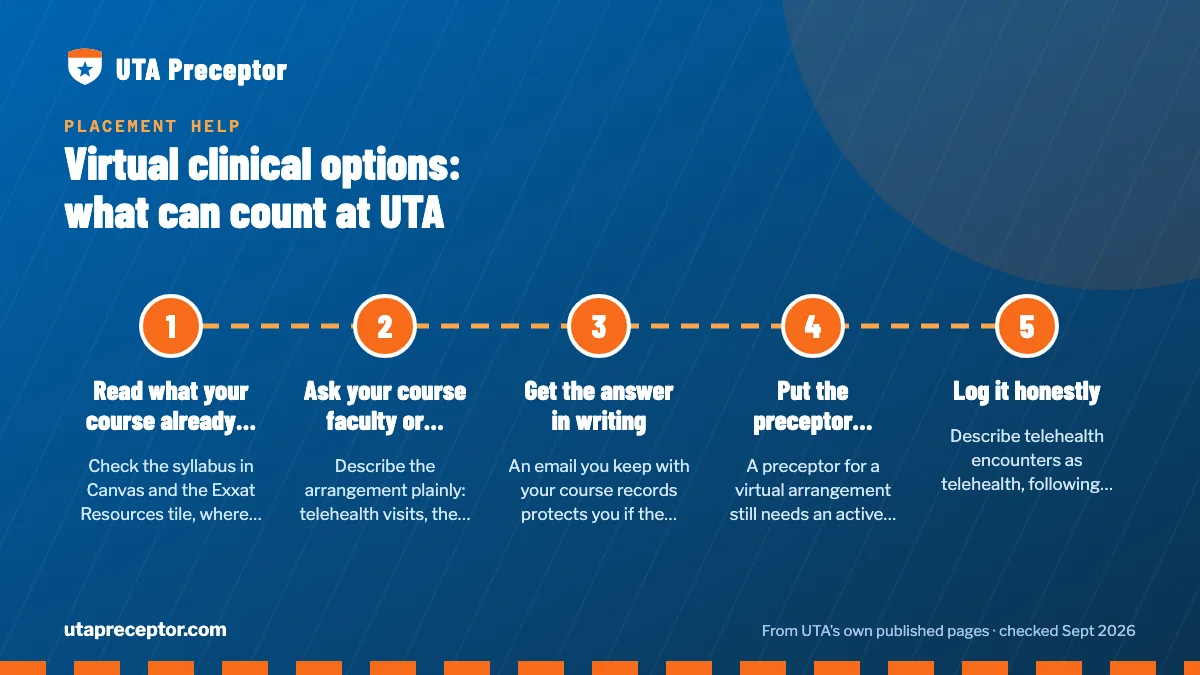
- Read what your course already saysCheck the syllabus in Canvas and the Exxat Resources tile, where UTA posts the Graduate Student Clinical Site and Preceptor Policy and the preceptor guidelines.
- Ask your course faculty or Clinical Coordinator directlyDescribe the arrangement plainly: telehealth visits, the type of preceptor, roughly how many hours, and where the patients are.
- Get the answer in writingAn email you keep with your course records protects you if the question comes up when your hours are reviewed.
- Put the preceptor through the normal routeA preceptor for a virtual arrangement still needs an active, unencumbered license, a year in the specialty role, a signed Preceptor Agreement and a site UTA approves. See Clinical Coordinator approval.
- Log it honestlyDescribe telehealth encounters as telehealth, following whatever your faculty told you, so no one reviewing your hours is misled.
Where virtual cannot help
Some problems look as if they could be solved online. Under UTA's rules, these can't.
- Replacing the direct-care minimum. Simulation and observation never count toward it, whatever platform delivers them.
- Replacing population-specific hours. The handbook rules out simulation for these entirely.
- Catching up below the minimum. If you are short on direct-care hours mid-course, simulation can't close that gap. Behind on clinical hours covers what can.
- Working around state rules. A preceptor based in a state where your UTA program isn't open raises the same state authorization question whether you meet in person or on a screen. Ask UTA first.
If one of these is the gap you are trying to fill, the answer has to be direct patient care, in person or in an arrangement your faculty have explicitly approved.
Simulation and observation never count toward UTA's minimum clinical hours, however they are delivered.
How we handle virtual requests
In-person placement near you is where we start, because it fits UTA's rules without an extra approval step. Where your course and faculty allow a virtual arrangement, we build the search around their answer, and we ask you to share it in writing before the search changes direction.
When one is allowed, the preceptor goes through the same checks as any other: license, a year in the specialty role, and fit with your course's population and setting. We plan the arrangement so the time you log in Exxat is the direct patient care your faculty accepted, and UTA's Clinical Coordinator gives the final approval on the preceptor and site.
To talk it through, use the form below or open the chat. How it works shows the rest of the process.
Questions UTA students ask
Does UTA accept telehealth hours for NP clinicals?
UTA hasn't said publicly. None of the handbooks, program pages or Exxat guides we reviewed address telehealth. Whether telehealth encounters count toward your course's hours is up to your course faculty, so ask them before you start, keep their answer in writing, and follow their instructions on how to log it.
Are clinicals in UTA's online NP programs done online?
No. The coursework is delivered online, but clinical hours are earned with a preceptor at a clinical site. UTA's online FNP page describes “Clinical experiences in your local area”, and you find and request the preceptor and site through Exxat like any other UTA student.
Can my preceptor supervise me remotely while I see patients?
UTA doesn't address it. Its public rules center on direct patient care with a preceptor UTA has approved, at a site with an affiliation agreement, and remote supervision isn't described anywhere public. Ask your course faculty before agreeing to it, because hours your faculty don't accept won't count toward graduation.
Is a virtual placement quicker to arrange than an in-person one?
Not necessarily. It still needs faculty approval before the search, then the same preceptor checks, Preceptor Agreement and site approval as an in-person placement. Because the faculty question comes first, a virtual route can add a step rather than save one. If time is short, the in-person route avoids that extra approval.
Can a virtual preceptor be in a different state from me?
Only if UTA agrees. UTA limits its NP programs and DNP to seven states, requires an RN license valid wherever you do clinicals, and asks students to email NursingSOA@uta.edu before seeking a preceptor in another state. It hasn't said how those rules apply to telehealth, so ask before you commit.
Related pages
Last checked 2026-09-23
We check these pages against UTA's own sources. UTA's current handbook and your course faculty have the final word.
Hand us the search. Keep your term.
Tell us your UTA track, your county and when your clinical course opens. We look for a preceptor and a site that fit what UTA asks for, and we help you put the approval packet together.
- Matched to your track's population and setting
- Paperwork prepared the way UTA's clinical team expects it
- In person near you, or a virtual option where your course allows it
Start your placement plan
A placement advisor replies with what a UTA-ready preceptor and site look like for you.