Find your own preceptor, ask UTA, or bring in placement help
Every route ends at the same place: a preceptor and site approved by UTA's Clinical Coordinator and/or course faculty, requested by you in Exxat. What changes is who does the searching, how much of your time it takes and how much runway you need. When time is short or leads are thin, a dedicated search built around UTA's process is the strongest way to get there.
Not sure which route fits?
Tell us your track, course, start date and county. A placement advisor replies with a clear read on your options, UTA's own help included, and how we would run your search.
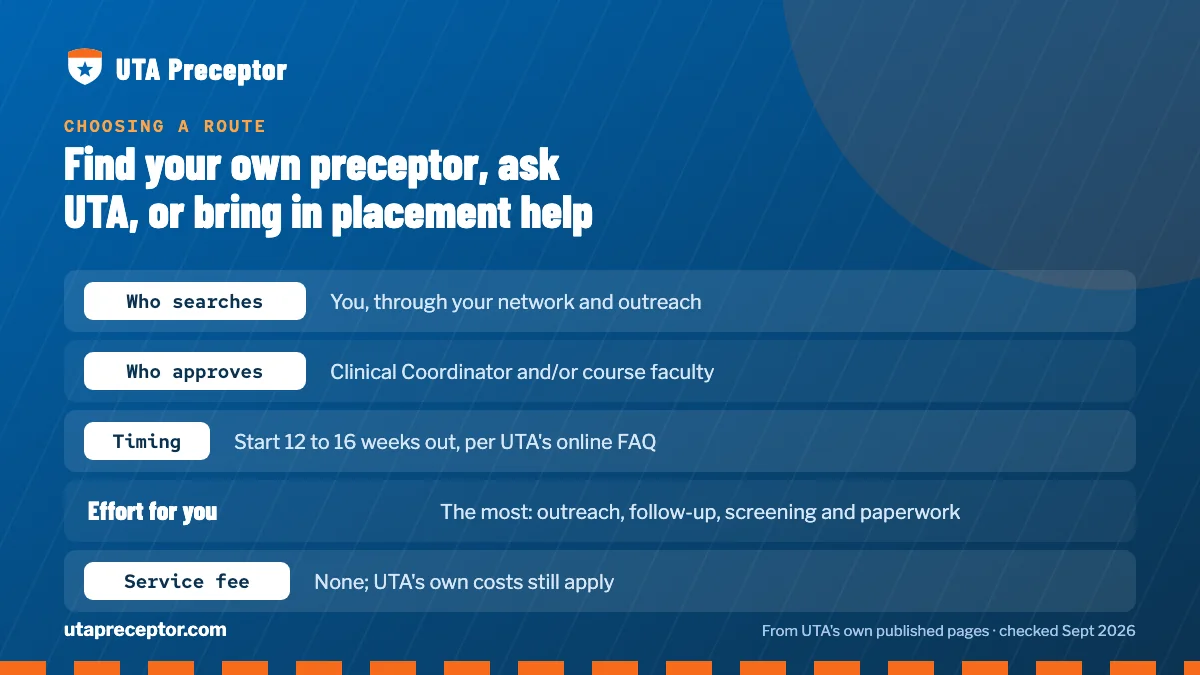
Every route ends at the same approval
UTA starts from self-placement. Its NP program pages ask students to find a preceptor who fits their program's requirements, and the Department of Graduate Nursing steps in to help students who are struggling with that search.
Whichever route finds the preceptor, the steps after it are the same. You file a self-placement request through MyRequest in Exxat, your Clinical Coordinator, course faculty or both approve the preceptor and site, the preceptor signs the Preceptor Agreement ahead of your first clinical day, and the agency needs an affiliation agreement with UTA. The route you choose decides how quickly and how cleanly you reach those steps.
The three routes side by side
| Question | Finding your own | Asking UTA's clinical team | Our placement service |
|---|---|---|---|
| Who searches | You, through your network and outreach | UTA's clinical team, while you keep searching | A placement advisor, working from your course, dates and location |
| Who approves | Clinical Coordinator and/or course faculty | Clinical Coordinator and/or course faculty | Clinical Coordinator and/or course faculty |
| Timing | Start 12 to 16 weeks out, per UTA's online FAQ | No published turnaround, so ask early | Planned backward from your course start and Wishlist close |
| Effort for you | The most: outreach, follow-up, screening and paperwork | Documenting your search, staying in touch and still searching | The least: you review screened candidates and file the request |
| Service fee | None; UTA's own costs still apply | UTA lists no placement fee of its own | Set out in a written quote before you commit |
| When it fits | You have leads, a workable employer site or plenty of runway | You have searched in earnest and stalled | Your network is thin, your specialty is scarce locally, time is short or a preceptor has dropped |
Finding your own preceptor
Self-placement gives you the most control. You choose who to approach, and a clinician who already knows your work can make for the smoothest approval of all. UTA's Exxat page notes that potential preceptors can be sent your Exxat profile, including your CV and work history, and asking a preceptor covers the message itself.
The price is time. Each candidate needs screening against UTA's minimums, a site that can sign an affiliation agreement and a signed Preceptor Agreement, all while you work and study. UTA's general MSN FAQ says to start the moment the program begins, and no later than your Pharmacology course.
It fits best when you have real leads, live near plenty of practices in your specialty or have a term or more of runway. It is hardest when every lead is a stranger and the course opens in weeks.
Asking UTA's clinical team for help
UTA's help is part of your program, and it's worth asking for. The Department of Graduate Nursing commits to assisting students who run into placement difficulty, and the online FAQ encourages a conversation with your Clinical Coordinator about partnering on clinical sites. The procedure behind it is a policy on students experiencing difficulties with clinical placements, posted inside Exxat.
Its particular strength is that the Clinical Coordinator the FAQ points you to is also one of the people who approve placements. UTA publishes no turnaround, location or specialty commitment for this help, and no definition of difficulty, so it works best as an early conversation.
It fits when you have searched in earnest and stalled. Ask weeks ahead rather than days; UTA placement assistance walks through how.
Bringing in our placement service
Our service takes the search off your hands and runs it around UTA's own process. A placement advisor looks for a preceptor and site that match your UTA course, with in-person placement near home as the main route and virtual arrangements added wherever your course and faculty approve them. Every candidate is screened against UTA's published minimums before you hear the name, and the Clinical Coordinator's packet is built with you.
You submit in Exxat with the packet complete, and UTA gives the final approval. If a preceptor drops, we are back on the search for the same course. You get a written quote and terms before committing, and what shapes the cost explains the factors.
It fits when your network is thin, your specialty is scarce where you live, your job leaves little time for outreach or a preceptor has just dropped. What the best UTA placement service does sets out the standard we work to.
Using more than one route
The routes work well together. You can keep your own search going, ask UTA for help and bring us in at the same time, and on a tight timeline that is often the smartest plan.
Coordination keeps it clean. UTA sets both a floor and a ceiling on requests per course in Exxat MyRequest, so two candidates chasing one slot can waste a request. Share the practices you've already approached with your Clinical Coordinator and with the placement desk, so each clinic hears one clear ask.
Whichever route finds your preceptor, begin clinical hours only after UTA has approved the preceptor and site.
Questions that settle it
- How many weeks until your clinical course opens, and is its Wishlist in Exxat still open?
- Do you have a few realistic leads who practice in your course's setting?
- Is your specialty easy to find where you live, or scarce?
- Have you already searched in earnest and stalled?
- How many hours a week can you give to outreach and paperwork?
Plenty of leads and time points to self-placement. A stalled search is worth raising with UTA. Little time, few leads, a scarce specialty or a preceptor who has just dropped is where our service does its best work, alongside UTA's own help.
Questions UTA students ask
Is finding my own preceptor cheaper than hiring help?
In service fees, yes: self-placement adds none. UTA's own costs, such as Exxat, clinical clearance, the liability insurance fee and any parking charges, apply on every route. What self-placement costs instead is time, and a search that runs past your course start can cost a term, as delayed graduation describes.
Will asking UTA for placement help count against me?
Nothing UTA publishes says so. The help is a published commitment, and the policy behind it sits with UTA's other clinical policies in Exxat. What matters is accuracy: describe your search truthfully, since the handbook lists false statements in a request for placement help among events reported to the Board of Nursing.
Which route gets me placed fastest?
UTA publishes no timeline for any route, and its approval steps are the same whoever found the preceptor. Speed comes from starting early, screening candidates before they are submitted and favoring sites that already have an affiliation agreement with UTA, which is exactly how our searches are run.
Can my employer be my clinical site if I find it myself?
Yes, within UTA's limits. Hours at your workplace are allowed when they meet the course's clinical focus, though your own department and your current supervisor are excluded. For Administration's NURS 5339, UTA says it prefers a site away from your own workplace. See clinicals at your employer.
Does this choice apply to DNP and RN-to-BSN students?
Not in the same way. UTA's DNP program works without preceptors; you record a project site in Exxat before NURS 6323 finishes. RN-to-BSN students don't need to identify a preceptor, because practice work happens in the workplace or community. This page is for MSN, NP certificate, Education and Administration students.
Related pages
Last checked 2026-09-23
We check these pages against UTA's own sources. UTA's current handbook and your course faculty have the final word.
Hand us the search. Keep your term.
Tell us your UTA track, your county and when your clinical course opens. We look for a preceptor and a site that fit what UTA asks for, and we help you put the approval packet together.
- Matched to your track's population and setting
- Paperwork prepared the way UTA's clinical team expects it
- In person near you, or a virtual option where your course allows it
Start your placement plan
A placement advisor replies with what a UTA-ready preceptor and site look like for you.