What a late clinical course actually costs you at UTA
A clinical course you can't start on time rarely costs just a few weeks. It moves to a later start, UTA waives none of its hours, and every course that depends on it moves too, pushing back your graduation, your certification exam and your start in practice. The cost is time, and most of it can be avoided with an early, well-checked placement.
Worried a clinical will slip?
Tell us your course, its start date and where your placement stands. A placement advisor replies with what could still be done before the course opens.
How a clinical course slips
Three things push a UTA clinical course to a later start, and all three are about the placement, not your grades.
- No approved placement in time. Per an excerpt of UTA's FNP guidelines (revised 2024), a student who misses the pre-semester deadline is rescheduled into the following course start.
- A clearance problem. Under UTA's Graduate Nursing Clinical Clearance Requirements, noncompliance can bring a registration-blocking clinical hold, a later clinical course or a denied placement.
- An agency that won't take you. When an agency turns down a student holding a vaccine exemption, UTA denies the self-placement request and pushes the clinical course to the following semester.
The course doesn't wait for you. Online clinical courses run on UTA's published schedule; the Summer and Fall 2026 accelerated online schedule, for example, listed NURS 5337 and NURS 5338 for a 9/21/2026 start. Miss your start and you join a later one.
No hours are waived
A late start can't be offset by doing less. UTA's handbook ties graduation to every program-required clinical hour and calls waiving any of them inappropriate. The minimum itself has to be direct patient care, with simulation and observation left outside it.
So a delayed course is the full course, later: 180 hours for NURS 5337 over its 11 online weeks, whenever those weeks arrive. Trying to fit the same hours into fewer weeks is how students fall behind on clinical hours.
The knock-on through your clinical sequence
UTA's clinical courses are chained by prerequisites, so one late course moves those after it. In the FNP track, NURS 5338 needs NURS 5337 first or alongside it, and the final practicum, NURS 5660, needs both. Miss the start of 5337 and the whole 720-hour sequence shifts.
| Track | Clinical practice courses | Final practicum, taken after both |
|---|---|---|
| FNP | NURS 5337 and NURS 5338 | NURS 5660 |
| AGACNP | NURS 5354 and NURS 5355 | NURS 5640 |
| AGPCNP | NURS 5352 and NURS 5353 | NURS 5645 |
| PNP-PC | NURS 5371 and NURS 5372 | NURS 5685 |
| PNP-AC | NURS 5373 and NURS 5374 | NURS 5680 |
| PMHNP | NURS 5324 and NURS 5325 | NURS 5650 |
Other programs have their own chains. Nursing Education's NURS 5362 requires every other course in the program first. Administration students follow an exact course sequence. DNP students can't implement their project until the site is approved in Exxat, and the Graduate Nursing Review Committee reviews proposals once a semester.
What keeps running while you wait
A delay isn't a pause. Several clocks keep going:
- Clearance. UTA expects compliance from the first course to the last, and Exxat marks items Expiring and then Expired. Anything with a date on it can lapse during a delay; clinical clearance has the list.
- The 30-day checks. Your drug test and background check belong inside the 30-day window before your first clinical course. If that course moves, ask whether checks timed for the old date still count.
- Your preceptor. A clinician who agreed to one term may not be available for the next, and a changed placement means a new request and a new approval.
- Your time limit. UTA's handbook gives six years to finish the MSN, and the DNP has the same maximum. One delay rarely threatens that; repeated ones eat into it.
- Your address. UTA's NP programs operate in seven states: Texas, New Mexico, Colorado, Arkansas, Florida, Virginia and California. A move during a longer program can lead to a denied or delayed placement, a requirement to complete clinicals in an approved state, or withdrawal. Check with NursingSOA@uta.edu first; see out-of-state clinicals.
After graduation, everything shifts too
A later graduation moves every step after it. In Texas you can't practice as an APRN until you've passed national certification and hold an APRN license, and interim approval for new graduates is no longer issued by the Board of Nursing. The license application relies on official documentation from your program, including your graduation date and clinical hours, so it waits on your program being finished.
Job offers and start dates planned around your expected graduation move with it. None of this carries a set figure, but each piece is time you had planned to spend working in your new role.
How to lower the risk
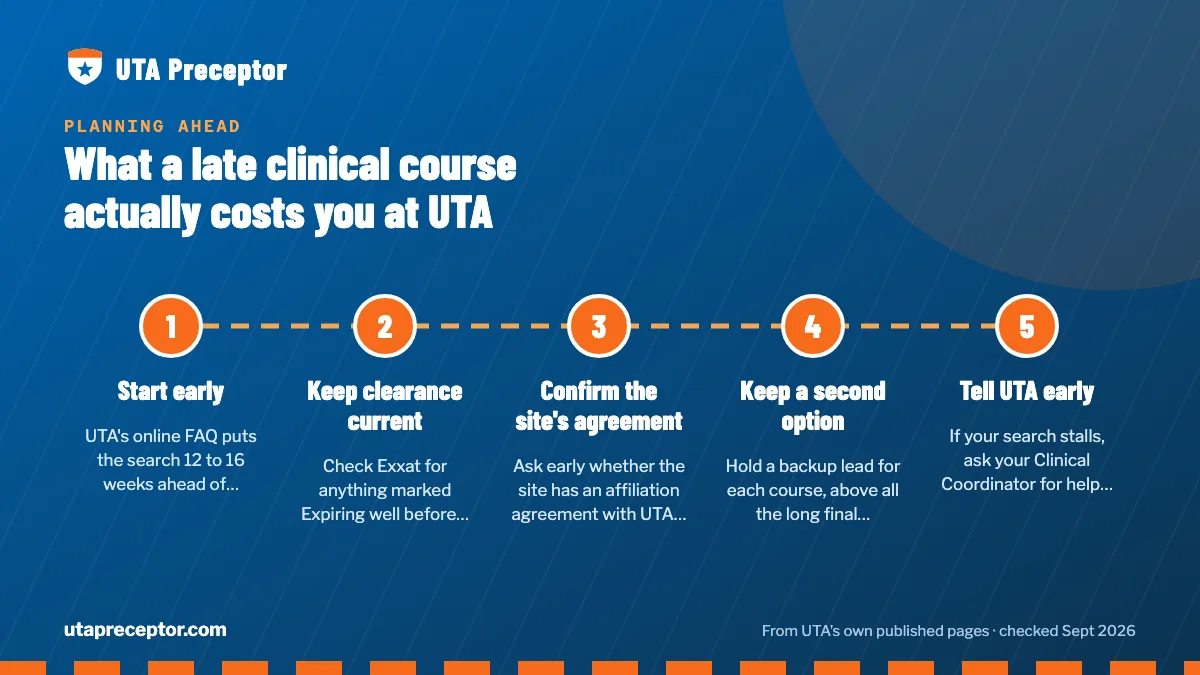
- Start earlyUTA's online FAQ puts the search 12 to 16 weeks ahead of clinicals, and its general MSN FAQ says to begin with the program itself. See the placement timeline.
- Keep clearance currentCheck Exxat for anything marked Expiring well before each clinical course, not the week it opens.
- Confirm the site's agreementAsk early whether the site has an affiliation agreement with UTA. Without one, an otherwise suitable preceptor can't host your hours.
- Keep a second optionHold a backup lead for each course, above all the long final practicum.
- Tell UTA earlyIf your search stalls, ask your Clinical Coordinator for help under UTA's Difficulties policy weeks before the course, not days.
- Check before you moveAsk NursingSOA@uta.edu before you relocate, sign a travel contract or line up an out-of-state preceptor.
Why students bring us in early
The risk on this page is the one our service is built to take on: a clinical course that can't start because there's no approved preceptor. A placement advisor searches for a preceptor and site matched to your UTA course, in person near home first and virtual where your course and faculty accept it, screens each candidate against UTA's published minimums, and prepares the Clinical Coordinator's packet with you well before the Wishlist closes.
Every request you file in Exxat has a complete packet behind it, and UTA gives the final approval. If a preceptor drops, the next search is already underway, and you see a written quote and terms before committing. Send your course and start date through the form below or the chat.
Questions UTA students ask
Will one late clinical course delay my graduation?
Often, because of the prerequisite chain. If the course that moves sits early in your sequence, the courses after it move too, and your final practicum and graduation follow. Whether a later start can be absorbed depends on your degree plan and the schedule, so ask MSN advising at MSNadvising@uta.edu to map it with you.
Can I take two clinical courses at once to catch up?
Sometimes. In the FNP track, NURS 5338 allows concurrent enrollment with NURS 5337, and the PNP and PMHNP second clinical courses have similar options. That doubles your weekly hours, and each course still needs its full total with an approved preceptor, so talk it through with your course faculty before you plan around it.
Does UTA ever shorten a clinical course for a delayed student?
No UTA source describes that, and the handbook points the other way: all program-required hours must be completed and none are waived. What can sometimes change is how the hours are spread within the course's weeks, for example with a second approved preceptor, which is a conversation for your course faculty.
Is a delay worse in the final practicum?
It tends to be. The online FNP practicum, NURS 5660, is the longest course at 360 hours over 13 weeks, and nothing comes after it to absorb a late start, so graduation moves directly. A 2024 UTA guidelines excerpt allows up to three preceptors for it; plan that placement earliest and keep a backup.
Does a delay change which UTA rules apply to me?
It can be worth checking. UTA revises its handbooks and policies over time; the current public MSN and PMC handbook is the January 2025 revision. If your course moves to a later term, read the policies in Exxat and your course Canvas page for that term rather than relying on what applied when you started.
Related pages
Last checked 2026-09-23
We check these pages against UTA's own sources. UTA's current handbook and your course faculty have the final word.
Hand us the search. Keep your term.
Tell us your UTA track, your county and when your clinical course opens. We look for a preceptor and a site that fit what UTA asks for, and we help you put the approval packet together.
- Matched to your track's population and setting
- Paperwork prepared the way UTA's clinical team expects it
- In person near you, or a virtual option where your course allows it
Start your placement plan
A placement advisor replies with what a UTA-ready preceptor and site look like for you.