Logging clinical hours at UTA: timesheets, logbooks and what counts
At UTA, graduate clinical hours go into Exxat: timesheets for your time, logbooks for the patients you saw. Only direct patient care counts toward the required minimum; simulation and observation can only add hours above it, and UTA waives none. UTA's public pages don't state a current logging deadline, but earlier UTA syllabi (2016–2018) said entries more than 7 days late were lost, so log the same day.
Get your placement plan
Tell us your UTA track and where you live. A placement advisor replies with what a UTA-ready preceptor and site look like for you.
Where UTA clinical hours are recorded
UTA uses Exxat to manage clinical paperwork, and its Exxat page names timesheets and logbooks as part of that job. As the names suggest, a timesheet records the time you spent at the site, and a logbook records the patient encounters behind that time.
Earlier UTA syllabi (2016–2018) said students kept the same pair under other names, “case logs & time logs”, first in Typhon and later in InPlace. If you see those names on an older UTA page, our Exxat page explains the history.
What UTA doesn't publish is the entry format: the fields a log needs, whether your preceptor signs off inside the system, or a sample log. No current syllabus we could read spells that out. Your course syllabus in Canvas and the Exxat user guides in the Resources tile are the places to check.
What counts as a clinical hour at UTA
The MSN and PMC handbook sets the rule in one line: “The minimum number of hours must be direct patient care experiences.” Every other kind of clinical time is measured against that minimum.
| Kind of time | Counts toward the minimum? | What UTA says |
|---|---|---|
| Direct patient care in your clinical course | Yes | This is what the minimum is made of. |
| Simulation | No | Counts only toward hours above the minimum, and can never replace population-specific hours. |
| Observation and other non-patient-care activity | No | Same as simulation: above the minimum only. |
| Hours your employer or preceptor pays you for | No | UTA's online FAQ says students cannot be paid by their employer or clinical site preceptor for clinical hours. |
| Hours in your own department, or with your supervisor as preceptor | No | Employer sites are otherwise allowed if they fit the course's clinical focus. |
| Telehealth | Not addressed | No UTA source we found covers it. Ask your course faculty before logging it. |
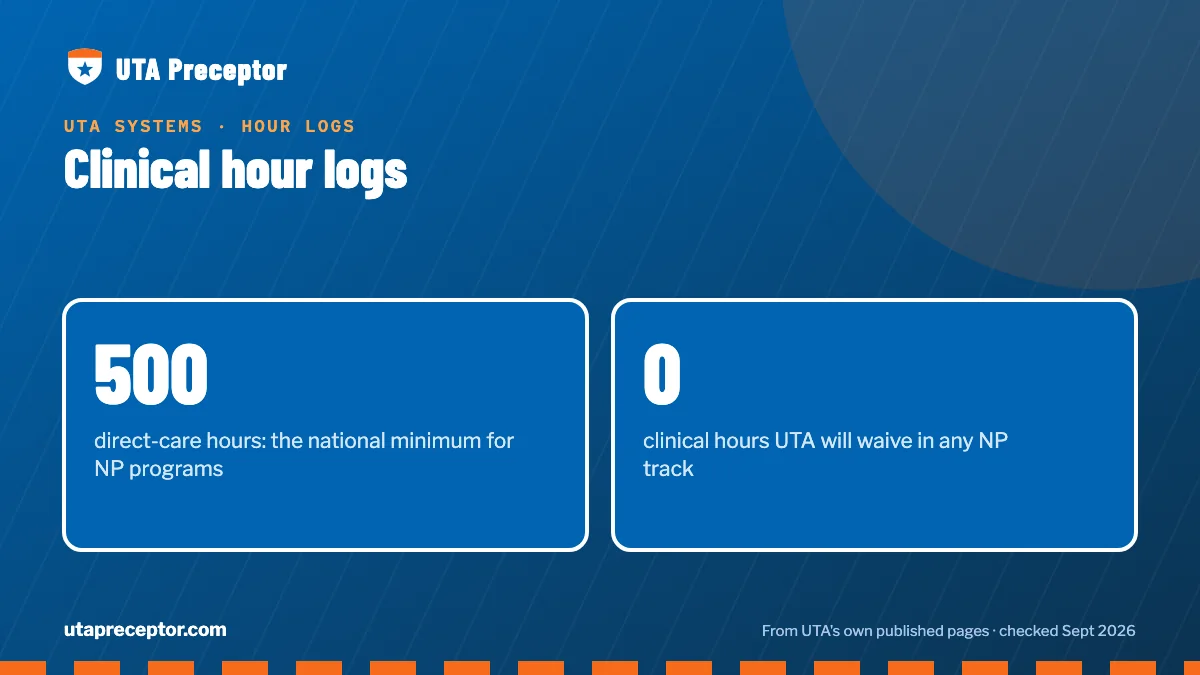
The national floor is 500 clinical hours for NP programs and 600 for Neonatal NP, and UTA builds its tracks above it. Students cannot graduate without every program-required hour, and the handbook calls waiving any of them “not appropriate”. Totals by track are on UTA clinical hours, the workplace rules on clinical hours at your job, and what virtual can and cannot mean on virtual clinical options.
Log the same day: the 7-day rule
Earlier UTA syllabi (2016–2018) said clinical encounters had to be entered within 7 days of the clinical day or the hours were lost. The rule appeared under Typhon and again under InPlace in Fall 2018.
UTA's current public pages don't give a deadline for Exxat entries, so your syllabus sets the rule for your course. Until you have read it, work as if the 7-day limit still applies. Logging early has no downside, and a late entry may not be accepted.
A routine that keeps logs clean
- Enter the timesheet and the logbook for a shift together, on the same day, so the time and the encounters match.
- Keep a running total against your course's required hours, so a shortfall shows up in week three rather than week ten.
- If a shift is canceled or cut short, record what actually happened, not the hours you planned.
- If an entry goes wrong, tell your course faculty right away instead of waiting for the end of the course.
Keep patient details out of your logs
A logbook describes patients, so it carries privacy risk. UTA's MSN and PMC handbook says “No PHI should be removed from the clinical setting either in writing or electronically.” Typing a name, date of birth or record number into a log you complete away from the site runs against that rule.
Log what the course needs to know about the encounter, not who the patient was. If you work at the facility where you are precepting, the handbook adds that your employee login should not be used to reach medical records unless the facility explicitly allows it. Don't open charts under your staff account to finish a student log. The rule covers paper and electronic copies alike, so the same care applies to notes on your phone that you plan to type up later.
Evaluations that sit beside your hours
Hours alone don't pass a clinical course. UTA's MSN/PMC student page says faculty evaluate each student with the Clinical Evaluation of Student tool, and you need 80% of scored items at “Meets Expectation with Moderate Assistance” in Clinical Practice 1 and at “Minimal Assistance” in Clinical Practice 2.
UTA's current public pages don't describe the preceptor's side. Earlier UTA syllabi (2016–2018) said preceptors evaluated the student, students evaluated the preceptor and site, and an evaluation was needed from any preceptor who spent more than 8 hours in clinical with the student. If you split a course between preceptors, check your syllabus for the current version of that rule.
Treat the two as separate requirements. A full hour count won't rescue a failing evaluation, and a strong evaluation won't make up for missing hours, since UTA requires all program hours to graduate.
DNP, Education, Administration and RN-to-BSN logs
DNP students log differently because there's no preceptor. The DNP handbook has them keep an activity log within Exxat, with time per activity, total hours and the AACN DNP Essentials (2006) each activity met, and the DNP Faculty Project Advisor approves or denies the hours. Hours must fall outside your normal paid employment; the rest is on DNP practice hours.
In the MSN Education and Administration tracks, UTA Online pages describe some practicum hours as logged, for example “90 logged hours with capstone community partnering project” in NURS 5340. The NURS 5362 teaching practicum carries 135 precepted hours, and earlier UTA syllabi (2016–2018) said students submitted 10 logs across it.
RN-to-BSN courses publish no hour counts for their practice work. The exception is the NURS 3300 co-op elective, which needs at least 120 hours in your work environment during the term. See RN-to-BSN practice experiences.
Why students plan their hours with us
Most hour problems start as placement problems: a preceptor who can only offer a few shifts, a site that cancels, a preceptor who leaves mid-course. Careful logging can't fix those, and UTA won't waive the gap.
That is why every search we run treats the course's hours and weeks as part of the fit: a preceptor who can host you week after week for the length of the course, and a replacement search the moment one drops. UTA approves every preceptor and site, and the file it reviews arrives complete. If you are already short, read behind on clinical hours; if your preceptor has left, see preceptor dropped out. Otherwise, use the form below and tell us your course, its start date and the hours it carries, so the search can be planned around them.
Questions UTA students ask
Can I log hours from my regular shifts at the hospital where I work?
No. Time you are paid for doesn't count, because UTA's online FAQ rules out being paid by your employer or your preceptor for clinical hours. Your employer can still host a student placement that fits the course's clinical focus, outside your paid shifts, as long as it isn't in your own department and your current supervisor isn't your preceptor.
Does time in a simulation lab count toward my UTA clinical hours?
Only above the minimum. The MSN/PMC handbook says simulation and observational activities may not be used to satisfy the minimum clinical hours, and simulation can never stand in for population-specific hours. Because UTA's tracks carry more than the national floor, some simulation may count toward the extra hours; your syllabus says whether a given course allows it.
I forgot to log a shift from two weeks ago. What should I do?
Tell your course faculty now. UTA hasn't published a late-entry rule for Exxat, but earlier UTA syllabi (2016–2018) said encounters logged more than 7 days after the clinical day were lost hours. Don't count on a late entry being accepted, and ask what your course allows before you add it.
Does my preceptor have to approve my logged hours?
UTA's public pages don't say how preceptors confirm hours in Exxat today. The one clear case is the DNP, where the Faculty Project Advisor approves or denies logged hours. For NP, Education and Administration courses, check the timesheet instructions in Exxat's Resources tile and your syllabus, and ask your preceptor early how they want to review your entries.
Can I start logging hours before my preceptor and site are approved?
Plan on no. UTA's current steps put Clinical Coordinator and/or faculty approval of the preceptor and site ahead of the clinical experience, with the Preceptor Agreement due by the first day. Earlier UTA syllabi (2016–2018) said approval had to come before any hours were done. Hours at an unapproved site risk not counting at all.
Related pages
Last checked 2026-09-23
We check these pages against UTA's own sources. UTA's current handbook and your course faculty have the final word.
Hand us the search. Keep your term.
Tell us your UTA track, your county and when your clinical course opens. We look for a preceptor and a site that fit what UTA asks for, and we help you put the approval packet together.
- Matched to your track's population and setting
- Paperwork prepared the way UTA's clinical team expects it
- In person near you, or a virtual option where your course allows it
Start your placement plan
A placement advisor replies with what a UTA-ready preceptor and site look like for you.