UTA DNP practice hours: how the 1,000 add up
UTA's DNP requires at least 1,000 practice hours after the bachelor's degree, and up to 500 of them can come from your MSN. The rest you earn in the program, logged in Exxat and approved by your faculty project advisor rather than a preceptor, and they must fall outside your normal paid job.
Talk through your DNP hours
Tell us your MSN background and where your project might happen. A placement advisor replies with how we would approach a project-site search for you.
The rule, piece by piece
The DNP hour requirement is individual. The catalog sets the overall floor, the DNP handbook explains the MSN credit, and your exact number is fixed when your first practicum starts.
| Piece | What UTA says | Where it says it |
|---|---|---|
| Overall minimum | 1,000 practice hours after the bachelor's degree | 2026-27 catalog |
| Credit from your MSN | Up to 500 clinical or practice hours, or related certifications, from your MSN | Catalog; DNP handbook |
| Hours earned in the program | A minimum of 500 to 1,000, depending on your MSN hours | DNP handbook |
Hours from NURS 6326 | 180, applied once the Graduate Nursing Review Committee approves your proposal | Catalog |
| When your number is set | At the start of your first practicum | DNP handbook |
| Who approves logged hours | Your DNP Faculty Project Advisor | DNP handbook |
The DNP handbook UTA links today is the 2024-25 edition, revised January 2025, and we found no newer one. Confirm anything that affects your plan with your advisor.
How much of your MSN counts
If you are an APRN, meaning an NP, CNS, CNM or CRNA, UTA's handbook says you “will be credited 500 clinical hours.” That is the most UTA gives from any master's program, which leaves at least 500 hours to earn in the DNP.
If your MSN was in administration or another non-APRN field, you supply a verification letter of your MSN clinical hours. UTA's materials describe a practice or clinical hour verification form bearing the school seal, or a certified letter. UTA credits what is verified, up to 500, and the fewer hours verified, the more you earn in the program.
Request that verification from your MSN school early. Your total is identified at the start of your first practicum, and a sealed form or certified letter is not something to chase in the final week.
Where the in-program hours come from
UTA's DNP is 36 credits and post-master's only, offered accelerated online and in a traditional semester online format. The handbook says the practicums are the last three sessions, 13 weeks each, and that is where the hours concentrate.
| Course | Title | Credits | What it adds |
|---|---|---|---|
NURS 6326 | Project Proposal Development | 3 | Your DNP Project Proposal; 180 practicum hours applied to the practicums once the proposal is approved |
NURS 6620 | DNP Practicum I | 6 | Project implementation; the handbook degree plan labels it “(500 Clinical Hours)” |
NURS 6621 | DNP Practicum II | 6 | Project evaluation, a virtual podium presentation and a manuscript; also labeled “(500 Clinical Hours)” |
The “500 Clinical Hours” labels on both practicums sit next to the handbook's statement that each student's requirement is individual, and UTA does not reconcile the two. Ask your advisor what your practicums must total. UTA's online page also notes that the practicums may run under other numbers: NURS 6331 and NURS 6332 for Practicum I, NURS 6333 and NURS 6334 for Practicum II.
Outside your paid job: what does not count
The handbook leaves no room here: practice hours have to sit beyond the normal scope of the job you are paid to do. Doing your usual work, however senior, adds nothing to your DNP total.
It also excludes direct patient care hours spent learning new skills, for example to earn a new certification. What counts are activities you log against objectives your advisor approved, each tied to the AACN DNP Essentials.
This matters most when your project sits at your workplace, which UTA's catalog anticipates. The location can be familiar, but the activity you log has to go beyond your normal duties. If you are unsure whether a task qualifies, ask your advisor before you log it, not after.
Hours inside your normal job description do not count, even when they happen at your project site.
Logging hours in Exxat
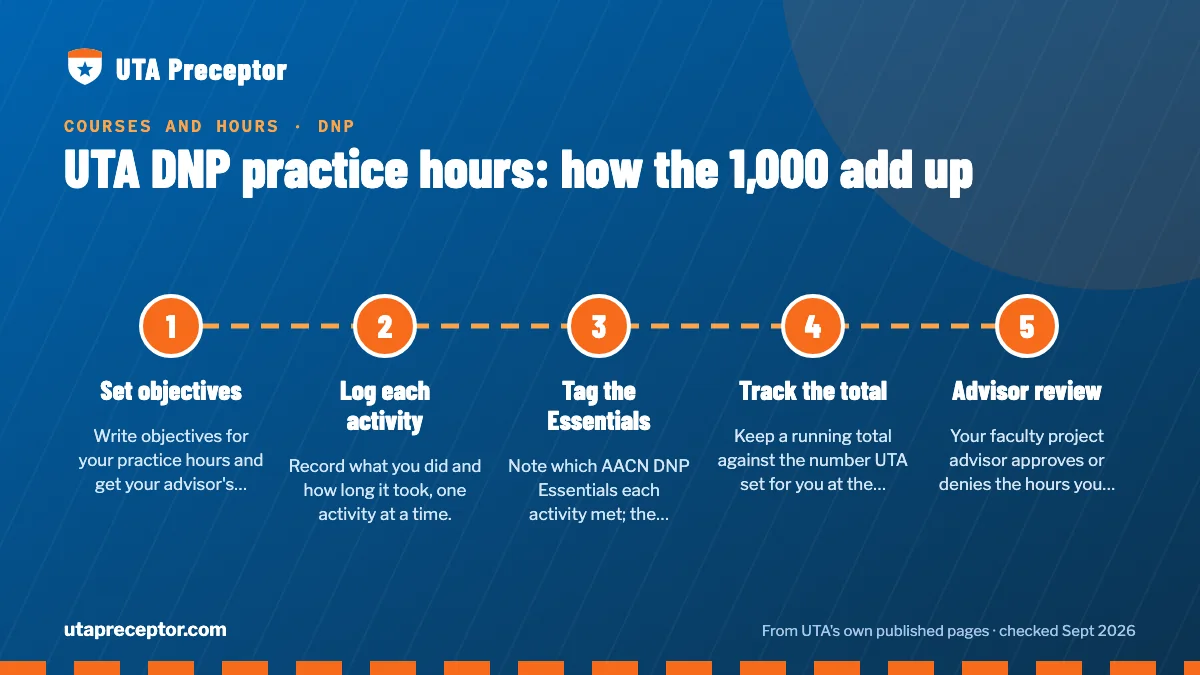
UTA's DNP handbook says preceptors are not used in the program. You keep your own practice-hour log inside Exxat, and your DNP Faculty Project Advisor approves or denies each entry. The handbook sets out the pieces:
- Set objectivesWrite objectives for your practice hours and get your advisor's approval before you log against them.
- Log each activityRecord what you did and how long it took, one activity at a time.
- Tag the EssentialsNote which AACN DNP Essentials each activity met; the handbook names the 2006 version.
- Track the totalKeep a running total against the number UTA set for you at the start of the first practicum.
- Advisor reviewYour faculty project advisor approves or denies the hours you submit.
For how UTA logs work more broadly, see UTA clinical hour logs, and for access and support, Exxat at UTA.
No preceptor, but you still need a place to do the work
Because nobody precepts DNP hours, there is no preceptor to find. The thing to secure is an approved project site, recorded in UTA's clinical management system by the close of NURS 6323, which gives the university's lawyers time to put a contract in place. The DNP project site page walks through that deadline and what follows it.
Your mentor is faculty. UTA's handbook says doctoral-prepared RN faculty serve as DNP faculty project advisors, and that advisor is the person who signs off on your hours.
The DNP shares the NP programs' short state list: only residents of Texas, Virginia, Florida, California, Colorado, New Mexico or Arkansas can enroll. If your project or your hours would happen anywhere else, raise it with UTA before you commit; out-of-state clinicals covers the state rules.
Why DNP students bring us the site search
Your hours belong to you and your advisor: you log them in Exxat, and your faculty project advisor signs off. What DNP students hand to us is the step that has to happen before any hour is logged, which is finding an organization willing to host the work.
A placement advisor works through the organizations near you that could host a project reaching past your day job and would sign a contract with UTA, then collects the contacts and site details you enter before NURS 6323 ends. Because practice hours must fall outside your paid role, that shortlist looks beyond your employer's routine work from the first conversation. UTA approves the site and the project, and what you enter gives its legal staff a clean start. If that sounds useful, use the form below, or read the DNP program overview first.
Questions UTA students ask
Do my NP certification hours count toward the UTA DNP 1,000?
Hours and certifications earned during your MSN can count, up to 500. The catalog allows clinical or practice hours, or related certifications, from your MSN program toward the 1,000, and APRNs are credited 500. What does not count is time spent during the DNP on direct patient care to learn new skills, such as training for a new certification.
What if my MSN had more than 500 clinical hours?
UTA caps the credit at 500 hours from any master's program, so a 720-hour NP program still counts for 500. That leaves at least 500 practice hours to earn in the DNP. The exact number you need is identified at the start of your first practicum, so check it with your advisor then rather than assuming.
Are UTA DNP classes live or self-paced?
It depends on the format. The catalog describes an accelerated online asynchronous option and a traditional semester option with synchronous online classes. The handbook says no face-to-face class meeting is required, and courses run 8 to 13 weeks; in the accelerated format you take two courses per eight-week session in sequence.
How long does UTA's DNP take?
UTA's handbook gives a minimum of two years full-time and three to five years part-time, with six years as the maximum. The online program page says as few as 27 to 32 months. In the accelerated format, the final three sessions are 13-week practicum courses.
Related pages
Last checked 2026-09-23
We check these pages against UTA's own sources. UTA's current handbook and your course faculty have the final word.
Hand us the search. Keep your term.
Tell us your UTA track, your county and when your clinical course opens. We look for a preceptor and a site that fit what UTA asks for, and we help you put the approval packet together.
- Matched to your track's population and setting
- Paperwork prepared the way UTA's clinical team expects it
- In person near you, or a virtual option where your course allows it
Start your placement plan
A placement advisor replies with what a UTA-ready preceptor and site look like for you.