UTA's dual NP tracks: two populations, 1,260 clinical hours
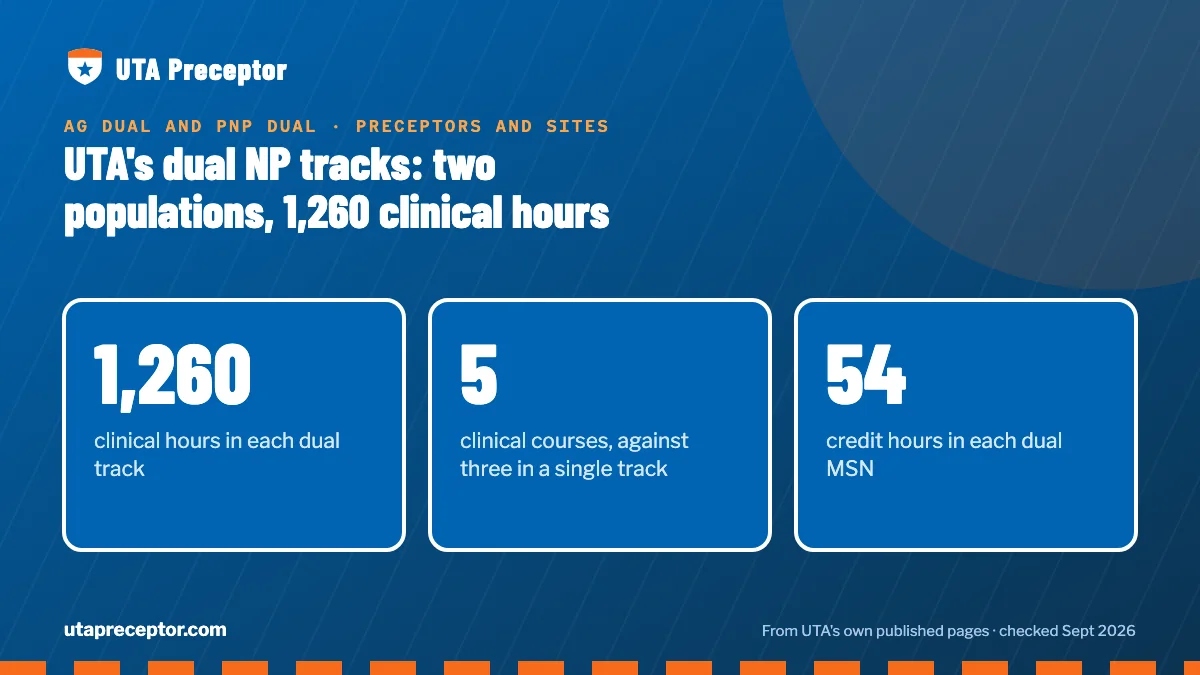
UTA runs two dual NP tracks: adult-gerontology acute and primary care, and pediatric acute and primary care. Each is a campus-based, 54-credit MSN with 1,260 clinical hours over five clinical courses, so you need preceptors in two different kinds of setting, and more placements than a single-track student.
Get your placement plan
Tell us your UTA track and where you live. A placement advisor replies with what a UTA-ready preceptor and site look like for you.
Two dual tracks, one campus-based format
UTA's graduate nursing page lists both duals among its campus-based graduate programs, and we found no UTA Online page for either. At UTA, campus-based means a mix: some courses fully online, some hybrid (UTA says they typically meet in person three times) and some in-seat, with fall and spring entry and hands-on time in the SMART Hospital while you are in clinicals. Some UTA graduate programs also hold required courses or events on Saturdays.
Time to finish is not published for either dual. The one campus figure UTA gives covers every campus MSN: two to three courses a semester, full time, finishing in 24 to 36 months. With 54 credits against 41 to 45 in the single tracks, ask the program director for a realistic plan before you give any preceptor dates.
Both duals fall under the MSN nurse practitioner listing on UTA's state map, which is open in Arkansas, California, Colorado, Florida, New Mexico, Texas and Virginia only. Clinical sites must be in one of those states, and a preceptor search outside your home state, or a move, starts with an email to NursingSOA@uta.edu under UTA's handbook.
The five clinical courses in each dual
Each dual takes all three acute care clinical courses from its single track and two of the three primary care ones, leaving out the first primary care clinical course. The course guides explain settings and prerequisites; this is the sequence as the 2026-27 catalog degree plans list it.
| Track | Acute care courses | Primary care courses | Course guides |
|---|---|---|---|
| AG dual | NURS 5354, NURS 5355, NURS 5640 | NURS 5353, NURS 5645 (not NURS 5352) | AGACNP courses and AGPCNP courses |
| PNP dual | NURS 5373, NURS 5374, NURS 5680 | NURS 5372, NURS 5685 (not NURS 5371) | PNP clinical courses |
One detail to raise with the program: the PNP dual plan lists NURS 5372 but not NURS 5371, yet the catalog gives NURS 5371, or concurrent enrollment in it, as the prerequisite for NURS 5372. The catalog does not say how dual students satisfy it, or in what order they take the five courses. Your degree plan in MyMav is the authority.
1,260 hours across two populations
Both duals carry 1,260 clinical hours on UTA's 2020-21 course lists, which UTA's program pages still link. That is 540 more than a single 720-hour track, by our arithmetic. No UTA source splits the 1,260 by course or by population, and those lists predate UTA's current MSN core, so confirm the figure with the program before you plan.
Texas rules explain why the two halves need their own hours. The Board of Nursing's program rule calls for at least 500 separate, non-duplicated clinical hours for each advanced role and population focus, and its licensure rule wants at least 500 supervised hours per track that relate directly to that role and population focus. In practice, keep each course's hours in that course's log and don't expect one rotation to serve both halves.
UTA's handbook adds its own rules on top: only hands-on patient care satisfies the minimum, simulation and observation are extras, and no NP hours are waived. Both halves are logged in Exxat's timesheets and logbooks.
Two kinds of preceptor, two kinds of site
For the AG dual, the catalog sets the acute care courses in “specialty practice and high acuity health care settings” and the primary care courses in “primary and long term health care settings,” both for adolescents through older adults. That points to a hospital-based preceptor for three courses and a clinic or long-term care preceptor for two.
For the PNP dual, UTA describes the population as birth to 21 years of age. UTA's pediatric acute care page names “hospitals, long term care facilities, emergency departments, and specialty clinics” as settings, and the pediatric primary care courses sit in “selected primary health practice sites.”
Every preceptor you use must clear UTA's published floor, an unencumbered, active provider license plus a year or more in the specialty role, and on a dual the specialty has to match the course that preceptor supervises. UTA does not publish its per-course lists of acceptable preceptor types; they are in Exxat, and UTA preceptor requirements covers what is public.
Admission: recent acute care experience
Both duals set an acute care bar. The AG dual catalog page asks for “a minimum of 2 years of RN experience, within the last 5 years, in an acute care setting,” and adds that students may not transfer into the program without it. The PNP dual catalog page uses the same two-year, five-year acute care wording, and UTA's PNP dual program page describes its applicants as “BSN nurses with two years of pediatric nursing experience.”
For the search, that experience is a network for the acute half. The primary care half is where you may know fewer people, so start that search first rather than last.
UTA's employer limits apply to both halves. Your workplace can host hours when its setting suits the course, so long as you are outside your own department and someone other than your supervisor precepts you.
Where Texas dual students find sites
For the adult acute half, look at each region's large public, academic and system hospitals; our AGACNP preceptor page lists examples by region. For the pediatric acute half, Texas's children's hospitals are the natural starting points, and several publish student rules. None of this means a hospital will take you; it tells you what each one asks for.
- Children's Health (Dallas and Plano): its master agreement list shows UTA with a biparty agreement running to February 2032 and a triparty agreement with UT Southwestern to December 2027. Its Primary Care Clinic has stopped taking NP students for preceptorships.
- Cook Children's (Fort Worth): it holds agreements with about 200 schools, each specific to the college and degree program, and new ones take about three months.
- Texas Children's (Houston): for MSN, APRN and other licensed students, the Affiliation Agreement Inquiry is due six months or more ahead of the rotation.
- CHRISTUS Children's (San Antonio): it wants a current affiliation agreement with your program and a preceptor already secured.
- Elsewhere: Dell Children's in Austin, El Paso Children's Hospital and Driscoll Children's in Corpus Christi and the Valley appear in regional research with no NP student rules found.
For the primary care halves, the community health center networks on our FNP preceptor page are one place to start, as long as the preceptor's panel matches your population.
Timing five searches
UTA's timing advice appears on its online program FAQ, written for online students, but it is the only timing guidance UTA publishes: begin the search 12 to 16 weeks out from the first clinical course, and have a preceptor by the time you reach Pharmacology. A dual needs five placements, some in systems with long lead times, so treat those markers as the start of a rolling search rather than one deadline.
Line up the acute care sites first where a hospital's calendar is long (Texas Children's six-month inquiry is the extreme), then fit primary care around them. Every course still needs its Exxat MyRequest, sign-off from the Clinical Coordinator and/or course faculty, a UTA agreement with the site and a signed Preceptor Agreement before the first clinical day. The placement timeline orders those steps.
A dual is not one long placement. Five courses can mean five approvals, and every new site needs its own affiliation agreement with UTA.
Why dual-track students choose us
For a dual, the placement desk plans both halves together: which preceptor carries which course, and in what order, so an acute care rotation and a primary care rotation don't collide. We search near you for preceptors in each setting, check them against UTA's minimums and the course descriptions, and for each one gather the CV, license proof, agreement forms and site details UTA's reviewers look at.
If one preceptor drops, we restart the search in that setting while the rest of the plan holds. UTA's Clinical Coordinator and course faculty rule on all five placements, and each request we help you build is organized around what they check. The how it works page lays out our side, and the form below is where to tell us which dual you are in.
Questions UTA students ask
Is there an online version of UTA's dual NP tracks?
Not that we found. UTA's graduate nursing page lists both duals among its campus-based programs, and UTA Online has pages for the single AGACNP, AGPCNP, PNP-AC and PNP-PC tracks but none for either dual. If you need online study and both populations, ask UTA about finishing one single track online and adding the other as a post-master's certificate.
Can I switch from a single NP track into a UTA dual?
The AG dual catalog page says students may not transfer in without the required RN experience: two years within the last five, in an acute care setting. The PNP dual page uses the same experience wording. UTA does not publish a transfer process beyond that, so ask your advisor before your first clinical course; UTA points degree-plan questions to MSNadvising@uta.edu.
Which certification exams line up with the two halves of a dual?
The Texas Board of Nursing recognizes separate exams for each side. Adult-gerontology acute care: ANCC's AGACNP or the AACN Certification Corporation's ACNPC-AG. Adult-gerontology primary care: ANCC's A/GPCNP or AANPCB's A-GNP. Pediatrics: PNCB's CPNP-AC and CPNP-PC. For a Texas APRN license, your program documents your role, population focus and clinical hours.
Who do I contact at UTA about dual-track clinicals?
UTA's directory lists a mailbox for each NP program on its Graduate Clinical Coordination Team, including AGAcuteNP@uta.edu, AGprimaryNP@uta.edu, PediacuteNP@uta.edu and PediprimaryNP@uta.edu. It lists no separate dual-track mailbox, so ask your program director which team handles each of your five clinical courses.
What ages do PNP dual preceptors need to see?
UTA describes both pediatric tracks as covering patients from birth to 21 years of age. A preceptor at a children's hospital and one in a pediatric primary care practice each fit that range, while a family practice that sees mostly adults would be a weak fit for a pediatric course. Confirm the setting for each course with faculty before you commit.
Related pages
Last checked 2026-09-23
We check these pages against UTA's own sources. UTA's current handbook and your course faculty have the final word.
Hand us the search. Keep your term.
Tell us your UTA track, your county and when your clinical course opens. We look for a preceptor and a site that fit what UTA asks for, and we help you put the approval packet together.
- Matched to your track's population and setting
- Paperwork prepared the way UTA's clinical team expects it
- In person near you, or a virtual option where your course allows it
Start your placement plan
A placement advisor replies with what a UTA-ready preceptor and site look like for you.