UTA Neonatal NP: finding a NICU preceptor for 600 clinical hours
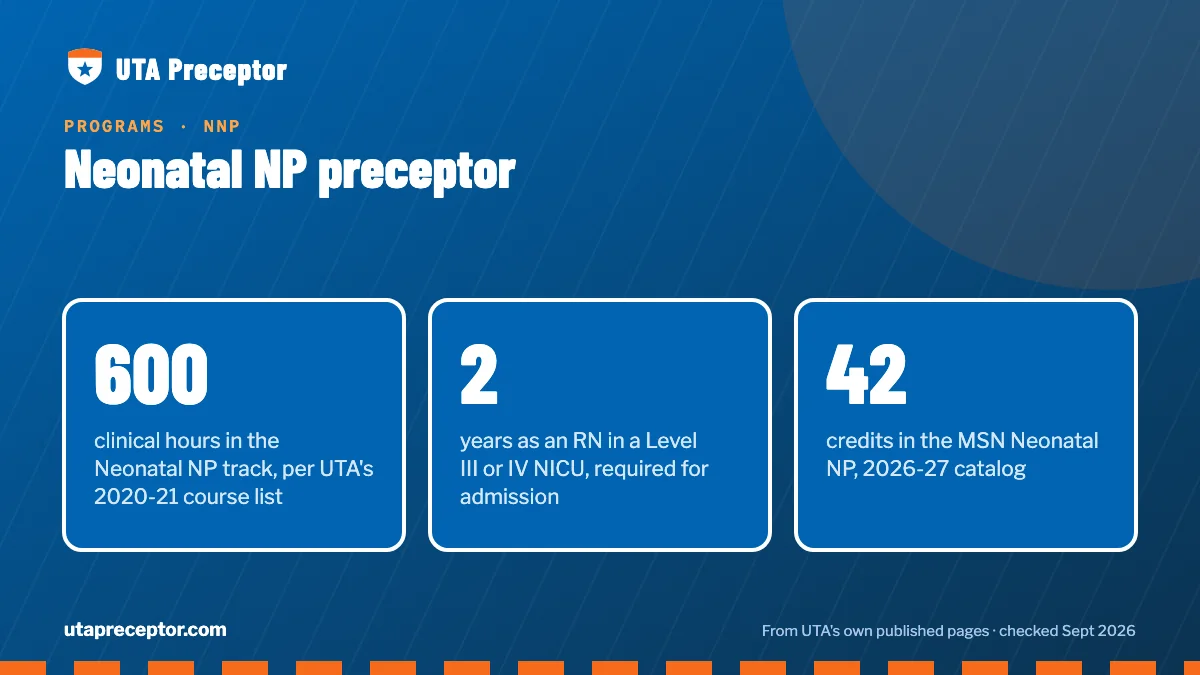
UTA's Neonatal NP track is campus-based, with two clinical courses that UTA's 2020-21 course list totals at 600 hours. You come in with two years as an RN in a Level III or IV NICU, and you leave needing a neonatal preceptor at a hospital that has, or will sign, an agreement with UTA. Hospital rules, not the search itself, usually set the pace.
Plan your NNP clinical site
Tell us which NNP course is next, the hospital where you work and the ones you could reach. A placement advisor replies with what a workable neonatal rotation looks like.
What UTA publishes about NNP clinicals
Less than for most tracks. UTA's public sources give the two NNP clinical course titles and credits, the 1:4 credit-to-clinical-hour ratio the catalog attaches to both, and a 600-hour total on the 2020-21 NNP course list. The MSN and PMC handbook adds that national bodies require at least 600 clinical hours for Neonatal NP programs, against 500 for other NP tracks.
What is missing is the setting. We found no public UTA description of where NURS 5450 and NURS 5610 take place, no required NICU level for clinical rotations, no per-course hour split and no public list of preceptor types. The admission rule points firmly at the NICU, but the clinical rules sit in your course materials and the preceptor categories UTA's FAQ says are “listed for each clinical course.”
Whoever precepts you must clear the two bars on UTA's Preceptor Resources page. Their provider license has to be active with no encumbrance, and they need a year or more of clinical experience in the specialty role. Approval of each preceptor and site sits with the Clinical Coordinator and/or course faculty. What else UTA publishes about preceptors is on UTA preceptor requirements.
A campus-based track
UTA's MSN and PMC handbook lists Neonatal NP only among its campus-based programs. It is not in the handbook's accelerated online list, and UTA Online's 2026-27 start calendar covers other tracks. The 2026-27 catalog lists the MSN at 42 credits.
Campus-based does not mean you are on campus every week. Most campus-based courses are delivered online, in the handbook's account, and UTA's department page puts the in-person part of a hybrid course at about three meetings. Starts are in fall and spring, a full-time load of two or three courses a semester is framed as finishing in 24 to 36 months, and the degree must be completed within six years.
For your preceptor, this means semester dates rather than the 11 and 13-week blocks of the online tracks. UTA also notes that some graduate programs hold required courses or events on Saturdays, which matters if you are working NICU shifts; ask the program director which dates are fixed before you build a rotation schedule around them.
Two clinical courses, 600 hours
NNP is the only UTA NP track with two clinical courses rather than three. There is no separate course page for them on this site, so here is what the catalog gives. How 600 compares with UTA's other tracks is on clinical hours by track.
| Course | Catalog title | Credits | Hours note |
|---|---|---|---|
NURS 5450 | Neonatal NP Clinical Practice | 4 | Catalog ratio of credit to clinical hours: 1:4 |
NURS 5610 | Neonatal NP Advanced Practicum | 6 | Same 1:4 ratio; the final clinical course |
The catalog does not convert the 1:4 ratio into clock hours, and no current UTA page divides the 600 between the two courses. The 2020-21 list is still linked from UTA's program pages but predates UTA's current MSN core, so confirm your hour target for each course in your syllabus or with course faculty.
Do not borrow another track's hour split for NURS 5450 or NURS 5610. Among UTA's NP tracks only FNP has published per-course hours, and NNP's course structure is different.
Admission: two years in a Level III or IV NICU
The 2026-27 catalog sets the NNP admission bar at “Two years of clinical experience as a Registered Nurse (RN) in a Level III or IV NICU.” No other UTA NP admission rule names a unit type and level, and this one means you start the program already knowing how a Level III or IV unit runs and who in it might teach.
Clinical courses also require an unencumbered RN license, valid in the state where you train. UTA's state-authorization map opens its NP programs, NNP included, only to students in Arkansas, California, Colorado, Florida, New Mexico, Texas and Virginia. If the NICU you have in mind is across a state line, or you are considering a travel contract, email NursingSOA@uta.edu before you approach anyone; out-of-state clinicals covers why.
Keep the finish line in mind as well. The Texas Board of Nursing recognizes the NCC exam for neonatal NP certification, and Texas licenses a new APRN only after certification, so the neonatal focus of your hours carries through to licensure.
When your NICU is also your employer
The admission rule means you may well be working in a NICU while you study, and the obvious first idea is to train there. Employer sites are permitted under UTA's online FAQ when they meet the course's clinical focus guidelines. Two exclusions apply: your own department is off limits, and so is using your current supervisor as preceptor.
For a NICU nurse, “your department” is likely the NICU itself. UTA does not define the word publicly, so if your hospital has more than one neonatal unit, or a neonatal service separate from where you work, ask your Clinical Coordinator before you assume it counts as a different department. The rules in full are on clinical hours at your employer.
Employers add their own steps. Cook Children's in Fort Worth tells staff going back to school to identify a preceptor, confirm or start an affiliation agreement and apply at least three weeks before the start date. UT Southwestern's APRN student guidelines rank UTSW employees first, then employees of Children's, Parkland and Texas Health. Clinical hours stay unpaid either way; UTA's FAQ rules out pay from an employer or preceptor for them.
How Texas hospitals take neonatal NP students
NICUs sit inside hospitals, so if your rotation is in one, that system's student process decides the timeline. None of the examples below confirms it will take a UTA NNP student, and we have not seen NICU levels published for them, so confirm the unit's level with the site.
In Houston, a UTHealth pediatrics page describes applications by Neonatal NP students for Memorial Hermann sites at The Medical Center, Katy, Memorial City and Cypress. It requires an affiliation agreement with the program, works only with fully accredited programs, notes paperwork takes about two months once an agreement exists, and tells students not to contact clinics or providers directly. Its windows are November 1 to January 1 for summer, March 1 to May 1 for fall and July 1 to September 1 for spring. Texas Children's asks licensed students for an Affiliation Agreement Inquiry at least six months ahead.
In Dallas, Parkland does not place students directly and refers them to their schools, UT Southwestern routes APRN students through its Office of Advanced Practice Providers, and Children's Health holds a biparty and a triparty agreement with UTA. In San Antonio, University Health includes UTA's College of Nursing on its current education-partner list and needs the school's request 30 to 45 days ahead. The broader list is on DFW and Texas hospital onboarding.
Timing, and why NNP students choose us
Treat the 12 to 16 weeks in UTA's online FAQ as a minimum for NNP, because hospital calendars can run longer: a six-month inquiry, a two-month onboarding or an application window that closes a season ahead. Start while you are still in your didactic courses, keep clearance current from the 60-day deadline onward, and send course-specific questions to UTA's Graduate Clinical Coordination Team mailbox for the track, NNP@uta.edu.
A placement advisor maps the neonatal units within your reach against each hospital's student rules and UTA's agreements, then looks for a preceptor who meets UTA's minimums in a unit outside your own department. The paperwork is where we save you the most time: a neonatal preceptor's CV, a license lookup, the hospital's details and the agreement forms, organized the way UTA's clinical team reviews them. If a preceptor's schedule changes or they leave mid-course, we come back in to find a replacement. UTA makes the approval decision with a complete request in hand. Read how it works.
Questions UTA students ask
Is UTA's neonatal NP program online?
Not in the accelerated online format. UTA's MSN and PMC handbook lists Neonatal NP only among its campus-based programs and leaves it out of the accelerated online list. Its description of campus-based programs is mostly online coursework with little time on campus, so expect some in-person meetings rather than weekly classes. Confirm the required campus dates with the program before you plan clinical shifts.
Why is UTA's NNP 600 hours when other UTA NP tracks are 720?
UTA's handbook notes that national bodies require at least 600 clinical hours for Neonatal NP programs, and UTA's 2020-21 NNP course list sets the track at 600. For context, Texas programs reported a median of 765 precepted hours for master's NNP tracks in 2025. Because the 600 comes from an older UTA list, confirm your current target in your syllabus.
Can a neonatologist precept a UTA NNP student?
UTA keeps the accepted provider types for each NNP course in the course materials rather than on a public page. Under 22 TAC §219.2, the Texas rule for APRN education, physicians are among qualified preceptors, but UTA's own written criteria decide. UTA's license and one-year-in-role minimums apply to a physician preceptor like anyone else.
Does UTA offer a post-master's neonatal NP certificate?
Yes. UTA lists a Neonatal NP post-master's certificate among its campus-based certificates, using the same clinical courses, NURS 5450 and NURS 5610. The program director sets the rest of your plan through a gap analysis, and the certificate page does not state an hour total. See post-master's NP certificates.
Do I need NRP certification for UTA's NNP clinicals?
UTA's clinical clearance policy lists NRP among the costs students pay, alongside CPR, ACLS and PALS, but no public UTA page says which tracks must hold which certification. Ask your course faculty, and check the hospital's own student requirements, since clinical agencies may add requirements of their own. See CPR, ACLS and PALS.
Related pages
Last checked 2026-09-23
We check these pages against UTA's own sources. UTA's current handbook and your course faculty have the final word.
Hand us the search. Keep your term.
Tell us your UTA track, your county and when your clinical course opens. We look for a preceptor and a site that fit what UTA asks for, and we help you put the approval packet together.
- Matched to your track's population and setting
- Paperwork prepared the way UTA's clinical team expects it
- In person near you, or a virtual option where your course allows it
Start your placement plan
A placement advisor replies with what a UTA-ready preceptor and site look like for you.